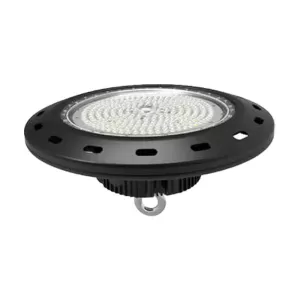
Wet Location and Enclosed High Bay Lights: IP Ratings, Washdown Areas and a Food Plant Layout
What wet location and enclosed high bay lights must withstand, how the US listing differs from IP65, and a 30 × 20 m food hall worked through our calculator.
Key points
- "Wet location" is a North American listing term; elsewhere buyers specify an IP rating. A sealed IP65 high bay resists dust and water jets, but it is not a UL wet-location listing unless the certificate says so.
- For a 30 × 20 m food hall with a 7 m ceiling, our calculator gives 24 × 150 W high bays for 300 lux and 42 for 500 lux (light-coloured surfaces, 100 lm/W).
- Enclosed fittings have no open vents: dirt, insects and spray stay out, and the lens can be wiped or washed without water reaching the driver.
- In washdown areas the weak points are cable glands, the driver box and the bracket; specify sealed glands, stainless fixings and a smooth body that does not trap residue.
Some buildings are kind to light fittings: a dry, clean warehouse at room temperature. Others are not. Food plants are hosed down after every shift, car washes and wash bays are wet all day, dairies and breweries are humid, and fish and meat processing combine water, salt and cleaning chemicals. For these spaces buyers ask for “wet location” or “enclosed” high bays. This guide explains what those terms mean, how they relate to IP ratings, and how many fittings a typical food hall needs.
Wet location, damp location and IP ratings
The term wet location comes from North American practice. Under the US electrical code and UL listings, a fitting may be listed for dry, damp or wet locations. A wet-location listing means the fitting can be exposed to rain, spray or washdown water. The rest of the world uses the IP code of IEC 60529:
| Rating | Protection against solids | Protection against water |
|---|---|---|
| IP54 | Dust-protected | Splashing water |
| IP65 | Dust-tight | Low-pressure water jets from any direction |
| IP66 | Dust-tight | Powerful water jets |
| IP67 | Dust-tight | Temporary immersion |
| IP69K | Dust-tight | High-pressure, high-temperature jets (tested to ISO 20653) |
The two systems are not interchangeable. An IP65 fitting is designed for the same conditions as many wet-location listings, but it only carries a UL wet-location listing if its certificate says so. If your project is in North America and the inspector asks for UL or ETL wet-location listing, that is a certificate question, not a design question. Elsewhere, the IP rating is what goes into the specification. Our guide to IP65 vs IP66 vs IP67 explains the tests behind each number.
What “enclosed” adds
Many older high bays had open reflectors: the lamp sat in a vented housing and the reflector was open below. Dust, insects and moisture got in, and the reflector darkened. An enclosed fitting has a sealed optical chamber, a lens or glass that closes the front, and a sealed driver compartment. For food areas this matters for three reasons:
- Hygiene. Nothing can fall from the fitting into the product, and insects cannot nest in it.
- Cleaning. The outside can be wiped or washed. Because there are no open vents, water does not reach the LEDs or driver.
- Light maintenance. A sealed lens loses less light to dirt than an open reflector, so the maintenance factor holds better between cleanings. Our high bay cleaning guide covers how often and how to clean.
Worked example: 30 × 20 m food production hall
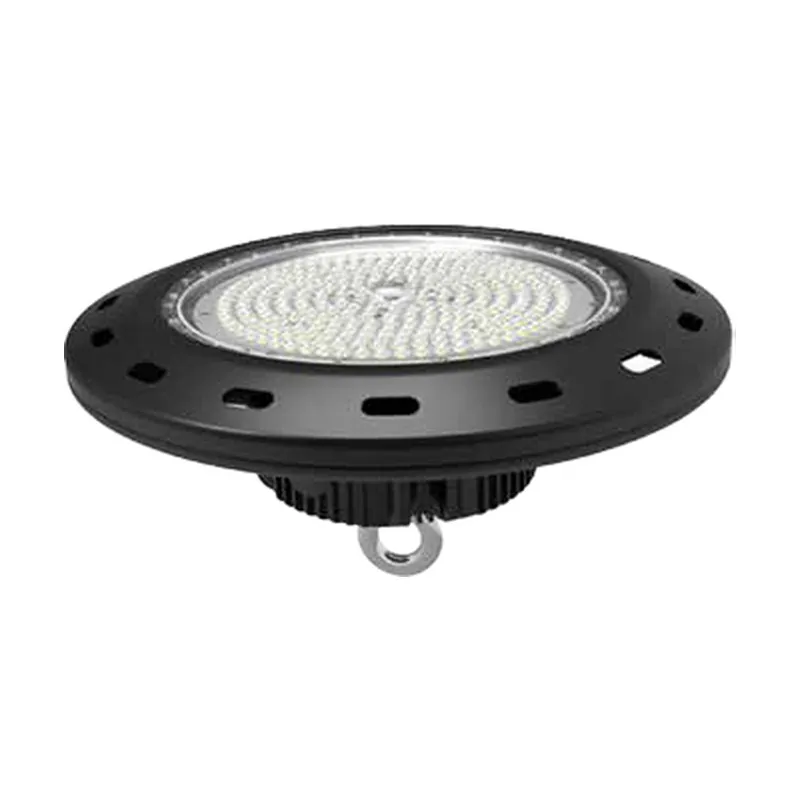
We ran a 30 × 20 m production hall with a 7 m mounting height through our high bay lighting calculator. Food halls usually have white or light walls and floors, so we used light reflectances. Fittings are 150 W at 100 lm/W, the minimum rated efficacy of our GKP40F UFO high bay, with a medium beam, a 0.8 m working plane and a maintenance factor of 0.8:
| Target | Typical use | Fittings (grid) | Spacing | Average | Power density |
|---|---|---|---|---|---|
| 300 lux | General processing, packing | 24 (6 × 4) | 5.0 × 5.0 m | 332 lux | 6.0 W/m² |
| 500 lux | Inspection, trimming, quality control | 42 (7 × 6) | 4.3 × 3.3 m | 582 lux | 10.5 W/m² |
The 500 lux layout is almost twice the count. In many plants it makes sense to light the whole hall to 300 lux and add local light over inspection tables, rather than lighting every square metre to inspection level. EN 12464-1 gives values for food industry tasks; check the figures your auditor uses.
Where wet fittings fail
The housing is rarely the problem. Failures in wet areas usually start at:
- Cable glands. A gland that is not tightened onto the right cable diameter lets water track along the cable into the driver. Specify glands sized for the cable you will use.
- The driver box. On fittings with a separate driver, check that the driver housing is rated as high as the lamp body.
- Condensation. A fitting that heats up and cools down every day breathes. Pressure-equalising vents (membranes that pass air but not water) reduce condensation inside the lens.
- Brackets and screws. Plain steel fixings rust quickly in salt or chlorine. Stainless steel brackets and screws are worth the small extra cost.
- Cleaning chemicals. Alkaline foams and chlorinated cleaners attack some plastics and coatings. Tell the supplier what you use; glass lenses are more resistant than polycarbonate.
Temperature and humidity
Wet areas are often hot or cold as well. Steam from cooking, blanching or sterilising lines can push the air under the roof well above room temperature. Check the fitting’s operating range: our GKP40F is rated −10 °C to +50 °C. For areas above that, see our guide to high temperature LED high bays; for chillers and freezers, look for fittings rated well below zero.
Car washes, wash bays and vehicle workshops
Wash bays combine direct water spray, detergent and vehicle exhaust. Mounting heights are often 5–6 m, so a wide beam helps spread light around the vehicle. Mount fittings to the side of the wash path rather than directly above the spray arms, so they are hit less by direct jets. Vehicle workshops next to wash bays usually need the same IP rating because doors are open and spray travels.
Common mistakes
- Asking for “waterproof” without a number. Every supplier will say yes. Ask for the IP rating, the test report and, in North America, the listing.
- Mixing IP ratings in one room. An IP65 high bay on a ceiling with an IP20 junction box beside it fails at the box.
- Forgetting the emergency lights. Emergency fittings in the same hall need the same protection; see our guide to wet location emergency lights.
- Choosing open-fin bodies where residue builds up. Deep fins collect grease and dust. In food areas, a smoother body is easier to keep clean.
Checklist for the specification
- Room size, mounting height and surface colours.
- Target lux for general areas and for inspection points.
- IP rating (IP65 minimum for hosed areas; IP66 or IP69K where required), and any listing needed.
- Lens material (glass or PC) and cleaning chemicals used.
- Ambient temperature range and humidity.
- Fixing material (stainless steel where salt or chlorine is present).
- Sensor or dimming needs, and emergency requirements.
Send these with the drawings and we will return the layout from our calculator, the fittings and the test reports for the IP rating.
Sources
Frequently asked questions
What is a wet location high bay light?
In the US and Canada, a fitting listed for wet locations may be exposed to rain, water spray or washdown. Outside North America the same need is expressed with an IP rating, usually IP65 or higher. Check which one your project or inspector requires before ordering.
Is IP65 enough for a food processing plant?
IP65 protects against dust and low-pressure water jets from any direction, which covers most hosed-down production areas. For high-pressure, high-temperature cleaning, ask for IP69K-tested fittings and confirm the cleaning chemicals with the supplier.
What does an enclosed high bay mean?
A fitting whose optical chamber and driver are sealed, with no open vents or gaps. Dirt, insects and moisture cannot reach the LEDs, and the outside can be cleaned without opening it.
How many high bays does a 30 × 20 m food production hall need?
In our calculation, 24 fittings of 150 W at 100 lm/W give about 330 lux at a 7 m mounting height; 42 give about 580 lux for inspection work at 500 lux. The exact count depends on the reflectances and the layout of the lines.