High Bay Light Cleaning: How Often, How to Do It Safely and What Dirt Costs in Lux
How to clean LED high bay lights and how often: a safe method, what not to use on lenses, and figures showing 40 fittings fall from 263 to 175 lux with dirt.
Key points
- Dirt on the lens and reflector blocks light; dirt on the heat sink traps heat. Both shorten the useful life of a high bay.
- In our 60 × 30 m example, the same 40 fittings give 263 lux when clean and 175 lux when the maintenance factor has fallen to 0.6.
- Designing for a dirty building without cleaning needs 50 fittings instead of 40: cleaning is cheaper than the extra lights and energy.
- Clean yearly in clean warehouses, every six months in workshops and every three months or less in foundries, mills and other dusty plants.
- Switch off and isolate, let the fitting cool, use a soft cloth with mild detergent, and never use solvents on plastic lenses.
LED high bays are often described as maintenance-free. The LEDs and drivers do run for years without attention, but the fitting hangs in the dustiest part of the building, in the warm air under the roof, and it collects whatever the process puts into the air. A layer of dust on the lens costs light. A layer on the heat sink costs life. This guide shows what cleaning is worth in lux, how often to do it, and how to do it safely.
What dirt does
| Where the dirt sits | Effect |
|---|---|
| Lens or cover | Blocks and scatters light; the floor gets darker and the beam wider |
| Reflector | Lower reflectance; less light directed downward |
| Heat sink fins | Insulates the housing; LEDs and driver run hotter, age faster |
| Sensor window | Occupancy or daylight sensors respond late or not at all |
| Walls and ceiling | Less reflected light; a second, slower loss |
Oil mist is worse than dry dust. It forms a sticky film that holds dust, yellows with heat, and cannot be blown off.
The maintenance factor: dirt in numbers
Lighting designs allow for these losses with a maintenance factor, MF: the fraction of the initial light still reaching the floor just before cleaning. It combines the ageing of the LEDs with dirt on the fittings and the room surfaces.
| Environment | Typical maintenance factor |
|---|---|
| Clean, with regular cleaning | 0.9 |
| Normal industrial, yearly cleaning | 0.8 |
| Dirty, yearly cleaning | 0.7 |
| Very dirty or rarely cleaned | 0.6 |
Worked example: what cleaning is worth
Take a 60 × 30 m building, 10 m high, lit to 200 lux with 150 W high bays at 130 lm/W. Our high bay lighting calculator gives the number of fittings needed for each maintenance factor:
| Maintenance factor assumed | Fittings by lumens | Fittings in a full grid | Lighting power |
|---|---|---|---|
| 0.9 | 31 | 32 (8 × 4) | 2.7 W/m² |
| 0.8 | 35 | 40 (8 × 5) | 3.3 W/m² |
| 0.7 | 40 | 45 (9 × 5) | 3.8 W/m² |
| 0.6 | 46 | 50 (10 × 5) | 4.2 W/m² |
Open the example and change the maintenance factor to see the count move.
A plant that will not be cleaned needs 50 fittings where a well-kept one needs 40: ten more fittings to buy and 1.5 kW more load, running every hour of every shift.
Now look at it the other way. Install the 40 fittings and let the dirt build up:
| Condition | Maintenance factor | Average on the floor |
|---|---|---|
| New and clean | 0.9 | 263 lux |
| Design condition | 0.8 | 234 lux |
| Dirty | 0.7 | 204 lux |
| Very dirty | 0.6 | 175 lux |
The building was designed for 200 lux. Somewhere below a factor of 0.7 it no longer meets its own specification, and nobody has changed anything. Cleaning brings back the part of the loss that is dirt. The part that is LED ageing stays.
How often
| Building | Suggested interval |
|---|---|
| Logistics warehouse, clean storage | 12 months |
| Assembly, general workshop | 6–12 months |
| Machining with oil mist, welding bays | 3–6 months |
| Foundry, cement, grain, timber mills | 1–3 months |
| Food production | As the hygiene plan requires |
The best guide is a lux meter. Measure at a few marked points when the installation is new and clean, and again every few months. When the reading has fallen by about 15–20%, it is time to clean. After cleaning, the reading tells you how much was dirt and how much was ageing.
How to clean a high bay safely
- Plan the access. Use a scissor lift or boom lift suited to the height, with a trained operator. Do not clean from a ladder at high bay heights. Cordon off the floor below.
- Isolate. Switch off the circuit at the board and lock it off. A wall switch or a sensor is not isolation.
- Let it cool. Ten to fifteen minutes. A cold cloth on a hot lens can crack glass and craze plastic.
- Dry clean first. Brush or vacuum the heat sink fins and the top of the housing. Compressed air is fast but blows dust onto everything below; use it only where that is acceptable.
- Wipe the lens. Use a soft, lint-free cloth with mild detergent in water. Wipe gently; grit dragged across a polycarbonate or acrylic lens scratches it.
- Rinse and dry with a clean damp cloth, then a dry one.
- Inspect. Check the lens for cracks and yellowing, the seals, the cable gland, the hook, the safety cable and the sensor window.
- Restore power and record the date and the lux reading.
What not to use
| Do not use | Why |
|---|---|
| Solvents, alcohol, ammonia or abrasive cleaners on plastic lenses | Clouding, cracking and yellowing |
| Pressure washers on standard fittings | Water forced past the seals |
| Wire brushes on the heat sink | Damages the coating; corrosion follows |
| Wet cleaning on a live fitting | Electric shock |
| Opening a sealed housing to clean inside | Breaks the seal; dust and moisture enter later |
Choosing fittings that are easy to keep clean
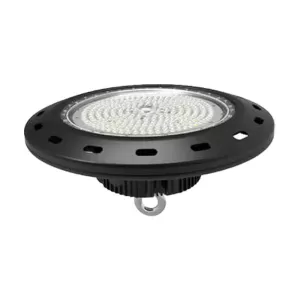
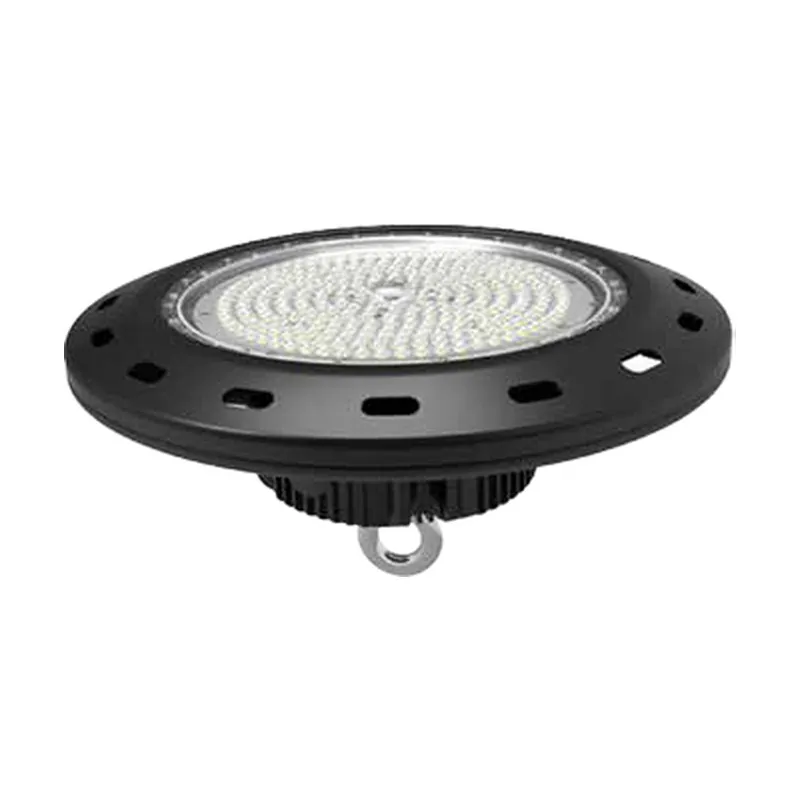
- Sealed optics. IP65 or better keeps dust out of the LED chamber, so only the outside needs cleaning. Our UFO LED high bay GKP40F is IP65 in 100, 150 and 200 W.
- Open, vertical fins. Dust falls through instead of settling. Flat tops collect it.
- Smooth lens. A flat glass or smooth lens wipes clean in one pass; deep prisms hold dirt.
- Heat and dust together. For foundries and furnace bays, use a fitting designed for it. See high temperature LED high bay lights.
Build cleaning into the design
When you plan a new installation, decide the cleaning interval first and choose the maintenance factor to match. Then:
- write the factor and the interval on the lighting drawing, so the next manager knows the design depends on it;
- mark three or four measuring points on the floor;
- combine cleaning with other work at height, such as sprinkler or crane inspections.
For the counting method, see how many LED high bay lights do I need, and for spacing, distance between high bay lights.
Common mistakes
| Mistake | Result |
|---|---|
| Treating LED as maintenance-free | Light level slides below the specification |
| Cleaning the lens but not the fins | Light returns; overheating continues |
| Glass cleaner on plastic lenses | Hazy lenses within a year |
| No baseline lux reading | No way to tell dirt from ageing |
| Designing with MF 0.9 for a dusty plant | Under-lit from the first year |
Ordering
Tell us the building size, mounting height, the process and how dusty or oily the air is. We will propose a fitting and a maintenance factor to match, and show the fitting count with it.
Sources
Frequently asked questions
How often should high bay lights be cleaned?
Once a year in clean warehouses and logistics halls, every six months in general workshops, and every three months or more often in dusty or oily plants such as foundries, mills and machining shops. Measure the lux level to confirm the interval.
How do you clean LED high bay lights?
Isolate the circuit, let the fitting cool, brush or vacuum dust from the heat sink, then wipe the lens with a soft cloth and mild detergent in water. Dry it, check the seals and the suspension, and switch on again.
Can I pressure-wash high bay lights?
Only if the protection rating allows it. IP65 covers low-pressure water jets and IP66 covers powerful jets; neither covers a pressure washer held close. In food plants, use fittings rated for washdown and follow the maker's instructions.
Do LED high bays need cleaning if they last 50,000 hours?
Yes. The rated life describes the LEDs, not the dirt on them. A dirty lens can take 20–30% of the light in a dusty plant long before the LEDs have aged.