Solar Street Lights in Pakistan: Sizing for Winter Fog (Lahore, Karachi, Islamabad, Peshawar, Quetta)
Sizing solar street lights for Pakistan with PVGIS data: winter sun hours for five cities, panel and battery for a 40 W light, panel tilt in Punjab and fog-spell recovery.
Key points
- Pakistan's hard month for solar street lights is winter, not the monsoon: on a flat panel, about 3.0–3.3 peak sun hours a day in Lahore, Islamabad and Peshawar in January, 4.4 in Karachi and 3.9 in Quetta in December.
- A 40 W light running 5 h at full power and 7 h at 30% needs a 150 Wp flat panel in Lahore, Islamabad or Peshawar, and 120 Wp in Karachi or Quetta.
- Tilting the panel to about 30° raises Lahore's January sun from 3.28 to 4.98 hours; the same light then needs only a 100 Wp panel and recovers from a 5-day fog spell in about 5 days instead of about 30.
- In Quetta and the northern hills, winter nights fall below freezing: LiFePO4 batteries need low-temperature charge protection.
Load-shedding, long cable runs and fast-growing housing schemes make solar street lights an obvious choice across Pakistan. The sun is strong for most of the year, yet many lights in Punjab and Khyber Pakhtunkhwa go dark in December and January. The reason is simple: they were sized for the annual average, and winter, with its short days, low sun and fog, needs much more. This guide sizes a typical light for five cities using public satellite data.
Sun hours by city
We took monthly irradiation on a horizontal surface from the European Commission’s PVGIS database. The figures are average peak sun hours (kWh/m² per day):
| City | Annual average | Worst month (flat panel) |
|---|---|---|
| Lahore | 5.12 | 3.28 (January) |
| Islamabad | 5.01 | 3.05 (January) |
| Peshawar | 4.97 | 3.01 (January) |
| Quetta | 6.07 | 3.94 (December) |
| Karachi | 5.64 | 4.36 (December) |
The north of the country has about 40% less sun in its worst month than in an average month. The monsoon, by contrast, is not the problem: even in July and August, Lahore averages over 5 peak sun hours on a flat panel. Size for winter.
The light we sized
A typical light for a housing society street, a link road or a market:
- 40 W LED, 5 hours at 100% from dusk, then 7 hours at 30%
- LiFePO4 battery at 12.8 V, MPPT controller, 90% efficient driver
- 3 nights of battery autonomy
That uses about 316 Wh a night and needs a battery of about 1,050 Wh (82 Ah). On a flat panel, the solar street light calculator gives:
| City | Worst month (PSH) | Panel needed | Standard panel |
|---|---|---|---|
| Lahore | 3.28 | about 134 Wp | 150 Wp |
| Islamabad | 3.05 | about 144 Wp | 150 Wp |
| Peshawar | 3.01 | about 146 Wp | 150 Wp |
| Quetta | 3.94 | about 111 Wp | 120 Wp |
| Karachi | 4.36 | about 101 Wp | 120 Wp |
Tilt is worth a panel size in Punjab
Lahore is at about 31.5° N. In January the noon sun is less than 40° above the horizon, so a flat panel catches it at a shallow angle. Our solar panel tilt angle guide has the PVGIS figures for Lahore:
| Tilt (facing south) | Annual average | January |
|---|---|---|
| 0° (flat) | 5.12 | 3.28 |
| 15° | 5.65 | 4.25 |
| 30° | 5.88 | 4.98 |
| 45° | 5.79 | 5.42 (but July falls to 4.51) |
At 30°, the worst month of the year rises to about 4.98 hours, and the same 40 W light needs only about 88 Wp, so a 100 Wp panel instead of 150 Wp.
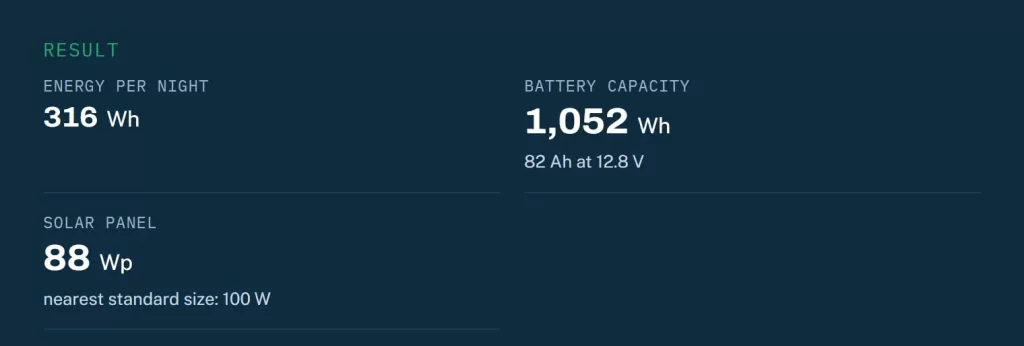
Open the Lahore example and change the sun hours to 3.28 to see the flat-panel result.
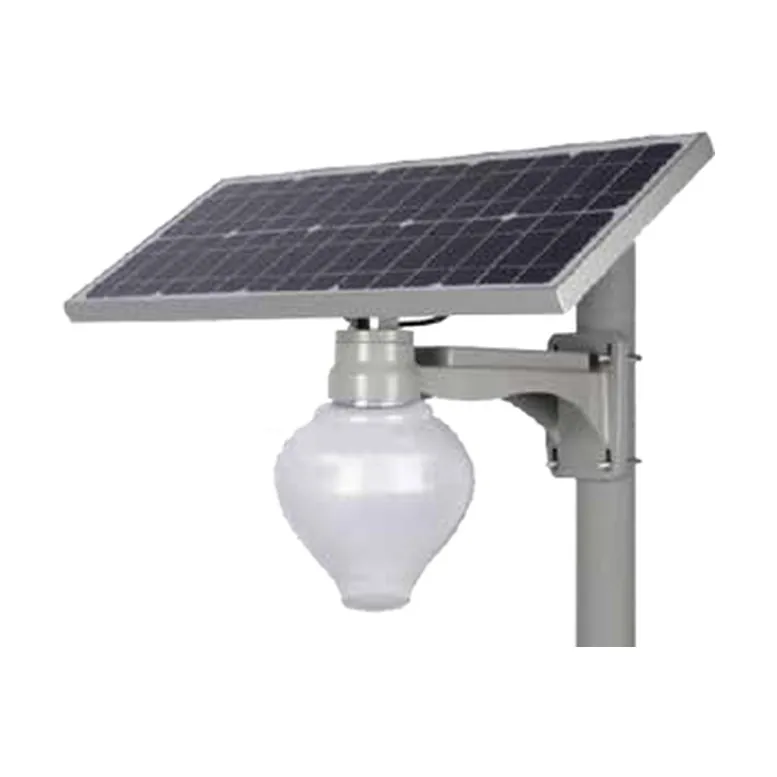
The same applies to Islamabad, Peshawar and the rest of the north: tilt the panel at about 30–35°, facing south. This is much easier with a split solar street light, whose panel bracket can be set to any angle and direction, than with an all-in-one light whose panel follows the lamp head.
The fog test
Winter in Punjab brings fog and smog that can block much of the sun for several days in a row. We ran a Lahore light with a 100 Ah LiFePO4 battery through the battery autonomy calculator for a 5-day fog spell, assuming the panel gives 20% of a normal day in heavy fog:
| Panel | Nights on battery | Days to refill afterwards | Result |
|---|---|---|---|
| 150 Wp, flat | about 4.7 | about 30 | Fails: the battery never catches up in winter |
| 200 Wp, flat | about 5.2 | about 7 | Passes |
| 150 Wp, tilted 30° | about 5.5 | about 5 | Passes |
| 120 Wp, tilted 30° | about 5.0 | about 10 | Just passes |
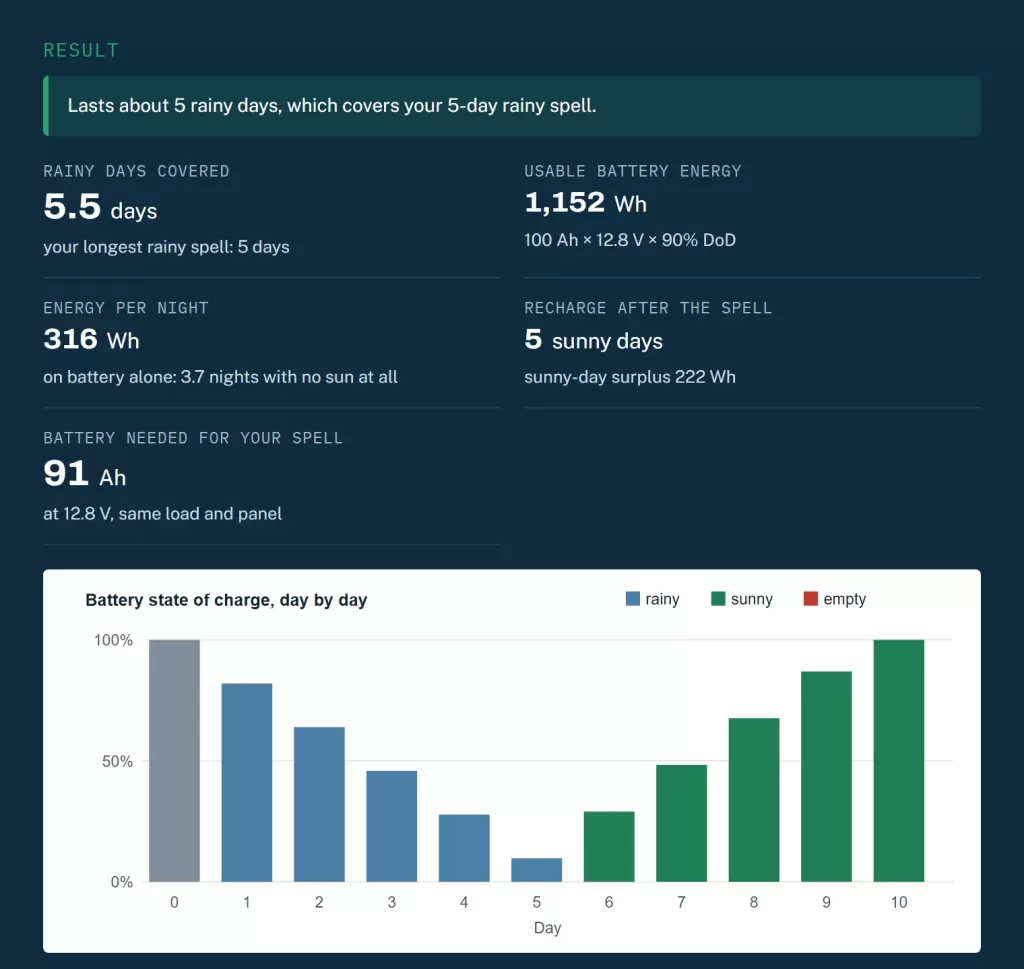
Try the tilted Lahore example and change the sun hours to 3.28 for the flat panel.
Tilting the panel does as much as adding 50 Wp, at no cost. Fog and smog also leave a film on panels: plan a cleaning round after the worst episodes. See how many rainy days a solar street light can last for the method.
Cold nights in Quetta and the north
Quetta, the northern hills and parts of Khyber Pakhtunkhwa have winter nights below freezing. LiFePO4 batteries can discharge in the cold, but must not be charged below about 0 °C without protection, or they are permanently damaged. Ask for:
- A BMS with low-temperature charge protection, which delays charging until the cells warm up
- A battery position that stays warmer, such as inside the pole or a buried box, rather than in an exposed box
- Capacity margin, because cold reduces the energy available
Heat and salt in Karachi and Sindh
Karachi’s sun is the easiest in the country, but summer heat and coastal air bring different problems:
- Battery heat: keep the battery shaded and ventilated; LiFePO4 handles heat far better than lead-acid. See how long solar street lights last
- Corrosion: specify hot-dip galvanised poles, stainless fixings and an IP66 or IP67 head near the sea; see IP65 vs IP66 vs IP67
- Dust: in interior Sindh and Balochistan, dust storms can cut panel output; tilt and cleaning matter
Pole height, spacing and wattage
The lamp wattage follows from the road. Most housing society streets of 6–7 m width are well served by 30–40 W at 6–7 m pole height, and two-lane link roads by 40–60 W at 8–9 m. Over-specifying the wattage is the most expensive mistake in solar lighting, because every extra watt needs more panel and battery. Check your road in our pole height and spacing calculator and read how tall street lights are.
What to check in a quotation
- Panel Wp and battery Wh for winter at your site, with the sun hours and tilt assumed
- Panel tilt and direction: about 30–35° facing south in the north; less in Karachi
- LiFePO4 battery with real usable Wh and low-temperature protection where needed
- MPPT controller with a programmable dimming profile; see MPPT vs PWM
- Anti-theft fixings and battery placement out of reach
- Corrosion protection for coastal sites
Get a sizing for your site
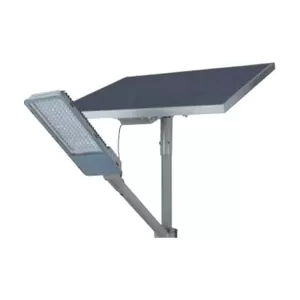
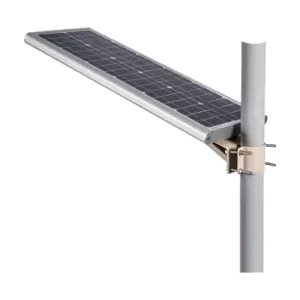
Send us the GPS location, road width, number of lights and burning hours. We check panel, tilt and battery against satellite data for your exact site and quote complete sets with poles. Our split solar street lights (20–60 W, with tiltable panels) suit Punjab and the north; our all-in-one solar street lights (15–60 W) suit Karachi, paths and smaller streets.
Sources
Frequently asked questions
How many peak sun hours does Lahore get in winter?
PVGIS satellite data give Lahore about 3.3 kWh/m² per day on a horizontal surface in January and 3.4 in December, against an annual average of about 5.1. On a panel tilted at 30° facing south, January rises to about 5.0.
What size solar panel does a 40 W solar street light need in Pakistan?
With 5 hours at full power and 7 hours at 30% (about 316 Wh a night), MPPT charging and 3 nights of battery: about 150 Wp on a flat panel in Lahore, Islamabad and Peshawar, 120 Wp in Karachi and Quetta. With the panel tilted at about 30°, Lahore needs only about 100 Wp.
Do solar street lights work in Lahore's winter fog and smog?
Yes, if they are sized for it. Fog and smog in December and January cut sunlight for days at a time. Tilt the panel towards the low winter sun, size the battery for the longest foggy spell, and make sure the panel is large enough to refill the battery afterwards. Clean panels after smog episodes.