
How Tall Are Street Lights? Heights, Dimensions and Spacing by Road Type
Typical street light heights for residential streets, main roads, highways and high masts, in metres and feet, and how height sets the spacing and wattage of a road.
Key points
- Most street lights stand 6–12 m (20–40 ft) tall: about 6–8 m on residential streets, 8–10 m on collector roads, 10–12 m on main roads and 12–15 m on highways.
- High masts at junctions, ports and yards are 20–40 m (65–130 ft).
- Height sets the spacing: poles usually stand about 3–3.5 times their height apart, so taller poles mean fewer poles but brighter lights.
- On a 7 m two-lane road, 8 m poles needed the least total power in our calculator comparison.
“How tall is a street light?” sounds like a trivia question, but the answer is the first decision in any street lighting design. Pole height decides how wide an area each light can cover, how far apart the poles can stand, how bright each luminaire must be and how much glare reaches drivers and neighbours. This guide gives typical heights by road type, the dimensions of a standard pole, and a worked comparison of different heights on the same road.
Typical street light heights
| Road or area | Typical mounting height | In feet |
|---|---|---|
| Footpaths, parks, cycle paths | 3–5 m | 10–16 ft |
| Residential streets | 6–8 m | 20–26 ft |
| Collector and distributor roads | 8–10 m | 26–33 ft |
| Main urban roads, arterials | 10–12 m | 33–40 ft |
| Highways and expressways | 12–15 m | 40–50 ft |
| Junctions, ports, yards (high masts) | 20–40 m | 65–130 ft |
“Mounting height” means the height of the luminaire above the road, which is slightly less than the pole length: part of the pole is in the foundation or below the base plate, and the arm may rise or fall a little. When a tender says “10 m pole”, ask whether it means overall length or mounting height.
Dimensions of a standard street light pole
Most modern street light poles are tapered (conical or polygonal) hot-dip galvanised steel. Typical dimensions:
| Pole height | Top diameter | Bottom diameter | Wall thickness | Base plate |
|---|---|---|---|---|
| 6 m | 60–70 mm | 130–150 mm | 3 mm | about 260 × 260 mm |
| 8 m | 60–70 mm | 150–170 mm | 3–3.5 mm | about 300 × 300 mm |
| 10 m | 70–80 mm | 180–200 mm | 3.5–4 mm | about 350 × 350 mm |
| 12 m | 80–90 mm | 200–220 mm | 4–5 mm | about 400 × 400 mm |
These are typical values for moderate wind; the actual design depends on the site’s wind speed, the luminaire’s weight and wind area, and for solar lights, the panel. Arms (brackets) are usually 1–2.5 m long and tilted 5–15° upwards. For more on materials and specifications, see our guide to street light poles.
Height sets the spacing
Street lights are usually spaced at about 3 to 3.5 times their mounting height. Further apart, and dark patches appear between the pools of light; closer, and you pay for poles you do not need. So:
- 6 m poles: about 18–21 m apart
- 8 m poles: about 24–28 m apart
- 10 m poles: about 30–35 m apart
- 12 m poles: about 36–42 m apart
The layout also changes with road width. When the road is about as wide as the pole is tall, poles on one side are enough. Wider roads need poles on alternate sides (staggered) or on both sides opposite each other.
Which height is best? A worked comparison
Taller poles mean fewer poles, but each light must be brighter to reach the road at the same level. We ran a 7 m two-lane road at class M5 (about 7.5 lx average) through our pole height and spacing calculator at four heights, with LED luminaires at 130 lm/W:
| Pole height | Layout | Spacing | Poles per km | Power needed per light | Power per km |
|---|---|---|---|---|---|
| 6 m | Staggered | 21 m | 96 | about 14 W | about 1.3 kW |
| 8 m | One side | 28 m | 36 | about 29 W | about 1.0 kW |
| 10 m | One side | 35 m | 29 | about 41 W | about 1.2 kW |
| 12 m | One side | 42 m | 24 | about 54 W | about 1.3 kW |
Three things stand out:
- 6 m poles are too short for this road. The calculator has to stagger them on both sides, so the road needs almost three times as many poles as with 8 m poles.
- 8 m is the sweet spot here: the fewest watts per kilometre and a modest number of poles.
- Going higher saves poles but not energy. From 10 m upwards, each extra metre of height needs a brighter light, and the total power creeps back up. Taller poles are also heavier and need bigger foundations.
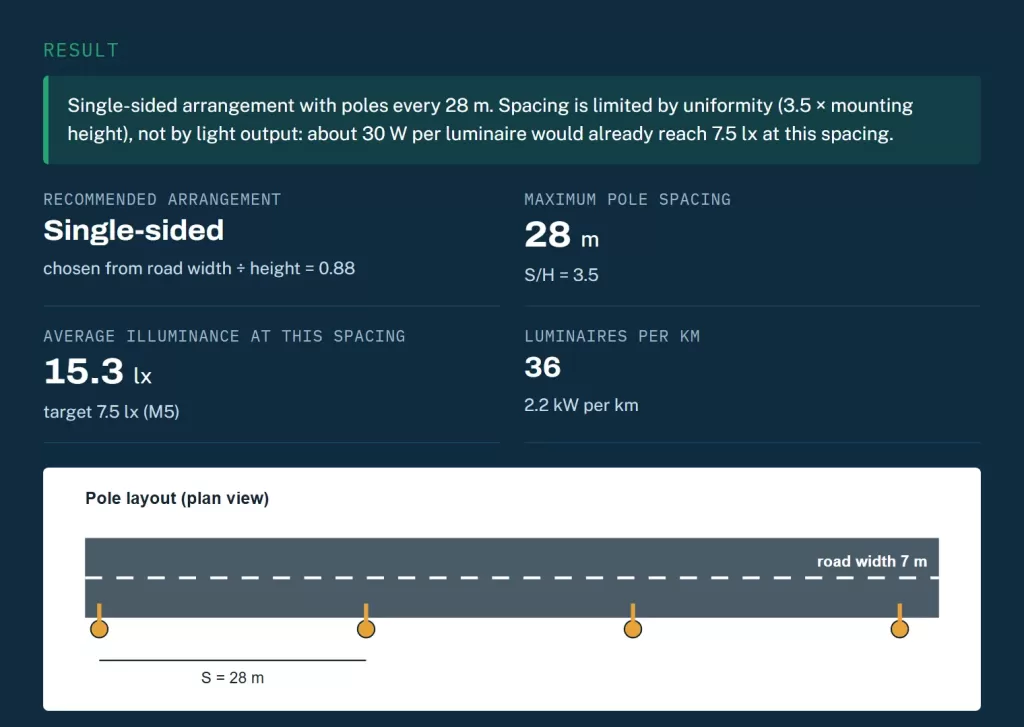
Open this example and change the pole height to compare. For the full method, see how many watts LED street light you need.
Other things that limit the height
- Neighbours. On residential streets, tall poles throw light into bedrooms and gardens. Lower poles with well-shielded optics are friendlier.
- Trees. Street trees grow into the light. Either mount the luminaire below the canopy or plan for pruning.
- Overhead lines and structures. Poles must keep a safe distance from power lines, and bridges or tunnels may limit the height.
- Airports. Near runways, aviation rules limit the height of any structure, including light poles.
- Maintenance access. Above about 12 m, maintenance needs a large aerial platform; high masts use a lowering ring instead.
- Solar lights. A solar panel on top of a tall pole catches the wind, so solar street lights are usually 4–8 m. See solar street light pole height and spacing.
Height and glare
A light mounted higher is further from the driver’s line of sight, so it causes less glare for the same output. That is one reason highways use 12–15 m poles even though lower poles could light the road: drivers at speed need low glare. On residential streets, the opposite concern applies: light should stay on the street, so lower poles and cut-off optics work better.
Send us the road width, the lighting class and any limits on pole height. We will propose the height, spacing and wattage, and a photometric layout to check it. See our LED street lights and solar street lights.
Sources
Frequently asked questions
How tall is a typical street light?
Most street lights are 6–12 m (about 20–40 ft) tall. Residential streets usually have 6–8 m poles, main urban roads 10–12 m, and highways 12–15 m. Decorative post-top lanterns in squares and parks are lower, often 3–5 m.
How tall is a street light in feet?
Roughly 20–26 ft on residential streets, 26–33 ft on collector roads, 33–40 ft on main roads and 40–50 ft on highways. High masts reach 65–130 ft.
How far apart are street lights?
Typically about 3 to 3.5 times the mounting height: around 21–28 m (70–90 ft) for 8 m poles and 30–35 m (100–115 ft) for 10 m poles. The exact spacing depends on the road width, the lighting class and the luminaire optics.
Why are some street lights taller than others?
Taller poles spread the light over a wider area, so they suit wider and faster roads and allow longer spacing. Lower poles suit narrow residential streets, where tall poles would throw light into houses and gardens.