Can a Street Light Charge a Solar Panel? The Numbers Say No
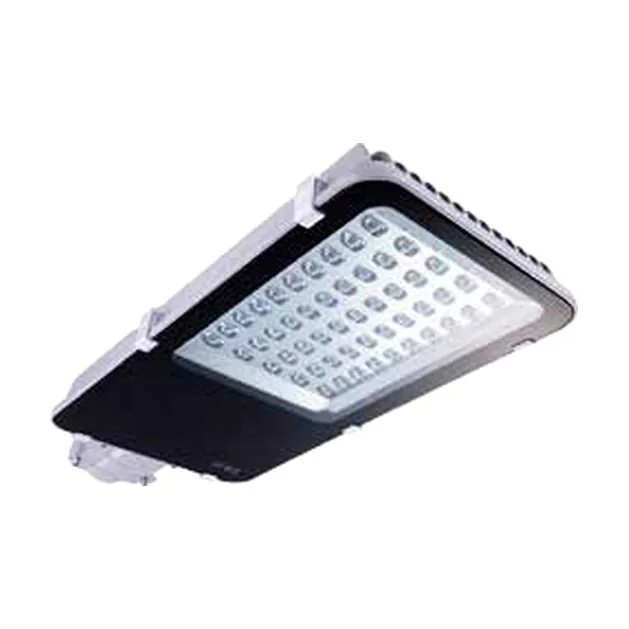
Can a solar light charge under a street light at night? We calculate the light on the ground under a 100 W LED street light and convert it to watts per square metre: about 1/20,000 of sunlight.
Key points
- A typical LED street light puts 15–20 lux on the road; bright sunlight is about 100,000 lux, so the street light gives roughly 1/5,000 to 1/7,000 of the light and about 1/20,000 of the usable power.
- By our pole spacing calculator, a 100 W LED at 10 m on a 7 m road gives an average of about 18 lux; that is roughly 0.06 W per square metre of light energy.
- Under that light, a 45 W solar panel would collect about 0.03 Wh in a 12-hour night, against the roughly 237 Wh a 30 W solar street light uses in the same night.
- Worse, a street light nearby can stop a solar garden light from switching on, because its dusk sensor thinks it is still day.
It is a fair question, and it comes up often: if a solar light sits under a bright street light all night, does that top up the battery? Some people hope it will help in winter, others worry that their solar street lights might be “charging each other”. The short answer is no. The long answer is a calculation, and it shows by how much.
How much light is under a street light?
Start with a normal street. We used our pole height and spacing calculator for a 7 m two-lane road with a 100 W LED at 10 m height, 130 lm/W, a maintenance factor of 0.8 and the M3 class of EN 13201 (15 lux average). It recommends a spacing of 35 m, which gives an average of about 18 lux on the road.
For a residential street with a 60 W LED at 8 m, the calculator gives a spacing of 28 m and an average of about 17 lux. Directly under the lamp the level is higher, perhaps two or three times the average; halfway between poles it is lower.
So the light falling on a solar panel under a street light is somewhere around 10–50 lux, depending on where it is.
How much light is the sun?
Full sun at midday is about 100,000 lux, and the solar industry rates panels at 1,000 W/m² of sunlight. A cloudy day still gives 10,000–20,000 lux. Even a dull winter day in Cape Town or Lahore delivers 2–3 kWh/m², according to PVGIS.
Turning lux into watts
Lux measures light as the eye sees it. A solar panel needs watts of light energy. For white LED light, one watt of light energy gives roughly 300 lumens (the exact figure depends on the spectrum). That lets us convert:
| Light on the panel | Light energy | Fraction of full sun (1,000 W/m²) |
|---|---|---|
| 10 lux | 0.033 W/m² | 1/30,000 |
| 18 lux (our 100 W example) | 0.06 W/m² | about 1/17,000 |
| 30 lux (close under the lamp) | 0.1 W/m² | 1/10,000 |
| 50 lux | 0.17 W/m² | 1/6,000 |
What the panel would collect
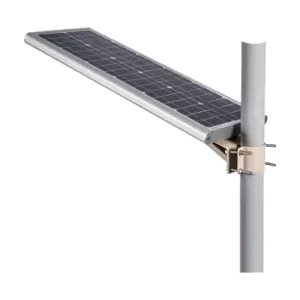
Now take the panel from a real solar street light. Our SL5730C030 all-in-one solar street light has a 45 W panel. If its output scaled down perfectly with the light (in practice it falls even faster in dim light), then at 15 lux:
- power: 45 W × 0.05 ÷ 1,000 ≈ 0.002 W
- energy over a 12-hour night: about 0.03 Wh
The same light uses about 237 Wh on a night of 5 hours at full 30 W and 7 hours at 30%, counting a 90% driver. So the street light would supply about one eight-thousandth of what the solar light needs. On a single day with 4 sun hours, the same panel collects about 130 Wh with an MPPT controller.
For a small solar garden light with a 0.5 W panel sitting right under a lamp at 30 lux, the night’s harvest is about 0.0006 Wh. The light itself uses about 2.7 Wh if it runs 0.2 W for 12 hours. The numbers are not close.
Why dim light is even worse than the arithmetic
The simple scaling flatters the street light. Solar cells lose efficiency at very low light, because a small leakage current inside the cell takes a larger share of what little current is produced. Below a few watts per square metre, many small panels produce almost nothing usable. And a charge controller needs the panel voltage to rise above the battery voltage before it charges at all. At 18 lux, a small panel may not reach that point.
The real problem: a street light can stop the solar light
If a street light has any effect on a solar light, it is a bad one. Most solar lights decide that it is night when the panel voltage drops below a threshold. A panel under a bright lamp may never see that drop, so:
- the light comes on late or not at all;
- it flickers on and off as the street light’s level changes or as cars pass;
- motion-sensor lights may stay in “day” mode.
If your solar light misbehaves near a street light, move it, shade the panel from the street light with a small hood, or choose a model with a timer mode. Our article on solar lights that stay on all night covers the other common causes.
Do solar street lights charge each other?
No. On a solar street light the panel faces the sky and the LED faces the road. The light reaching one light’s panel from the next pole is a few lux at most. Solar street lights are sized on sunshine alone, with a battery for the cloudy days. Our solar street light calculator sizes the panel and battery from your city’s sun hours, and the article on how many rainy days a solar street light can run explains the battery reserve.
What about indoor light?
The same logic applies indoors. An office at 500 lux is about 1/200 of full sun. Small solar cells in calculators work because the calculator uses microwatts. A solar garden light or power bank left on a windowsill charges from the daylight through the window, not from the room lights. Our article on solar lights for indoor use shows why the panel needs to be outside.
Moonlight, for comparison
A full moon gives about 0.1–0.3 lux, roughly a hundred times less than a street light. Neither will charge a solar panel in any meaningful way.
What this means when you choose solar lighting
- Size every solar light on its weakest month of sunshine, not on any light it gets at night.
- If street lights or security lights are nearby, check that the solar light’s dusk sensor will still work, or pick a model with a timer.
- Do not place solar garden lights directly under porch lights or street lights in the hope of extra charge.
- If a site is already lit by street lights, think about whether a solar light is needed at all, or whether a better-placed mains light would do the job.
For councils and contractors
On streets that mix grid street lights and solar lights, keep the solar panels out of the direct beam of the grid lights, or the solar lights may switch late. We size our solar street lights from PVGIS data for the site; send us the location, pole height and road width, and we will check the panel and battery for your weakest month and point out any shading or light-pollution problems from neighbouring lights.
Sources
Frequently asked questions
Will a street light charge my solar lights?
Not in any useful way. The light under a street light carries about one twenty-thousandth of the power of full sun, so a garden light would need thousands of nights under it to collect what one sunny day gives.
Can solar panels charge from LED light indoors?
Technically yes, but only a tiny trickle. Indoor lighting at 300–500 lux is still 200 to 300 times weaker than full sun, and small solar cells are less efficient in dim light.
Why does my solar light not turn on near a street light?
Most solar lights switch on when the panel voltage drops at dusk. A street light shining on the panel can keep the voltage above that threshold, so the light thinks it is still day. Move the light or shade its panel from the street light.
Do solar street lights charge from each other?
No. Each solar street light's panel faces the sky, away from the LED heads, and the light falling on it at night is far too weak to matter.