Light Pole Hand Hole: Size, Cover Plate, What Goes Inside and How to Size the Fuse
What a light pole hand hole is for, where it sits, how the cover plate is secured, what goes inside (fuse, terminals, earth, surge protector) and a fuse calculation for our LED street lights.
Key points
- The hand hole is the access opening near the base of a light pole; behind its cover plate sit the cable joint, a fuse or small breaker, the earth terminal and often a surge protector.
- The opening weakens the pole shaft, so it is reinforced with a welded frame and placed on the side away from traffic or the main wind load, as the pole design specifies.
- Our 150 W LDM30C street light draws about 0.67 A at 230 V (power factor above 0.97); the in-pole fuse is sized above that for driver inrush and below the rating of the cable up the pole.
- A missing or loose hand hole cover leaves live parts within reach of the public; replace it with a matching plate and tamper-resistant screws, never tape or cable ties.
Every street light and area light pole has one small opening that matters more than its size suggests: the light pole hand hole. It is where the supply cable meets the cable up to the luminaire, where the fuse sits and where the pole is earthed. Maintenance crews open it on every fault call, and a missing cover plate is one of the most common hazards found on pole surveys. This guide explains what the hand hole is for, how it is built and covered, what goes inside, and how to size the fuse for an LED street light.
For the other parts of a lighting column, see parts of a street light.
Where the hand hole sits
The opening is usually placed:
- near the base, high enough to stay above standing water, soil and grass cutting, and low enough to work on from the ground;
- above the base plate welds, so the reinforcement around the opening does not clash with them;
- on the side the pole design specifies, often away from oncoming traffic and turned so the opening is not on the face that takes the highest bending stress from wind.
On a breakaway base, the electrical disconnect is arranged so the cable separates cleanly when a vehicle knocks the pole down; the hand hole gives access to that connector.
Size and reinforcement
Cutting a hole in the shaft removes steel or aluminium exactly where bending stress is highest. Pole makers compensate with a welded frame or doubler plate around the opening, and the structural design accounts for the reduced section. Typical sizes:
| Pole type | Typical opening | What fits inside |
|---|---|---|
| Small area or decorative pole, 3–6 m | about 50 × 100 mm to 100 × 150 mm | Cable joint, inline fuse, earth lug |
| Street lighting column, 6–12 m | larger door, often 300–500 mm tall | Fuse carrier or cut-out on a mounting rail, terminal block, SPD |
| High mast, 20 m and above | full base door | Distribution board, winch drive, control gear |
Never enlarge a hand hole on site. It changes the pole’s structural capacity, and the pole maker’s calculation no longer applies. If the opening is too small for the equipment you want, choose a different pole or move the equipment to a cabinet. Our street light pole guide covers wall thickness and materials.
The cover plate
The cover, also called the hand hole cover, access cover or electrical cover, does three jobs: it keeps people’s hands away from live parts, keeps water and animals out, and restores some stiffness to the opening.
A good cover has:
- the same material as the pole, or a compatible one, to avoid galvanic corrosion (stainless screws on galvanized steel are common);
- tamper-resistant fixings: pin-hex or triangular screws, or a hinged door with a lock on larger columns;
- a gasket, or at least a close fit with a drip edge;
- an earth connection where the cover is metal and the local code asks for it.
If a cover is lost, replace it with a plate made to the opening and screw positions. Tape, plastic bags and cable ties are not covers.
What goes inside
A typical street light hand hole contains:
- Incoming supply cable, from the underground network, entering through the foundation’s conduit or cable entry. See street light foundation design for duct sizes.
- Fuse or miniature circuit breaker, protecting the cable up the pole and the luminaire. In some networks this is a sealed cut-out owned by the utility.
- Terminal block or cable joint, connecting the supply to the cable that runs up the shaft to the luminaire.
- Earth terminal, welded to the pole, bonding the shaft, the protective conductor and the luminaire.
- Surge protective device (SPD), optional but common on LED installations, especially in lightning-prone areas or long feeders.
- Control equipment, such as a photocell relay or a wireless node, on some systems.
Sizing the fuse: a worked example
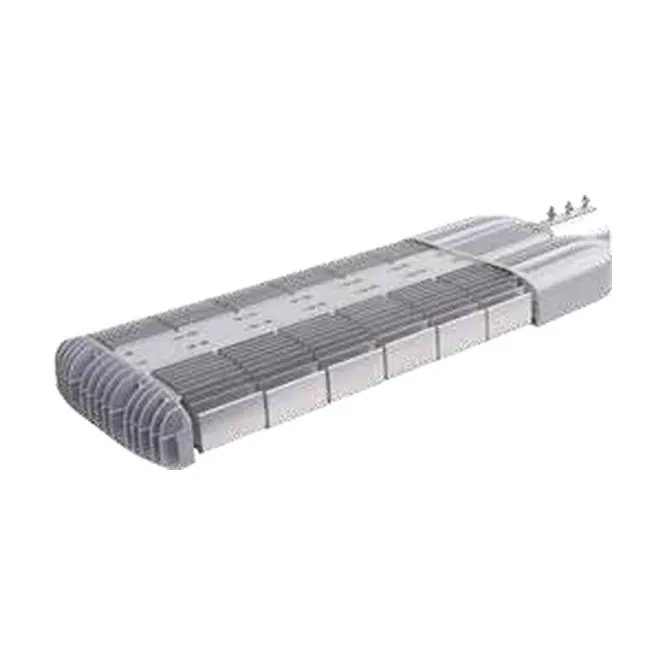
Take one of our LDM30C modular LED street lights at 150 W, AC 230 V, power factor above 0.97.
Running current: 150 ÷ (230 × 0.97) ≈ 0.67 A
For other sizes of the same series:
| LDM30C power | Running current at 230 V |
|---|---|
| 60 W | 0.27 A |
| 100 W | 0.45 A |
| 150 W | 0.67 A |
| 250 W | 1.12 A |
The fuse has to satisfy three conditions:
- above the running current, with margin;
- able to ride through driver inrush: when the driver switches on, its input capacitors draw a peak lasting a fraction of a millisecond. A time-delay (slow-blow) or gG fuse rated a few amps above the running current usually copes; check the driver datasheet for the inrush peak and duration;
- below the current rating of the cable up the pole, so the cable is protected. With the small currents of an LED luminaire, the cable size is usually set by mechanical strength and voltage drop rather than current.
The result is a fuse of a few amps for a single LED luminaire, much smaller than the fuses that old high-pressure sodium installations with ignitors needed. Use the rating your local network rules specify where they exist.
For whole-circuit wiring, see our street light circuit diagram.
Inspection and maintenance
During routine pole inspections, open the hand hole and check:
- cover present, fixings tight, gasket intact;
- no water, soil, insects or nests inside;
- terminal screws tight and free of corrosion;
- earth connection tight and continuous to the luminaire;
- SPD status indicator, if fitted;
- the inside of the shaft at the opening for corrosion, which often starts here first.
Our light pole maintenance guide gives a full inspection list.
What to send us
If you are ordering lights for existing poles, tell us the hand hole size and what it already contains, the supply voltage and whether you want an SPD supplied with each luminaire. We will match the luminaire’s input rating and cable entry to your poles.
Sources
Frequently asked questions
What is a hand hole on a light pole?
An opening near the base of the pole, closed by a removable cover plate, that gives access to the cable connections, fuse and earth terminal inside the shaft without dismantling the pole or the light fitting.
How big is a light pole hand hole?
It depends on the pole. Small area-lighting poles have openings of roughly 50 × 100 mm to 100 × 150 mm; street lighting columns and high masts have larger doors that can hold a fuse board or a distribution panel. The pole drawing gives the exact size.
What size fuse goes in a street light pole?
One sized above the luminaire's running current with room for driver inrush, and below the current rating of the cable to the luminaire. For a single LED street light of 60–250 W at 230 V, the running current is only 0.3–1.1 A, so a small fuse with a time-delay characteristic is usual; follow the driver's inrush data and local rules.
Can I buy a replacement hand hole cover?
Yes. Measure the opening and the screw positions, or give the pole maker's model, and order a plate of the same material and thickness with tamper-resistant fixings. Do not leave the opening uncovered.