
Breakaway Light Pole Bases: How They Work, Where They Are Required and How to Install Them
How breakaway light pole bases work: frangible bases, slip bases and breakaway couplings, passive safety classes, where they are required, wiring disconnects and installation.
Key points
- A breakaway base lets a light pole detach or deform when hit by a vehicle, reducing injury to the occupants.
- Main types are frangible transformer bases, slip bases and breakaway couplings under a standard base plate.
- They are used on poles beside high-speed roads that are not protected by barriers or set outside the clear zone.
- Wiring needs breakaway connectors so cables separate cleanly, and installation must follow the tested configuration exactly.
A rigid light pole beside a fast road is one of the most dangerous objects a vehicle can hit. Breakaway bases make poles safer by letting them give way on impact. This guide explains the types, where they are used and how to install them properly.
How breakaway bases work
When a vehicle hits a rigid pole, it stops almost instantly, and the occupants take the full force. A breakaway pole is designed so that its base releases or fractures at a controlled force. The vehicle pushes the pole out of the way, slowing less abruptly, and the pole falls or is carried over the vehicle. Tests check that the change in the vehicle’s speed and the risk of the pole entering the passenger compartment stay within limits.
Types of breakaway support
Frangible transformer base
A cast aluminium base, sometimes called a transformer base, sits between the foundation and the pole. It is designed to fracture on impact. It also provides an access compartment for wiring. Common in the US on roadside poles.
Slip base
Two plates, one on the pole and one on the foundation, clamped by bolts at a set torque. On impact, the pole plate slides off the foundation plate. The bolt torque is critical.
Breakaway couplings
Special couplings screw onto the anchor bolts and support the pole’s base plate. They are designed to snap at a defined load, releasing the pole.
Passive safety poles
In Europe, poles are classified under EN 12767 for passive safety, by energy absorption: high energy absorbing (HE), low energy absorbing (LE) and non-energy absorbing (NE). Some are designed to bend and wrap around the vehicle rather than break away. The right class depends on the road, speed and what lies behind the pole.
Where breakaway poles are used
- Poles beside highways and high-speed roads within the clear zone
- Medians without barriers
- Ramps and slip roads
- Some rural roads with higher speeds
They are generally not used where:
- Poles are behind crash barriers
- Poles are in urban areas with many pedestrians, where a falling pole could hit people
- Speeds are low
Road authorities set the rules, and they differ between countries. See our highway light pole guide for layout and pole types on high-speed roads.
Wiring at breakaway poles
When a pole breaks away, its cables must not hold it or remain live. Use:
- Breakaway connectors: fused or unfused connectors that pull apart cleanly
- Fused disconnects: in the base, to isolate the pole’s circuit
- Slack cable in the foundation, so the connector separates rather than the cable pulling out of the conduit
Installation must match the tested configuration
Breakaway systems are tested as a complete assembly: pole, base, bolts, foundation height and fixture. Small changes can stop them working:
- Foundation height: usually close to ground level, so the remaining stub does not snag vehicles (often a maximum of about 100 mm above the ground)
- Anchor bolt size and projection: as specified
- Bolt torque: especially critical for slip bases
- Pole weight and height: within the tested range
- Fixtures and arms: within tested weights
- No extra attachments: signs, banners or cameras can change the behaviour
Use the manufacturer’s installation instructions and inspection checklist.
Foundations
Breakaway poles still need proper foundations: concrete designed for the soil and loads, with anchor bolts set to template. The difference is in the top: it must be near ground level and level, so the breakaway device works and does not leave a dangerous stub.
Maintenance and after an impact
- Inspect breakaway devices during routine maintenance for corrosion and damage
- After an impact, replace breakaway components; they are designed for one use
- Check the foundation and anchor bolts; damaged bolts must be replaced
- Reinstall poles exactly to the tested configuration
Our light pole maintenance guide covers general inspection.
Choosing breakaway or protected poles
On a new road, designers compare options: breakaway poles, poles behind barriers, poles set back outside the clear zone, or high masts at interchanges with fewer, more protected structures. Each has costs and maintenance implications. On wide junctions, a few high masts may reduce the number of roadside poles altogether; see the high mast lighting guide.
LED fixtures on breakaway poles
LED fixtures are lighter than many older sodium lanterns, which helps keep the assembly within tested weight limits. Choose fixtures with low weight and wind area, and confirm with the pole supplier that the fixture is within the breakaway pole’s tested range. Our modular LED street lights are designed for main roads and highways.
Costs and trade-offs
Breakaway hardware adds cost to each pole, and poles must be replaced after impacts, which adds maintenance cost. Barriers cost more per metre but protect against many hazards at once, not just poles. Setting poles back may need longer arms or brighter fixtures to keep the light on the road. Road authorities weigh these factors along each route, often choosing breakaway poles on open rural sections, barriers where other hazards already exist, and high masts at complex junctions.
Common installation errors
Field inspections often find breakaway poles installed with foundations too high, anchor bolts too long, wrong washers, slip bases over-tightened, or extra equipment added to the pole. Each can stop the device from working. A short checklist signed off at installation, with photos of the base, helps avoid these problems and gives evidence for later inspections.
Our projects
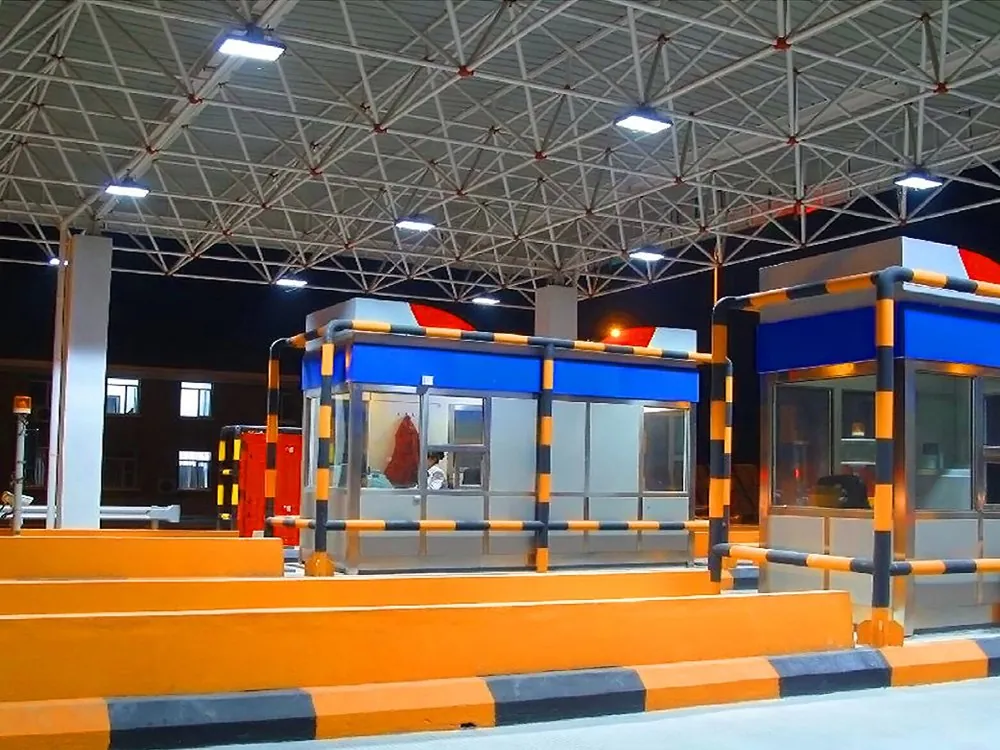
We supplied lighting for an expressway toll station and road projects where pole layout and safety were part of the design. Send us the road speed, cross-section and safety requirements, and we will propose fixtures and work with your pole supplier on a compliant assembly.
Sources
Frequently asked questions
What is a breakaway light pole base?
A pole base designed to fracture, slip or release when struck by a vehicle at speed, so the pole falls away instead of stopping the vehicle abruptly. This reduces the forces on the vehicle's occupants.
Where are breakaway light poles required?
Typically on poles beside roads with higher speeds where the pole is within the clear zone and not shielded by a barrier. Rules come from national road authorities and vary by country.
Do breakaway poles need special wiring?
Yes. Breakaway electrical connectors or fused disconnects allow the cable to separate when the pole is knocked down, so the pole does not stay tethered and live wires are isolated.