Street Light Circuit Diagram: From the Supply to the LED, Explained Block by Block
LED street light circuit, block by block: fuse, surge protector, photocell, driver (EMI filter, rectifier, PFC, constant current) and LED modules, with a feeder example.
Key points
- A mains LED street light has five blocks: supply and pole fuse, surge protector, switching (photocell or controller), driver, and LED modules.
- The driver itself has four stages: EMI filter, rectifier, power-factor correction and a constant-current output.
- A 150 W light with a power factor above 0.95 draws about 0.69 A at 230 V; twenty of them on one circuit draw about 13.7 A.
- On a 600 m feeder with lights 30 m apart, 10 mm² cable loses about 6.5% at the last light and 16 mm² about 4%.
- A solar street light replaces the mains blocks with panel, charge controller and battery, and uses a DC driver.
An LED street light looks simple from the street: a pole, a head, a light that comes on at dusk. Inside, it is a chain of blocks, each with its own job and its own way of failing. Knowing the chain makes it much easier to specify a light, design a circuit and find a fault. This guide walks through the circuit of a mains-powered LED street light block by block, then shows the numbers for a whole street circuit.
The complete chain
Mains supply (L, N, PE)

   │

   ▼

Pole cut-out: fuse or MCB, isolator

   │

   ▼

Surge protective device (SPD)

   │

   ▼

Photocell or smart controller (switch / dim)

   │

   ▼

LED driver

   ├─ EMI filter

   ├─ Rectifier

   ├─ Power-factor correction (PFC)

   └─ Constant-current output (+ dimming input)

   │

   ▼

LED modules (strings of LEDs in series, sometimes in parallel)
The protective earth (PE) runs to the pole, the luminaire body and the SPD.
Block 1: Supply and pole cut-out
Street lights are fed by an underground cable or an overhead line. At the base of each pole, a cut-out or small distribution unit holds:
- a fuse or miniature circuit breaker that protects the cable to the head;
- an isolator so the head can be worked on safely;
- the earth connection for the pole.
The cable from the cut-out to the luminaire runs up inside the pole. It must be sized for the head’s current, which is small, and protected against chafing at the arm.
Block 2: Surge protective device
Street lights are tall, exposed and connected to long cables, so they pick up voltage spikes from lightning and from switching on the network. The SPD sits between the supply and the driver and diverts the spike to earth. It is a consumable part: each large surge wears it a little. Many SPDs have an indicator or disconnect the light when they reach end of life, so the driver is not left unprotected. A good earth is essential; an SPD without an earth path cannot work.
Block 3: Photocell or controller
This block decides when the light is on:
- Photocell: a light sensor and switching circuit, often in a standard twist-lock socket on top of the luminaire (ANSI C136.10 three-pin or the newer seven-pin version with dimming contacts). It switches on at dusk and off at dawn. Our guide to the automatic street light with LDR explains the sensing circuit.
- Timer or central switching: a whole circuit switched from the feeder pillar by a time switch or a contactor.
- Smart controller: a node in the same socket that switches, dims, meters energy and reports faults by radio.
Block 4: The LED driver
The driver turns mains AC into the steady direct current the LEDs need. Inside a typical outdoor driver:
| Stage | What it does |
|---|---|
| EMI filter | Stops the driver’s switching noise from getting onto the mains, and filters incoming noise |
| Rectifier | Turns AC into pulsating DC |
| Power-factor correction | Draws current in step with the voltage, so the light behaves like a resistive load (power factor above 0.9 or 0.95) |
| Constant-current stage | Holds the LED current at the set value regardless of mains variation and LED temperature |
| Dimming interface | 0–10 V, DALI or a timer profile that lowers the output current |
Drivers also include protection against over-voltage, short circuit, open circuit and over-temperature. The driver is the part most likely to fail in an LED street light, usually from heat or surges, which is why good designs put it in a separate, ventilated compartment. Our article on LED streetlight components shows where each part sits in the housing.
Block 5: LED modules
The LEDs are mounted on metal-core boards and connected in series strings, so the same current flows through every LED in a string. Larger lights use several modules, each with its own lens. In a modular design, a failed module can be replaced without changing the whole head.
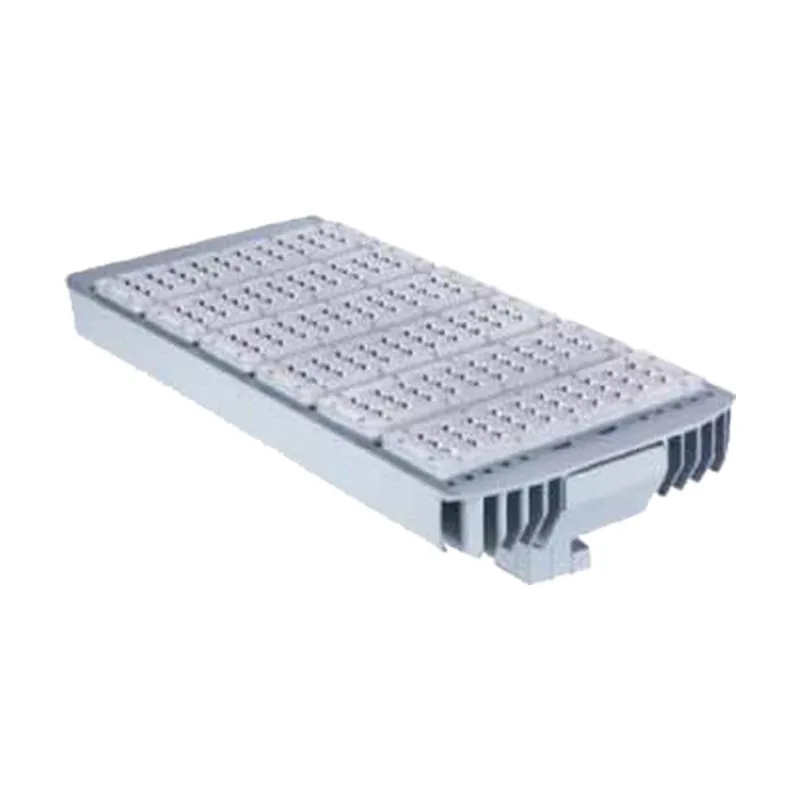
Our modular LED street light BGLDM30G is an example: 60–300 W built from identical modules, with a power factor above 0.95 and the driver in a sealed compartment on the back of the housing, separate from the LED chamber.
From one light to a whole circuit
A street lighting circuit feeds many lights from a feeder pillar. Take twenty 150 W lights at 230 V with a power factor of 0.95:
- Current per light: 150 ÷ (230 × 0.95) ≈ 0.69 A
- Total for the circuit: about 13.7 A
With lights 30 m apart, the cable runs about 600 m, and the current falls by 0.69 A at every pole. Adding up the drop in each section of a single-phase copper cable:
| Cable | Drop at the last light | As % of 230 V |
|---|---|---|
| 6 mm² | 24.8 V | 10.8% |
| 10 mm² | 14.9 V | 6.5% |
| 16 mm² | 9.3 V | 4.0% |
With 100 W lights instead, 10 mm² gives about 4.3%. LED drivers usually accept a wide input range, so they keep the light output stable even at the far end, but national wiring rules limit voltage drop and the cable must also pass fault-current checks. Long streets are often split into shorter circuits or fed on three phases, with lights connected to alternate phases.
Inrush current
When a whole circuit switches on at dusk, every driver charges its input capacitors at once. The total inrush can be many times the running current for a fraction of a millisecond, and it can trip a small breaker even though the steady current is well inside its rating. Check the inrush figure on the driver datasheet and the number of drivers per breaker the manufacturer allows, and use the breaker curve recommended for LED loads.
The solar version
A solar street light keeps the same idea but changes the front of the chain:
Solar panel → Charge controller (MPPT or PWM, with light sensing and timer)

                 │                  │

                 ▼                  ▼

              Battery           DC driver → LED modules
The controller detects dusk from the panel voltage, so no separate photocell is needed. It also runs the dimming profile and protects the battery. Our guide to DC street lights covers the low-voltage side.
Using the diagram for fault finding
| Symptom | Block to check first |
|---|---|
| Whole street dark | Feeder pillar, timer or contactor, main fuse |
| One light dark | Pole fuse, SPD, driver |
| Light on during the day | Photocell or controller |
| Light flickers | Driver, loose connection, failing LED string |
| Part of the head dark | One LED module or string |
| Several lights fail after a storm | SPDs and drivers; check the earth |
Designing the circuit
Before choosing cable and breakers, fix the lights’ wattage and spacing. Our pole height and spacing calculator gives the spacing and wattage for a road, which sets the number of lights per kilometre and the circuit current.
Ordering
Send us the supply voltage, the control method (photocell, timer, smart nodes) and the road layout. We will propose the luminaire, driver options and SPD rating, and help with the circuit loading.
Sources
Frequently asked questions
What is the circuit of an LED street light?
Mains supply → fuse or breaker in the pole → surge protector → photocell or controller → LED driver (EMI filter, rectifier, power-factor correction, constant-current stage) → LED modules. Each block can be checked separately when the light fails.
How does an automatic street light turn on at night?
A photocell (a light sensor with a switching circuit) closes the supply to the driver when the light level falls below a threshold at dusk and opens it at dawn. Smart controllers do the same with a schedule and can dim the driver.
How many LED street lights can be on one circuit?
It depends on the current, the voltage drop and the breaker's tolerance to inrush current. Twenty 150 W lights at 230 V draw about 13.7 A in steady state, but their drivers' inrush when switching on together can trip a small breaker; check the driver's inrush figure and the breaker curve.
Where is the surge protector in a street light?
Usually inside the luminaire, between the supply terminals and the driver, and sometimes also in the pole base. It diverts voltage spikes from lightning and switching to earth before they reach the driver.