Types of Street Light Bulbs: Sodium, Mercury, Metal Halide, Induction and LED Compared
The main types of street light bulbs, how to recognise each by its colour, their typical efficacy and lifespan, which are being phased out, and what a 250 W sodium lamp costs to run versus LED.
Key points
- Five lamp families have lit streets: low-pressure sodium, high-pressure sodium, mercury vapour, metal halide and induction; LED luminaires now replace all of them.
- You can usually tell them apart by colour: deep yellow (low-pressure sodium), orange-pink (high-pressure sodium), bluish-green white (mercury), crisp white (metal halide).
- By our retrofit calculator, one 250 W sodium lamp with a 15 % ballast loss uses about 1,259 kWh a year at 12 hours a night; a 100 W LED uses 438 kWh, 65 % less.
- Mercury vapour is already banned or phased out in the EU and the US; sodium and metal halide supplies are shrinking as LED takes over.
- Replacing a bulb with an LED corn lamp is possible, but a complete LED luminaire gives better optics and heat control.
If you look down a street at night you can often guess the lamp type from the colour alone. Each colour belongs to a different technology, with its own efficiency, lifespan and maintenance needs. Councils, contractors and property managers still run all of them, and knowing which one you have helps you plan a replacement. This guide covers the five lamp families that have lit streets for the last 60 years, and how each compares with LED.
The five lamp families at a glance
| Lamp type | Light colour | Typical lamp efficacy | Colour rendering (Ra) | Typical lamp life |
|---|---|---|---|---|
| Low-pressure sodium (LPS, SOX) | Deep monochrome yellow | 100–200 lm/W | Close to 0 | 16,000–18,000 h |
| High-pressure sodium (HPS, SON) | Orange-pink, about 2,000 K | 80–150 lm/W | 20–25 | 24,000 h |
| Mercury vapour | Bluish-green white | 35–65 lm/W | 15–50 | 16,000–24,000 h |
| Metal halide (MH) | Crisp white, 3,000–4,500 K | 65–115 lm/W | 65–90 | 10,000–20,000 h |
| Induction | White | 60–90 lm/W | 80 | 60,000–100,000 h |
| LED luminaire | 2,700–6,000 K, chosen at order | 110–160 lm/W (luminaire) | 70–90 | 50,000–100,000 h |
Note that the lamp efficacies above are for the bare lamp. In a fitting, losses in the ballast and reflector take a large share away. An LED figure is normally given for the complete luminaire, which makes LED look even better in a fair comparison.
Low-pressure sodium
Low-pressure sodium was the most efficient lamp for decades, but it emits almost all its light at one wavelength, 589 nm. Under it, every colour looks yellow or grey. It was popular on motorways and in countries such as the UK, and astronomers liked it because the single wavelength is easy to filter out. Few LPS lamps are still made, and spare lamps are becoming hard to find.
High-pressure sodium
HPS lamps give the familiar orange-pink street glow. They balance efficiency, long life and acceptable visibility, and they were the default street lamp from the 1970s until LED. Sizes of 70, 100, 150, 250 and 400 W are common. Our metal halide vs high-pressure sodium comparison covers HPS in more depth, and our replacing HPS with LED guide gives wattage equivalents.
Mercury vapour
Mercury lamps were the first high-intensity discharge lamps used widely on streets, from the 1930s onward. They are inefficient by modern standards and contain mercury. The United States stopped the manufacture and import of mercury vapour lamp ballasts from 2008 under the Energy Policy Act of 2005, and the EU phased out these lamps from 2015. Any remaining mercury street lights are prime candidates for replacement. Our history of street lights article traces how each technology took over from the last.
Metal halide
Metal halide lamps add metal salts to the mercury arc to give a whiter light with better colour rendering. They were often chosen for city centres, squares and sports areas where people need to see colours. Their drawbacks are shorter life and colour shift as they age. Some cities used them as a “white light” step before LED.
Induction
Induction lamps have no electrodes; a magnetic field excites the gas. Their main selling point was very long life, which made them popular for tunnels and hard-to-reach poles in the 2000s. They are bulky, and LED overtook them on efficiency and price.
LED
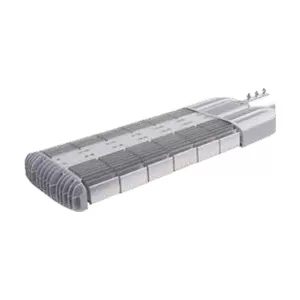
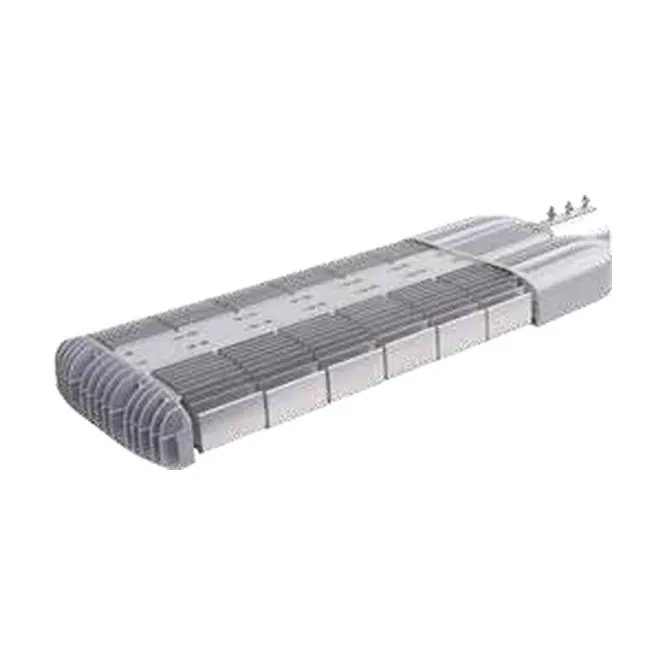
An LED street light is not a bulb but a complete luminaire: LEDs, lens, driver and heat sink designed together. That lets the optic put light on the road instead of into gardens and the sky. Our LDM30C modular street light runs from 30 to 350 W at more than 110 lm/W, with colour temperatures of 3,000 to 6,000 K and a 140° × 80° road lens. The 60–300 W BGLDM30C version holds a CQC product certificate.
What a sodium lamp costs to run, compared with LED
Take one pole with a 250 W HPS lamp, a 15 % ballast loss, 12 hours a night and electricity at $0.15 per kWh. Replacing it with a 100 W LED luminaire, our LED retrofit savings calculator gives:
| Per pole, per year | 250 W HPS | 100 W LED |
|---|---|---|
| System power | 287.5 W | 100 W |
| Energy | 1,259 kWh | 438 kWh |
| Energy cost at $0.15/kWh | $189 | $66 |
| Energy saving | 821 kWh (65 %) | |
| Maintenance (assumed) | $20 | $2 |
| CO₂ avoided at 0.5 kg/kWh | 0.41 t |
Our LED street light power consumption article shows how to calculate the energy use of any wattage, per night, per year and per kilometre of road.
Bulb or whole fixture?
Many owners ask whether they can just swap the lamp. LED corn lamps with E27 or E40 bases fit most old lanterns, usually after the ballast is bypassed. The catch is heat: a closed lantern built for a lamp that radiates heat traps the warmth an LED needs to shed through a heat sink, and the light distribution follows the old reflector rather than the road. Our LED street light bulb vs fixture guide compares the two options in detail.
How to identify what you have
- Look at the colour at night, using the table above.
- Read the lamp label if you can reach it: SON, HPS or NAV mean high-pressure sodium; SOX means low-pressure sodium; HQL or MBF mean mercury; HQI, MH or CDM mean metal halide.
- Check the ballast label in the pole or lantern, which shows the lamp type and wattage.
Send us the lamp type, wattage, pole height and road width, and we will suggest an LED replacement and the energy saving for your network.
Sources
Frequently asked questions
What types of bulbs are used in street lights?
Historically low-pressure sodium, high-pressure sodium, mercury vapour, metal halide and induction lamps. New installations today use LED luminaires almost everywhere, and many cities are replacing the older lamps.
Why are some street lights orange?
Orange-pink light comes from high-pressure sodium lamps, and deep monochrome yellow from low-pressure sodium. Both were chosen for their high efficiency, at the cost of poor colour rendering.
How much electricity does a sodium street light use compared with LED?
A 250 W high-pressure sodium lamp with ballast draws about 288 W. At 12 hours a night that is about 1,259 kWh a year. A 100 W LED luminaire, a common replacement, uses about 438 kWh, roughly 65 % less.
Can I put an LED bulb in an old street light?
Yes, LED corn lamps fit E27 or E40 sockets, usually after bypassing the ballast. Heat build-up inside closed lanterns and poor light distribution are the common problems, which is why most cities replace the whole luminaire.