History of Street Lights: From the First Gas Lamps to LED, and What Each Step Changed
Gas street lights were first lit on Pall Mall, London, in 1807 and in Baltimore in 1817. How arc, mercury, sodium and then LED lamps took over, and why.
Key points
- Gas street lighting was first shown on Pall Mall, London, in 1807; the first public gas street lamp in the United States is usually dated to Baltimore in February 1817.
- Electric arc lamps lit public squares from 1879, but street lighting only became cheap and widespread with mercury and then sodium discharge lamps in the 20th century.
- High-pressure sodium dominated roads from the 1970s to the 2010s for its efficiency, at the cost of orange light and poor colour rendering.
- LED replaced sodium because it uses roughly half the energy for the same road, gives white light and can be dimmed and controlled.
Every street lighting project we quote is the latest step in a story that started more than two centuries ago. Knowing that story helps explain the choices buyers still face: why old poles are spaced the way they are, why some towns still want “warm” light, and why so many tenders are about replacing sodium lamps. Here is a short, practical history, ending with the kind of retrofit we do today.
Before gas: oil lamps and candles
For centuries, city streets were lit, if at all, by candles or oil lamps in lanterns, often provided by householders by order of the town. Light levels were tiny by modern standards, and lamplighters had to fill, trim and light every lamp by hand.
1807–1817: the first gas street lamps
Coal gas changed that. In 1807, Frederick Albert Winsor demonstrated gas street lighting on Pall Mall in London. Within a few years gas companies were laying pipes under London streets.
In the United States, the first public gas street lamp is usually dated to Baltimore, 7 February 1817. The Gas Light Company of Baltimore had been chartered the year before, after a demonstration associated with the painter Rembrandt Peale’s museum, and is widely described as the first gas company in the country. Other American cities followed over the next decades.
Gas lamps were brighter than oil, but they still needed lamplighters, open flames and a gas network. Many cast-iron posts from that era survive, now converted to electricity; our cast-iron lamp post guide covers what that conversion involves today.
1870s–1900s: arc lamps and the first electric streets
The first practical electric street lights were arc lamps, where a bright arc jumps between carbon rods. In April 1879 Charles Brush lit Cleveland’s Public Square with arc lamps, and a number of towns soon claimed to be the first “electrically lighted city”. Arc lamps were extremely bright and harsh, needed their carbons replaced often, and were usually mounted on tall towers or poles.
Incandescent lamps followed in the 1880s and were used for many streets in the early 20th century. They were easy to maintain but very inefficient, around 10–15 lumens per watt.
1930s–1960s: discharge lamps arrive
The big efficiency gains came from gas discharge lamps:
- Low-pressure sodium (LPS) was used for road lighting from the 1930s, first in the Netherlands. It was the most efficient light source of its time, but almost pure yellow: you could not tell a red car from a blue one.
- Mercury vapour lamps spread in the mid-20th century, with a bluish-white light and moderate efficiency.
- Metal halide (1960s) improved colour and efficiency and became common for floodlighting and sports.
1970s–2010s: the orange era of high-pressure sodium
High-pressure sodium (HPS) became commercially available in the mid-1960s and, through the 1970s and 1980s, the standard road lamp in much of the world. It gave around 80–120 lumens per lamp watt, long life and a golden-orange colour that drivers got used to. Its weaknesses were poor colour rendering, light thrown in all directions by a bulb inside a reflector, and losses in the magnetic ballast that added 10–20% to every lamp’s power. We compare the two sodium-era rivals in metal halide vs high-pressure sodium.
2010s–today: LED street lights
LED street lights became practical once white LEDs passed about 100 lm/W and drivers became reliable. Large city programmes started around 2009–2012; Los Angeles alone replaced more than 140,000 street lights with LED from 2009. By the late 2010s, LED had become the default for new roads and replacements in most countries.
LED changed four things at once:
| HPS | LED | |
|---|---|---|
| System power for a typical main road head | 250 W lamp, about 285 W with ballast | about 100–150 W |
| Light distribution | Bulb in reflector, much light wasted | Lens aims light onto the road |
| Colour | Orange, CRI about 20–25 | White, CRI 70–90, 2700–6000 K |
| Control | On or off | Dimming, timers, remote monitoring |
Our HPS to LED conversion chart lists the usual wattage equivalents.
A modern retrofit: Tanzhou Avenue
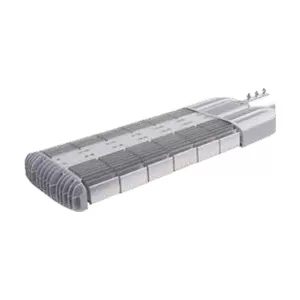
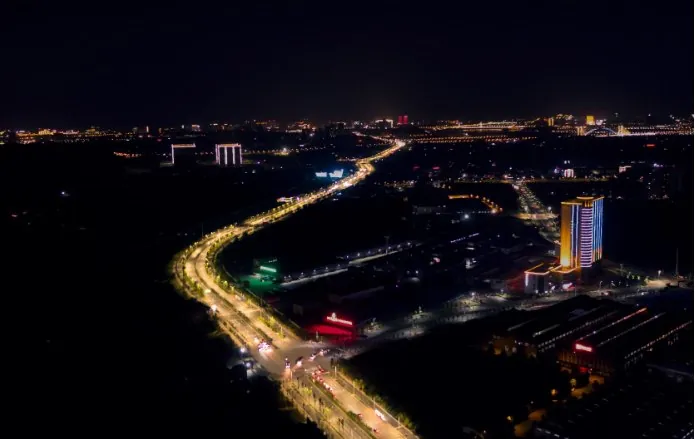
In 2020 we supplied LED street lights for the retrofit of the main road and service roads along 13 km of the Tanzhou Avenue expressway in Xiangtan. It is the same step that cities everywhere have taken over the last fifteen years: keep the existing poles where they are sound, replace sodium heads with LED heads matched to the road class, and gain dimming. Today the head we use most often for this kind of road is the LDM30C modular LED street light, 30–350 W, IP67, with a 140° × 80° road lens.
What history means for today’s buyer
- Old pole spacing is not sacred. Many streets were laid out for gas lamps or sodium; check spacing and height with modern optics rather than copying the old layout.
- Colour preferences are cultural. Residents used to orange light often prefer 3000 K over cold 5000–6000 K LEDs.
- Heritage looks can stay. Classic lantern and post designs can carry LED modules.
- Each technology step gave more light per unit of energy. Oil to gas, gas to electric discharge, sodium to LED. The next gains are in controls: dimming at quiet hours and switching off where light is not needed.
Summary
Street lighting went from oil and candles to gas in the early 1800s, starting in London in 1807 and Baltimore in 1817, then to electric arc and incandescent lamps, to the sodium lamps that lit most roads for half a century, and finally to LED. Each step brought more light for less energy and less maintenance. Today’s projects are mostly about finishing that last step well: the right LED head, on the right poles, with the right controls.
Sources
Frequently asked questions
Where was the first gas street lamp in America?
In Baltimore, Maryland. The Gas Light Company of Baltimore, chartered in 1816, is generally described as the first gas company in the United States, and its first public street lamp is usually dated to 7 February 1817.
When did street lights become electric?
Arc lamps were used for public lighting from the late 1870s, including Cleveland's Public Square in 1879. Electric street lighting spread through the early 20th century as incandescent and then discharge lamps became cheaper than gas.
Why were street lights orange?
Because sodium lamps produce yellow-orange light. Low-pressure sodium is almost pure yellow; high-pressure sodium is golden orange. They were chosen for efficiency, not colour.
When did cities switch to LED street lights?
Large programmes began around 2009–2012. Los Angeles replaced more than 140,000 street lights with LED from 2009, and by the late 2010s LED had become the default for new and replacement street lighting in most countries.