DC LED Street Lights: 12 V, 24 V and 48 V Systems, Cable Losses and When They Make Sense
DC LED street lights at 12 V, 24 V and 48 V: which wattages 12 V suits, battery and panel sizes from our calculator, voltage drop along a street, DC drivers and when DC beats AC.
Key points
- 12 V DC LED street lights suit about 20–60 W; in our calculator a 40 W light needs a 120 Wp panel and 82 Ah at 12.8 V, an 80 W light 164 Ah, which is where 24 V (82 Ah) becomes the better choice.
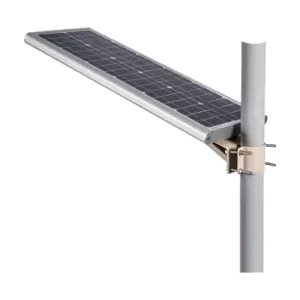
- Almost every solar street light is a DC street light: the panel, battery and LED all run on 12 V or 24 V, with no inverter.
- Low voltage is fine inside one pole: a 40 W light at 12 V draws 3.3 A and loses under 2% in 5 m of 2.5 mm² cable.
- Low voltage is poor along a street: ten 40 W lights 30 m apart, fed from one end at 48 V, lose about 16% in 6 mm² cable and still about 10% in 10 mm².
- At 24 V the same street loses almost 40%, so shared DC systems use 48 V or higher, or keep each light self-contained.
- LEDs are DC devices, so a DC supply removes the AC-to-DC stage of the driver, but the driver still has to regulate the LED current.
An LED is a direct-current device. Every mains-powered LED street light starts by turning the AC supply into DC inside its driver. So it is natural to ask whether a street light could simply run on DC from the start. Many already do: almost every solar street light is a DC street light. This guide explains the common DC voltages, why voltage drop decides what is practical, and where DC makes sense.
Three kinds of DC street lighting
| Type | Voltage | How it works |
|---|---|---|
| Self-contained solar light | 12 V or 24 V | Panel, battery, controller and LED on one pole; no cable to other poles |
| Shared DC bus | 24–48 V | A central solar array or battery bank feeds several lights along a cable |
| DC microgrid or high-voltage DC feed | 110–380 V DC | Higher voltage distribution with DC drivers at each light |
The first type is by far the most common. The second is used on campuses, in villages and on short private roads. The third appears in pilot projects and in buildings or sites that already have DC distribution.
12 V DC LED street lights: which sizes work
A 12 V DC LED street light works well from about 20 to 60 W; above that, 24 V is the better system voltage. The reason is current and battery size. We sized four lights in our solar street light calculator with 5 hours at full power, 7 hours at 30 %, 3 nights of autonomy, LiFePO4 and 4 peak sun hours:
| LED power | Current at 12.8 V | Current at 25.6 V | Battery energy | Battery at 12.8 V | Battery at 25.6 V | Panel |
|---|---|---|---|---|---|---|
| 20 W | 1.6 A | 0.8 A | 526 Wh | 41 Ah | 21 Ah | 60 Wp |
| 40 W | 3.1 A | 1.6 A | 1,052 Wh | 82 Ah | 41 Ah | 120 Wp (open) |
| 60 W | 4.7 A | 2.3 A | 1,578 Wh | 123 Ah | 62 Ah | 180 Wp |
| 80 W | 6.3 A | 3.1 A | 2,104 Wh | 164 Ah | 82 Ah | 250 Wp (open) |
The stored energy is the same at either voltage; what changes is the current, the cable and the cell arrangement. Up to 60 W, 12.8 V keeps currents under 5 A and the battery to a single common pack size. At 80 W, the 12.8 V battery reaches 164 Ah and the panel current exceeds 10 A on a sunny day, so 25.6 V halves both.
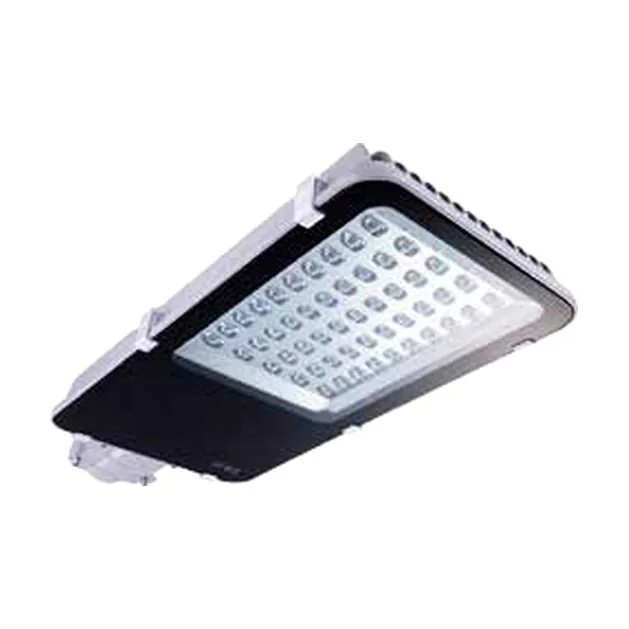
In our own range, the all-in-one SL series runs 15–60 W from 12.8 V LiFePO4, the SL4830G split light runs 20–60 W from 12 V batteries, and the LDZ30J housing takes a DC 12/24 V driver from 20 to 80 W. At 100 lm/W, a 60 W light gives about 6,000 lm, enough for residential and village roads on 6–8 m poles.
Inside one pole: 12 V and 24 V
In a self-contained solar light, all the cables are short: panel to controller, controller to battery, controller to LED. At these lengths low voltage works well.
A 40 W light:
| System | Current | Drop in 5 m of 2.5 mm² | Drop as % of supply |
|---|---|---|---|
| 12 V | 3.3 A | 0.23 V | 1.9% |
| 24 V | 1.7 A | 0.11 V | 0.5% |
Both are fine. 24 V becomes worth considering for larger lights, above about 60 W, or where the battery is buried at the pole base and the LED is at the top of a 10 m pole. Our solar street light calculator sizes the panel and battery for either voltage.
Along a street: why voltage drop decides
Now feed ten 40 W lights, 30 m apart, from one end of a 300 m cable. The first section carries all 400 W, the last only 40 W. Adding the drop in each section gives:
| Supply | Cable | Total drop at the last light | As % of supply |
|---|---|---|---|
| 24 V DC | 10 mm² | 9.5 V | 39% |
| 48 V DC | 6 mm² | 7.9 V | 16% |
| 48 V DC | 10 mm² | 4.7 V | 10% |
| 110 V DC | 4 mm² | 5.2 V | 5% |
(Copper at 0.0172 Ω·mm²/m, two-wire DC circuit, current falling by 40 W at each light.)
At 24 V the far lights would hardly work. At 48 V, even 10 mm² cable loses a tenth of the voltage, and the cable is far heavier and more expensive than a mains cable would be for the same lights. Only at around 100 V and above does DC distribution along a street become comparable with AC.
There are ways to reduce the drop: feed from the middle, split into shorter branches, or place the central supply in the middle of the run. But the physics does not change. Power is voltage times current, and losses grow with the square of the current.
DC drivers
A DC street light still needs a driver. The LED string needs a regulated current, not just a voltage, and the supply voltage changes as the battery charges and discharges. A DC driver (a DC-DC constant-current converter):
- holds the LED current steady from, for example, 10 V to 14.6 V on a 12.8 V battery;
- dims the light on command from the solar controller or a timer;
- protects the LEDs against reverse polarity and voltage spikes.
In solar lights the driver is often combined with the charge controller. Our compact LED street light LDZ30J is supplied with an AC driver for mains roads or a DC 12/24 V driver for solar systems, in the same 20–80 W housing. That lets one luminaire type serve both grid and solar streets on a project.
Safety
IEC 61140 places DC systems up to 120 V (ripple-free) in the extra-low voltage band. In practice:
- 12 V, 24 V and 48 V systems carry a low shock risk, which is one reason they are popular for solar and campus lighting;
- above 120 V DC, the installation needs the same protection as mains;
- DC arcs do not pass through zero like AC, so they are harder to extinguish. Use DC-rated switches, fuses and breakers at every voltage;
- battery banks can deliver very high short-circuit currents; fuse them close to the terminals.
When DC makes sense
| Situation | DC suits it? | Why |
|---|---|---|
| Off-grid road, poles far apart | Yes, self-contained solar | No cable between poles at all |
| Short private road or campus, central battery | Sometimes, at 48 V | Short runs keep the drop acceptable |
| Long public road with grid nearby | Usually no | AC distribution at 230 V is cheaper and simpler |
| Site with an existing DC microgrid | Yes, with DC drivers | Avoids double conversion |
| Mixed project, some solar, some grid | Use one luminaire with AC or DC drivers | Same optics and spares |
For most roads the real choice is between self-contained solar lights and grid-powered AC lights; our solar vs grid street lights cost comparison helps with that decision. A shared low-voltage DC bus is attractive on paper because there is no inverter, but the cable cost usually cancels the saving once the poles are more than a few tens of metres apart.
Wiring good practice
- Keep low-voltage DC cables as short as possible; put the battery and controller close to the light.
- Size cable for voltage drop, not just for current rating.
- Mark polarity clearly and use connectors that cannot be reversed.
- Seal every connection: low-voltage joints corrode easily, and a small resistance at 12 V causes a large loss.
- Fuse the positive conductor close to the battery.
Common mistakes
| Mistake | Result |
|---|---|
| Running 12 V or 24 V along a street | Far lights dim or dark |
| Sizing DC cable for current only | Large voltage drop |
| AC-rated switches in DC circuits | Contacts weld or arc |
| No fuse at the battery | Fire risk in a short circuit |
| Driver without wide input range | Light flickers as the battery voltage falls |
Ordering
Tell us whether the site is off-grid or has a DC supply, the voltage, the number of lights and the distances. We will propose self-contained solar lights or luminaires with DC drivers, and check the cable sizes.
Sources
Frequently asked questions
Are 12 V DC LED street lights bright enough for a road?
For residential, village and estate roads, yes. Up to about 60 W, a 12 V light gives about 6,000 lm at 100 lm/W, which suits 6–8 m poles. For main roads needing 80 W or more, a 24 V system keeps the current and battery size reasonable.
What is a DC street light?
A street light whose LED driver runs from a direct-current supply instead of mains AC. Most are solar street lights at 12 V or 24 V; others run from a shared DC bus fed by a central solar array, a battery bank or a DC microgrid.
Is 12 V or 24 V better for a solar street light?
For small lights both work. 24 V halves the current for the same power, which reduces cable and connector losses and suits lights above about 60 W or long cables between panel, battery and lamp.
Can DC street lights run from one central solar system?
Yes, but the voltage drop along the street is the limit. At 24 V or 48 V, the cables needed for several lights spaced 30 m apart become very thick. Central systems usually use 48 V for short runs or higher DC voltages for longer ones.
Are DC street lights safer than AC?
Systems below 120 V ripple-free DC fall in the extra-low voltage band of IEC 61140, which lowers the shock risk. Higher DC voltages need the same protection as mains, and DC arcs are harder to break, so switches and fuses must be DC-rated.