LED Street Light Housing: Die-Cast Bodies, Heat Sinks, Seals and Weight
What an LED street light housing does, ADC12 die-cast vs extruded 6063 heat sinks, lens vs glass covers, IP65 vs IP67, and weight per 100 W across our five street light bodies.
Key points
- The housing (casing) is the heat sink, the seal and the mounting in one part; it decides how long the LEDs and driver last.
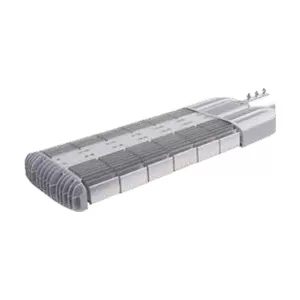
- Most LED street light bodies are ADC12 die-cast aluminium; modular designs add extruded 6063 heat sinks with more fin area.
- Across our five street light bodies, weight per 150 W ranges from 3.5 kg (slim BGLDM30J) to 6.85 kg (LDM30C, IP67, separate heat sinks).
- A heavier housing is not automatically better, but the extra metal usually buys thermal margin and a longer rated life.
Buyers searching for an “LED street light casing” are usually comparing two things: how well a housing will last outdoors, and how much it adds to the weight on the pole. Both questions come back to the same part. In an LED street light, the housing is the heat sink, the water seal and the mounting at once. This guide explains what to look for and compares the five housings in our own street light range.
What the housing does
- Carries heat away from the LEDs. Even an efficient LED turns more of its input power into heat than into light, and that heat collects at the board. The housing conducts it to fins and releases it to the air.
- Keeps water and dust out. Gaskets, the lens or glass seal and the cable gland set the IP rating.
- Holds the light on the pole. The spigot clamp or tenon fitting, and the tilt adjustment, are part of the housing.
- Houses the driver. Often in a separate chamber, away from the LED heat.
The first job matters most for life. LED lumen maintenance and driver life both drop as temperature rises, so a housing that runs a few degrees cooler can add years. Our LED street light lifespan article covers the effect in more detail.
Materials
| Material | Where it is used | Notes |
|---|---|---|
| ADC12 die-cast aluminium | Main body of most street lights | Complex shapes in one piece; good thermal conductivity for a casting alloy |
| 6063 extruded aluminium | Separate heat sinks, modular designs | Higher thermal conductivity than casting alloys; long thin fins possible |
| PMMA (acrylic) | Individual LED lenses | High transmission; shapes the road distribution |
| Tempered glass | Flat cover over the LED board | Scratch and UV resistant; protects the lens |
| Sheet steel or plastic | Low-cost lights | Poorer heat transfer; plastic ages in UV |
A powder coat protects the aluminium. In coastal and industrial air, ask for a thicker coat or a marine-grade finish.
Our five street light housings compared
All figures come from our product data. Weight per 150 W is our calculation from those tables, to make different body sizes comparable.
| Model | Body | Cover | IP | Power range | 150 W weight | Rated life |
|---|---|---|---|---|---|---|
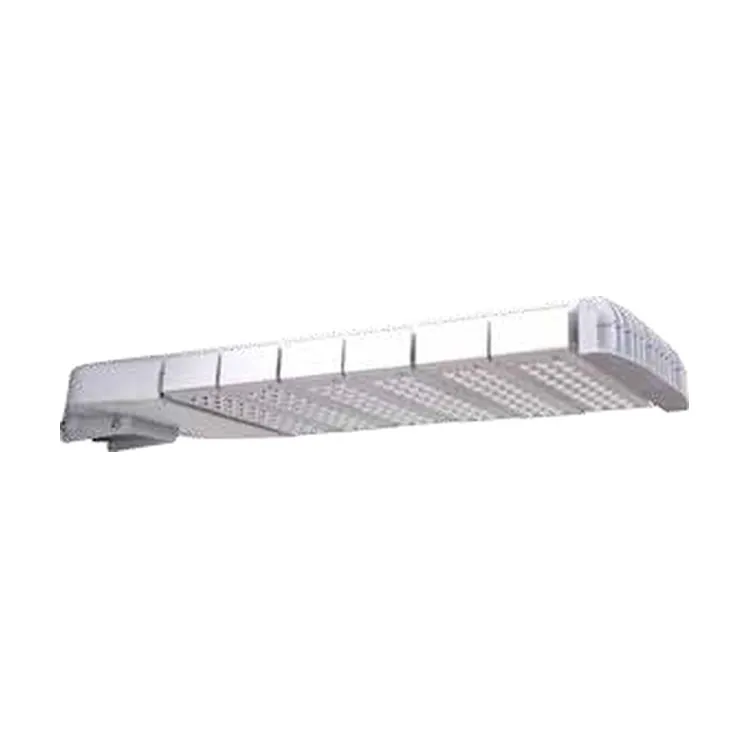
| LDM30C | ADC12 frame + 6063 heat sink per module | PMMA lens | IP67 | 30–350 W | 6.85 kg | > 80,000 h |
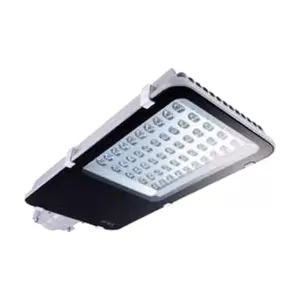
| BGLDM30G | ADC12 die-cast | PMMA lens | IP65 | 60–300 W | 4.1 kg | > 80,000 h |
| BGLDM30J (slim) | ADC12 die-cast | PMMA lens | IP65 | 30–300 W | 3.5 kg | > 80,000 h |
| LDL30G (orchid) | ADC12 die-cast | Tempered glass + PMMA | IP65 | 20–80 W | — (80 W: 3.5 kg) | > 50,000 h |
| LDZ30J | ADC12 die-cast | Tempered glass + PMMA | IP65 | 20–80 W | — (80 W: 3.82 kg) | > 30,000 h |
Three things stand out:
- The LDM30C carries the most metal. Each LED module has its own 6063 heat sink, and the IP67 seals add weight. That is the trade for the highest sealing in the range and a rated life of over 80,000 hours.
- Slim bodies save pole load. The BGLDM30J at 150 W weighs about half as much as the LDM30C. On tall poles, long arms or wind-exposed sites, that difference matters for the pole design; see light pole EPA.
- Compact heads trade life for price. The LDZ30J’s rated life is over 30,000 hours, against over 80,000 for the modular bodies. It suits low-traffic lanes, compounds and solar poles, where a lower price matters more.
How housing size grows with power
In a modular design, more power means more modules and a longer body:
| LDM30C power | Length | Weight |
|---|---|---|
| 30–50 W | 412 mm | 4.5 kg |
| 60–100 W | 497 mm | 6.0 kg |
| 120–150 W | 581 mm | 6.85 kg |
| 180–200 W | 665 mm | 8.0 kg |
| 250 W | 749 mm | 8.9 kg |
| 300 W | 883 mm | 10.0 kg |
| 350 W | 917 mm | 12.0 kg |
Because each module has the same optic, uniformity does not change as you add power. The longer body does change the projected area and the load on the arm, so check the pole when moving up a size. For choosing the wattage itself, see how many watts an LED street light needs.
IP65 or IP67?
IP65 resists water jets and is enough for most roads. IP67 adds a temporary immersion test. It is worth having:
- on coastal roads and bridges exposed to spray;
- in regions with long, heavy rainy seasons;
- where large day-night temperature swings cause condensation inside weaker seals.
Our IP65 vs IP66 vs IP67 guide explains the tests.
What to check on a sample
- Fin area and thickness. Thin, closely spaced fins clog with dust and bird droppings; open fins self-clean in rain.
- Driver chamber. A separate, ventilated or thermally isolated driver compartment helps driver life.
- Gasket quality. Silicone gaskets that are continuous, not glued strips, and a breather valve against condensation.
- Fasteners. Stainless screws avoid seized covers after a few years.
- Tilt and spigot clamp. Check that it fits your arm diameter and allows the tilt your design needs; see our street light bracket guide.
Common mistakes
- Comparing price per watt without comparing housings. A light-bodied 150 W head and a heavy one are not the same product.
- Choosing the lightest head for a hot climate. Less metal means less thermal margin.
- Ignoring weight changes on a retrofit. A new head can be heavier or lighter than the old lamp; check the arm and pole.
What to send us
The road type, the pole height and arm you have, the climate (coastal, hot, rainy), and the wattage or lighting class. We will suggest the housing that fits, with its weight and dimensions for your pole check.
Sources
Frequently asked questions
What material is an LED street light housing made of?
Usually high-pressure die-cast aluminium alloy, most often ADC12. Modular designs add extruded 6063 aluminium heat sinks. Cheaper lights may use thin sheet or plastic parts, which shed heat poorly.
Why does the housing matter for an LED street light?
LED life and driver life fall as temperature rises. The housing carries heat from the LED board to the air and keeps water and dust out. A body with too little metal or fin area runs the LEDs hotter and shortens their life.
What is the difference between IP65 and IP67 for a street light housing?
IP65 resists water jets; IP67 also survives temporary immersion. IP67 suits coastal roads, areas with heavy driving rain and places where condensation is a problem. Our LDM30C is IP67; our other street light bodies are IP65.
Can I buy an empty LED street light housing?
We sell complete luminaires, tested as a unit with their LEDs, driver and seals. An empty housing assembled elsewhere loses that testing, so we do not recommend it for public roads.
How heavy is an LED street light?
From our product tables, a 150 W street light weighs 3.5 kg (BGLDM30J), 4.1 kg (BGLDM30G) or 6.85 kg (LDM30C). An 80 W compact head weighs about 3.5–3.8 kg.