Street Light Brackets and Arms: Single, Double and Median Layouts, Spigot Fit and Tilt
Street light bracket types, spigot fit, arm length and tilt, plus our spacing calculation comparing single-side, opposite and median double-arm layouts for a 15 m road.
Key points
- The bracket (arm) sets the luminaire's position over the road: outreach, mounting height and tilt. It must also match the luminaire's spigot diameter and carry its weight and wind load.
- By our pole spacing calculator, a 15 m road at M3 (15 lux) on 10 m poles needs 66 heads of 100 W per km either as opposite single arms (66 poles) or as median double arms (33 poles); a single-side layout needs 200 W heads at 35 m.
- Median double arms halve the number of poles and foundations for a divided road with the same light.
- Our slim modular head weighs 2.9 kg at 60–100 W and 3.9 kg at 180–200 W: on a 2.5 m arm the heavier head exerts a static moment of about 96 N·m at the pole.
When a street lighting project is planned, most attention goes to the luminaire and the pole height. The bracket that joins them gets less: it is often chosen from a catalogue at the last minute. Yet the bracket decides where the light lands, how many poles are needed on a divided road, and whether an LED head fits at all. This guide covers bracket types, the details that cause problems on site, and the effect of the layout on the number of poles, using our spacing calculator.
Bracket types
- Single arm. One arm reaching over the road. The standard for most streets.
- Double arm (180°). Two arms pointing in opposite directions. Used in central medians, car parks and squares.
- Twin arm (90°) or multi-arm. For junctions and corners.
- Wall bracket. Fixed to buildings in narrow streets; see our article on wall-mounted street lights.
- Post-top adapter. For lanterns and luminaires that sit on top of the pole rather than on an arm.
- Pole-band brackets clamped to wood or concrete poles; see the street light arm for a wood pole.
Arms can be integral (welded or formed with the pole) or detachable, bolted to the pole top. Detachable arms make transport easier and allow changes later.
Outreach, height and tilt
- Outreach is how far the luminaire sits from the pole. It brings the light over the carriageway, especially when poles stand behind a footpath or verge. Longer arms increase the load on the pole.
- Mounting height is measured to the luminaire, not the pole top. A rising arm adds height.
- Tilt is the angle of the luminaire to the horizontal. With LED optics that already throw light across the road, keep tilt small (0–5°) to limit glare and upward light. Many of our heads have an adjustable mounting angle, so the final tilt can be set on site.
The spigot: the most common site problem
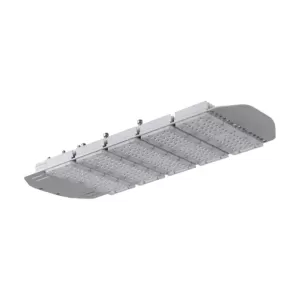
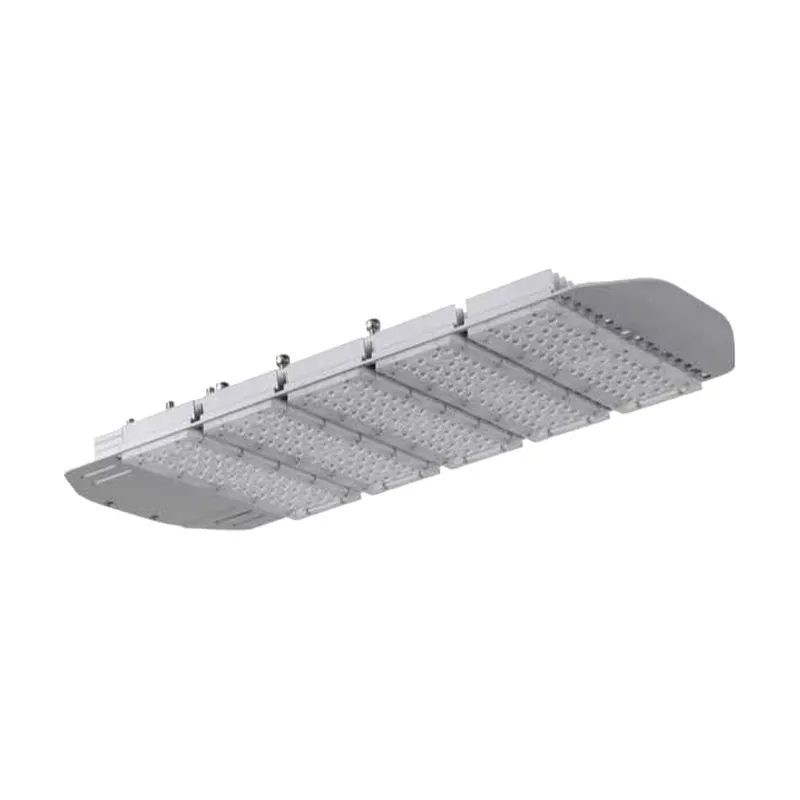
The luminaire clamps onto the end of the arm, the spigot. If the diameters do not match, the head either does not fit or is held loosely and can rotate in the wind. Common outside diameters are about 42, 48, 60 and 76 mm. Before ordering heads for existing arms, measure the spigot and send the diameter and the insertion length available. When the poles come from another supplier, also send the pole colour so the head can match. Our slim modular LED street light and other heads accept single- or double-arm poles with an adjustable mounting angle.
Our calculation: three layouts for a 15 m road
A 15 m road can be a wide street with poles on one or both sides, or a divided road with two 7.5 m carriageways and a central median. We ran each layout through our pole height and spacing calculator with 10 m mounting height, 100 lm/W heads, a maintenance factor of 0.8 and class M3 (15 lux average).
| Layout | Head power | Spacing | Average illuminance | Poles per km | Heads per km | Load per km |
|---|---|---|---|---|---|---|
| Single side, single arms | 200 W | 35 m | 17.4 lux | 29 | 29 | 5.8 kW |
| Both sides, opposite single arms | 100 W | 31 m | 15.4 lux | 66 | 66 | 6.6 kW |
| Median, double arms (two 7.5 m carriageways) | 100 W | 31 m | 15.4 lux | 33 | 66 | 6.6 kW |
What the table shows:
- Single side uses the fewest poles, but on a road 1.5 times as wide as the mounting height the far side gets less light, and uniformity across the road is the weak point. The calculator’s own rule picks single-side layouts only when the road is no wider than the mounting height.
- Opposite single arms light both halves evenly but double the poles, foundations and cable crossings.
- Median double arms give the same light as the opposite layout with half the poles. On divided roads, this is usually the cheapest civil work.
Arm load: real head weights
The luminaire’s weight at the end of the arm creates a bending moment at the pole. For our slim modular head, the static moment is weight × 9.81 × outreach:
| Head | Weight | Outreach | Static moment at the pole |
|---|---|---|---|
| 60–100 W | 2.9 kg | 1.5 m | about 43 N·m |
| 180–200 W | 3.9 kg | 1.5 m | about 57 N·m |
| 180–200 W | 3.9 kg | 2.5 m | about 96 N·m |
Static weight is the smaller part of the story. Wind on the head, the arm and the pole shaft usually governs the design, and a double arm carries two heads. Give the pole designer the head weight and projected area, and let them check the arm and foundation to the local wind code. LED heads are lighter than the old sodium lanterns they replace, which helps when reusing arms; see our guide to the street light pole for wind design.
Corrosion and finish
Arms are usually hot-dip galvanised steel, sometimes powder-coated over the zinc. Check:
- that the inside of the arm is galvanised as well as the outside;
- that cable entry holes are deburred, so insulation is not cut;
- that bolts are galvanised or stainless, with insulating washers where metals differ.
Our article on galvanized steel light poles explains coating thicknesses.
Ordering checklist
- Layout: single side, opposite, staggered or median.
- Mounting height and outreach.
- Arm type: integral or detachable, single, double or multi-arm.
- Spigot diameter and insertion length.
- Tilt, or an adjustable head.
- Head weight and projected area for the pole check.
- Finish and colour.
For spacing on a new road, our guide to pole distance calculation walks through the method step by step.
What to send for a quotation
Send the road cross-section (carriageways, median, footpaths), the lighting class, and, for existing poles, the spigot diameter and arm photos. We will propose the head wattage and layout, and supply the weights and areas the pole designer needs.
Sources
Frequently asked questions
What is a street light bracket?
The arm or fitting that holds the luminaire on the pole. It sets the outreach over the road, the tilt and the height, and ends in a spigot onto which the luminaire clamps.
What spigot size do street lights use?
Common outside diameters are about 42, 48, 60 and 76 mm, with 60 mm widely used for road luminaires. Many LED heads accept a range with an adapter. Always measure the arm and give the diameter when ordering.
When should I use a double-arm street light pole?
On divided roads with a central median, a double-arm pole in the median lights both carriageways from one pole and one foundation. It is also used in car parks and squares.
How much should a street light arm tilt?
Usually 0–15°. With modern LED optics a flat or small tilt (0–5°) gives the best control of glare and sky glow; larger tilts were used with older lamps to push light across wide roads.