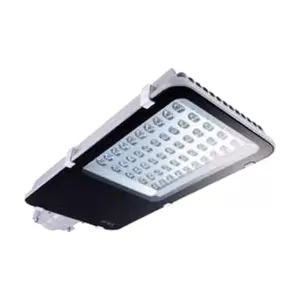
Wall-Mounted Street Lights: Brackets, Spacing and Wattage for Narrow Streets
When to mount street lights on building walls instead of poles: bracket types, mounting heights, calculator spacing for 4–8 m streets, glare into windows, fixings and permissions.
Key points
- Wall brackets suit streets too narrow for poles: old town centres, alleys, terraces and lanes between buildings.
- Our spacing calculator gives about 17 m spacing for a 4–5 m street lit from 5 m with 20 W lights, and 21 m for a 6 m street lit from 6 m with 30 W.
- An 8 m street lit from 7 m with 40 W needs lights on both walls, staggered, at about 24 m.
- Glare into upper-floor windows is the most common complaint; use cut-off optics, a level fitting and warm white near homes.
- Every bracket needs the building owner's consent, a fixing suited to the wall, and a safe route for the cable.
In the oldest parts of many cities, there is no room for lighting poles. Pavements are narrow or missing, buildings stand at the edge of the street, and a pole would block doors, cars or wheelchairs. The answer for centuries has been to fix the lights to the buildings. Modern LED street lights work just as well on wall brackets, as long as the bracket, the height, the spacing and the glare are worked out properly.
Where wall mounting makes sense
- Historic centres with narrow streets and no space for poles
- Alleys, passages and lanes between buildings
- Terraced housing where façades line the street
- Market streets, pedestrian zones and courtyards
- Industrial yards and estate roads lined by warehouses
- Bridges, underpasses and arcades where poles are impractical
If there is space for a pole at the kerb, a pole is usually easier: no permissions from building owners, simpler maintenance and freedom to place the light where the calculation wants it.
Bracket types
| Bracket | Projection | Typical use |
|---|---|---|
| Short wall bracket | 0.3–0.6 m | Alleys, courtyards, building perimeters |
| Wall arm | 0.6–1.5 m | Streets, to bring the light over the carriageway |
| Decorative or heritage bracket | 0.5–1.2 m | Historic centres, with lantern-style luminaires |
| Catenary or span wire | Across the street | Very narrow streets, lights hung in the middle |
A longer arm moves the light towards the middle of the street and improves uniformity on the far side, but it increases the load on the wall fixing. For a street up to about one mounting height wide, a 0.6–1 m arm on one side is usually enough.
Mounting height
The building decides the height more than the calculation does:
- above ground-floor shop signs, awnings and door canopies;
- below upper-floor windows where possible, to keep light out of bedrooms;
- high enough for delivery vehicles to pass under the arm.
In practice that gives 4–5 m in old narrow streets and 6–7 m on wider streets lined by taller buildings.
Spacing and wattage: calculator examples
We ran four typical streets in our pole height and spacing calculator, using 90 lm/W compact street lights and a maintenance factor of 0.8. The calculator treats the wall bracket like a pole at the street edge, which is a fair model for a fitting on a short arm.
| Street width | Mounting height | Light | Class | Layout | Spacing | Average |
|---|---|---|---|---|---|---|
| 4 m alley | 5 m | 20 W | P4 (5 lux) | One wall | 17 m | 9.8 lux |
| 5 m lane | 5 m | 20 W | P3 (7.5 lux) | One wall | 17 m | 8.6 lux |
| 6 m street | 6 m | 30 W | P3 (7.5 lux) | One wall | 21 m | 8.7 lux |
| 8 m street | 7 m | 40 W | P3 (7.5 lux) | Both walls, staggered | 24 m | 11.6 lux |
In the narrow streets, the spacing is set by the uniformity limit of 3.5 times the mounting height, not by the wattage: in the 4 m alley, 20 W gives almost twice the P4 level, and the calculator reports that about 11 W would be enough at 17 m. In practice the building positions often decide the spacing; the calculation tells you whether the gaps they leave are acceptable.
For the 8 m street, the width is more than the mounting height, so the calculator switches to a staggered layout on both walls. That means brackets on both sides of the street and two sets of owner agreements. Our street light pole distance calculation explains the method in detail.
Glare into windows
The most common complaint about wall-mounted lights comes from residents whose bedroom windows are a few metres from the fitting. To avoid it:
- Use a cut-off road optic that sends light down and along the street, not sideways into the façades.
- Mount the fitting level. Tilting it up throws light into windows across the street.
- Choose warm white in residential and historic streets: 3,000 K is common, and 2,700 K in conservation areas.
- Add a house-side shield where a window is very close.
- Dim late at night when the street is quiet.
Our guide to LED residential street lights covers optics and colour temperature for housing areas in more detail.
Fixings and the building
A wall bracket loads the wall with the weight of the arm and luminaire plus wind on both. Points to check:
- Wall material. Solid brick, concrete and stone take chemical anchors well; hollow blocks, render over insulation and timber frames need special fixings or a different position.
- Anchor type. Use stainless steel chemical or mechanical anchors rated for the load, at the spacing the bracket maker gives.
- Edge distance. Keep anchors away from corners and window openings.
- Heritage buildings. Conservation rules may limit drilling and require fixings in mortar joints rather than in stone.
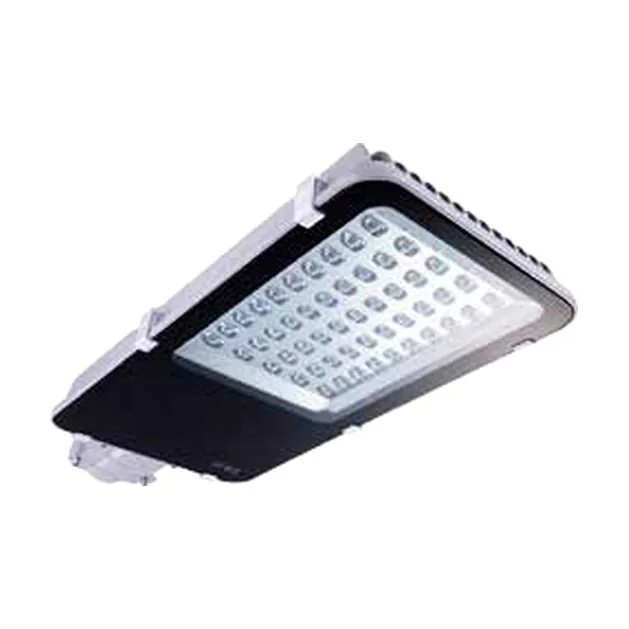
The light itself is not heavy. Our compact LED street light LDZ30J, for example, weighs 1.1 kg at 20 W and 2.4 kg at 40 W, and fits a standard single-arm spigot.
Power supply
Getting power to a wall bracket is often harder than fixing it:
- run cable in conduit on the façade, in a colour that matches the wall, or inside the building to a hole behind the bracket;
- fit an isolator or fused connection unit at each light for safe maintenance;
- keep the street lighting circuit separate from the building’s own supply, unless the owner agrees otherwise;
- in historic streets, existing cable routes from old gas or electric lamps may be reusable.
Each light can switch with its own photocell, or the circuit can be switched centrally. A central switch with dimming makes later control easier.
Permissions and maintenance
Before fitting anything to a building, agree in writing:
- the right to fix the bracket and run the cable;
- access for maintenance, usually from a lift in the street;
- who pays for repairs if the wall is damaged;
- what happens when the façade is painted, insulated or rebuilt.
Many cities have standard wayleave agreements for this. Without one, a refurbishment can remove a light overnight.
Heritage streets
In historic centres, the luminaire often has to look like the old lanterns it replaces. LED lantern-style fittings on decorative brackets can keep the look while using a fraction of the energy. Our article on Victorian street lamps covers period styles.
Common mistakes
| Mistake | Result |
|---|---|
| Bright cool-white fittings next to bedrooms | Complaints and requests to remove lights |
| Tilting fittings up to reach the far side | Glare into windows opposite |
| Weak fixings in hollow or rendered walls | Brackets loosening in wind |
| No written agreement with owners | Lights removed during refurbishment |
| Following building positions without checking spacing | Dark gaps between lights |
Ordering
Send us the street width, the mounting heights the buildings allow, the positions available and the light level required. We will run the spacing, propose the luminaire, optic and colour temperature, and suggest a bracket length.
Sources
Frequently asked questions
How high should a wall-mounted street light be?
Usually 4–7 m, set by the building: above ground-floor windows and shop signs, below upper-floor windows where possible. In narrow streets 5 m is common; on wider streets 6–7 m allows wider spacing.
How far apart should wall-mounted street lights be?
About 3–3.5 times the mounting height. Our calculator gives about 17 m for 5 m mounting and 21 m for 6 m mounting on residential P3 and P4 streets, with 20–30 W LED lights.
Who owns a street light on a building wall?
It depends on the country and the agreement. Often the light belongs to the municipality and the building owner grants a right to fix it to the wall. The agreement should cover access, maintenance and what happens if the building is refurbished.
Can a normal LED street light be mounted on a wall?
Yes, on a wall bracket with an arm. The luminaire is the same; the bracket replaces the pole. Check that its spigot size fits the bracket and that the optic suits a fitting set back from the road edge.