LED Residential Street Lights: Wattage, Pole Height, Spacing and Colour for Housing Estates
How to light residential streets with LED: lux classes, worked spacing examples from our calculator, why 20–40 W is usually enough, warm colour temperature, glare and light into bedrooms.
Key points
- Residential streets are usually lit to EN 13201 classes P2 to P4: an average of 10, 7.5 or 5 lux, far less than a main road.
- On a 6 m wide street with 6 m poles on one side, a 30 W LED at 110 lm/W reaches about 10.6 lux at 21 m spacing; the spacing limit, not the wattage, sets the layout.
- Most estate streets need 20–40 W per light. Higher wattage mostly adds glare and light into bedrooms.
- Choose 3000 K or 2700 K, a road optic with good back-light control, and a dimming step after midnight.
Residential streets are where most complaints about street lighting come from: too dark, too bright, too blue, or shining into a bedroom. Getting them right is less about buying a powerful light and more about choosing the right lighting class, spacing and optic. This guide works through real examples with our pole height and spacing calculator, so you can check a design or a quotation for a housing estate, a gated community or a town’s side streets.
How much light a residential street needs
Main roads are designed for drivers at speed (M classes, measured in luminance). Residential streets are designed mainly for pedestrians, cyclists and slow traffic, so most standards use illuminance classes. In EN 13201-2 these are the P classes:
| Class | Average maintained illuminance | Typical use |
|---|---|---|
| P2 | 10 lux | Busy estate roads, streets near schools and shops |
| P3 | 7.5 lux | Typical residential streets |
| P4 | 5 lux | Quiet cul-de-sacs, lanes, mews |
| P5 | 3 lux | Very quiet lanes, rural housing |
Other countries use similar ranges. Our EN 13201 classes guide explains how the class is chosen from traffic, speed and crime risk. For most estates the answer is P3 or P2.
Worked examples from our calculator
We ran four typical residential streets through the calculator, with one row of lights on one side, a maintenance factor of 0.8 and the calculator’s spacing limit of 3.5 × mounting height:
| Street | Pole height | LED power and efficacy | Class | Spacing | Average lux | Lights per km | Enough power for the class |
|---|---|---|---|---|---|---|---|
| 5 m lane | 5 m | 20 W, 100 lm/W | P4 (5 lux) | 17 m | 9.5 | 59 | about 11 W |
| 6 m street | 6 m | 30 W, 110 lm/W | P3 (7.5 lux) | 21 m | 10.6 | 48 | about 21 W |
| 6 m street | 6 m | 40 W, 110 lm/W | P2 (10 lux) | 21 m | 14.2 | 48 | about 28 W |
| 7 m estate road | 8 m | 60 W, 110 lm/W | P2 (10 lux) | 28 m | 12.9 | 36 | about 46 W |
The last column is the most useful. On every street, the spacing was limited by uniformity (lights more than about 3.5 × height apart leave dark patches), not by the light output. Once the spacing is fixed by the pole height, a 6 m street needs only about 21 W at 110 lm/W to reach P3. A 30 W light gives some margin for dirt and ageing; a 60 W light on the same street would mostly add glare and complaints.
In other words, for residential streets pole height and spacing decide the layout, and the wattage only needs to be just enough. If a quotation offers 80–100 W heads on 6 m poles for a housing estate, ask why.
Energy per kilometre
At 12 hours a night, the 6 m street with 30 W lights uses 48 × 30 W × 4,380 h ≈ 6,300 kWh per kilometre a year. With a common dimming profile (full power for five hours, 50% for the rest of the night) it falls by about 29%, to roughly 4,500 kWh. That is about a quarter of what the same street used with 70 W sodium lamps on all night with their ballasts. Our HPS to LED wattage chart shows the conversion for older streets.
Colour temperature: warm is better at home
For residential streets we recommend 3000 K, or 2700 K where residents are sensitive to light or near nature areas. Reasons:
- Warm light feels more comfortable and less glaring at the same lux level.
- It contains less blue light. The American Medical Association’s 2016 guidance on LED community lighting recommended 3000 K or lower for street lighting.
- Colour rendering of faces, clothing and cars is still good (our LDZ30J and LDM30C street lights come in Ra 70, 80 or 90).
4000 K is still common on through roads. For side streets and estates, warm white is the better default. Both street lights below are available at 3000 K.
Glare and light into bedrooms
A residential street light is often 5–10 m from a bedroom window. Things that help:
- Road optic with low back-light. A good asymmetric road lens throws light along the street and onto the footpath, not backwards into gardens.
- Mount the head flat. Tilting a head up by 10–15° increases spacing a little but sends light towards windows and drivers’ eyes.
- House-side shields where a pole stands right in front of a window.
- Pole position. Put poles on boundaries between houses rather than in front of windows when the layout allows.
- Dimming after midnight. It cuts both energy and spill light when fewest people are out.
Which of our lights fit residential streets
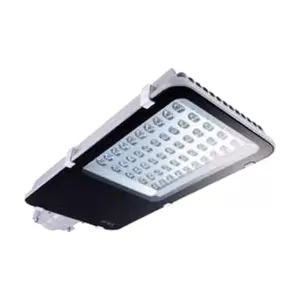
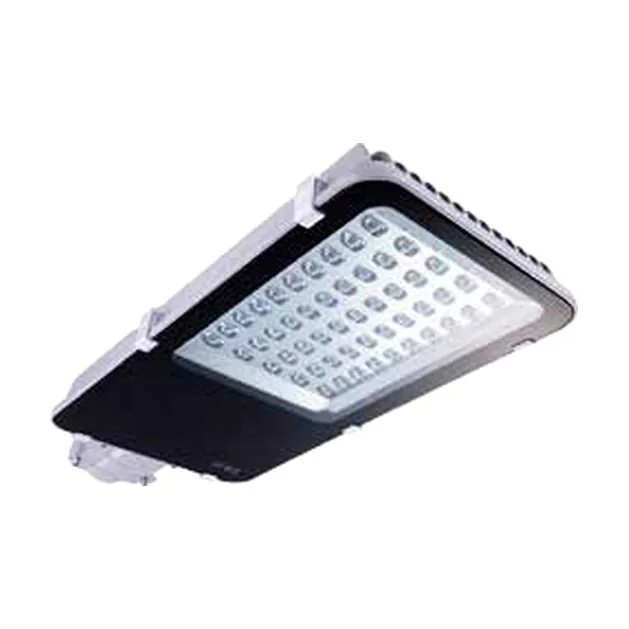
- The compact LDZ30J LED street light, 20–80 W, IP65, die-cast aluminium with tempered glass, for 3–8 m poles. The 20–40 W versions cover the lanes and streets in the table above.
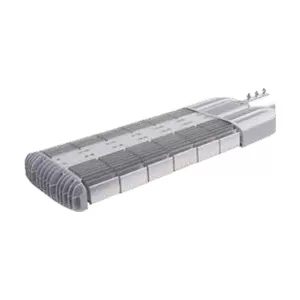
- The modular LDM30C LED street light, 30–350 W, IP67, over 110 lm/W with a 140° × 80° road lens. Use its lower wattages on estate distributor roads with 8 m poles; the BGLDM30C version (60–300 W) holds CQC product certificate CQC19010221751.
- Where there is no grid supply, see solar street lights for homes and private roads.
A quick design checklist
- Agree the lighting class with the client or authority (usually P2–P4).
- Fix the pole height from the street width, trees and the look the developer wants (5–8 m).
- Set spacing up to about 3.5 × height on one side; stagger on both sides for streets wider than about 1.5 × height.
- Choose the lowest wattage that reaches the class with margin, using real luminaire efficacy.
- Choose 3000 K, a low back-light road optic and a dimming profile.
- Check light near windows and add shields where needed.
Summary
Residential streets need a few lux, even spacing and warm, well-controlled light. In our calculator examples, 20–40 W LEDs on 5–6 m poles at about 3.5 × height spacing meet the usual P3–P4 classes, with 40–60 W for wider estate roads. Spend the budget on optics, colour and controls rather than extra watts.
Sources
Frequently asked questions
What wattage LED street light is used for residential streets?
Usually 20–40 W with an efficacy of 100–130 lm/W, on 5–6 m poles. Wider estate roads with 8 m poles may use 40–60 W. Work it out from the lux class and spacing rather than copying a wattage from another project.
How far apart should street lights be on a residential street?
As a rule of thumb, up to about 3.5 times the mounting height on one side of the street: about 17 m for 5 m poles, 21 m for 6 m poles and 28 m for 8 m poles. Closer spacing improves uniformity; wider spacing leaves dark gaps between lights.
What colour temperature is best for residential street lights?
Warm white, 3000 K or 2700 K. It gives good colour rendering for faces and cars, less glare and less blue light at night. Many cities now specify 3000 K or lower for residential areas.
How do I stop a street light shining into bedrooms?
Use a road optic with low back-light, mount the head level rather than tilted up, and fit a house-side shield where a light stands close to a window. Dimming after midnight also helps.