30W vs 50W LED Street Light: Lumens, Spacing and Which Saves More per Kilometre
30 W or 50 W LED street light? Lumens at 90 lm/W, spacing on 5–7 m residential roads from our calculator, load per kilometre, running cost and the solar panel each needs.
Key points
- At 90 lm/W, the minimum rating of our LDZ30J compact street light, 30 W gives about 2,700 lm and 50 W about 4,500 lm.
- On a 7 m road with 8 m poles at class P2 (10 lux), our calculator spaces 30 W lights at 14 m and 50 W lights at 24 m: 72 versus 42 lights per km, for almost the same load (2.2 kW vs 2.1 kW).
- On narrow 5 m lanes with 6 m poles, both reach the 21 m spacing cap, so 30 W is enough and 50 W only adds brightness.
- For solar, a 50 W light on our calculator's profile needs a 150 Wp panel and 103 Ah battery at 4.5 sun hours, against 80 Wp and 62 Ah for 30 W.
30 W and 50 W are the two sizes most often requested for residential streets, estate roads, campuses and village lanes, both grid and solar. The temptation is to pick the cheaper 30 W, or to play safe with 50 W. Neither choice is right by default. The answer depends on road width, pole height and how far apart you can afford to put the poles. This guide runs both sizes through our calculators.
Lumens: what each size gives
| Efficacy | 30 W | 50 W |
|---|---|---|
| 90 lm/W | 2,700 lm | 4,500 lm |
| 100 lm/W | 3,000 lm | 5,000 lm |
| 110 lm/W | 3,300 lm | 5,500 lm |
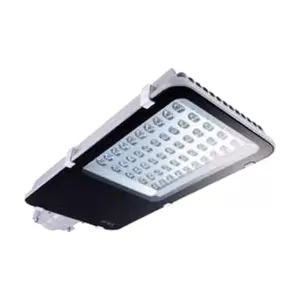
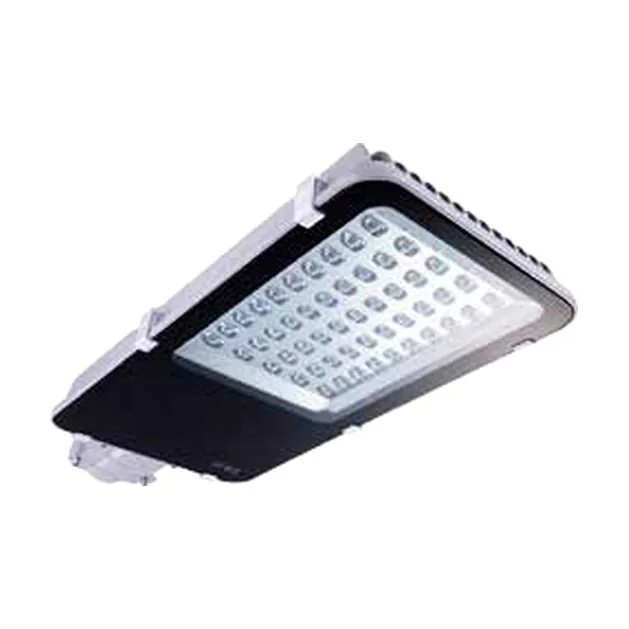
Our LDZ30J compact LED street light is rated above 90 lm/W, comes in 20–80 W steps and has a 140° × 80° road optic, IP65, for 3–8 m poles. We use 90 lm/W in the calculations below so that the results hold at the minimum rating.
Spacing on three typical roads
We ran both sizes through our pole height and spacing calculator, single-sided poles, maintenance factor 0.8, for EN 13201 classes P2 (10 lux) and P3 (7.5 lux):
| Road | Pole | Class | 30 W spacing | 30 W average | 50 W spacing | 50 W average | Power that just meets the class |
|---|---|---|---|---|---|---|---|
| 5 m lane | 6 m | P2 | 20 m | 10.1 lux | 21 m | 16.1 lux | 31 W |
| 5 m lane | 6 m | P3 | 21 m | 9.7 lux | 21 m | 16.1 lux | 23 W |
| 6 m street | 7 m | P2 | 17 m | 10.1 lux | 24 m | 11.9 lux | 43 W |
| 6 m street | 7 m | P3 | 22 m | 7.8 lux | 24 m | 11.9 lux | 32 W |
| 7 m road | 8 m | P2 | 14 m | 10.6 lux | 24 m | 10.3 lux | 57 W |
| 7 m road | 8 m | P3 | 19 m | 7.8 lux | 28 m | 8.8 lux | 43 W |
(open the 7 m, 30 W example · open the 7 m, 50 W example)
The calculator caps spacing at 3.5 times the pole height (21 m on 6 m poles, 28 m on 8 m poles) to keep uniformity acceptable. The last column shows the wattage that would just meet the class at that cap.
What the table means per kilometre
| Road and class | 30 W: lights per km | 30 W: load | 50 W: lights per km | 50 W: load |
|---|---|---|---|---|
| 5 m lane, P2 | 50 | 1.5 kW | 48 | 2.4 kW |
| 6 m street, P2 | 59 | 1.8 kW | 42 | 2.1 kW |
| 7 m road, P2 | 72 | 2.2 kW | 42 | 2.1 kW |
| 7 m road, P3 | 53 | 1.6 kW | 36 | 1.8 kW |
Three patterns:
- Narrow lanes: choose 30 W. On a 5 m lane both sizes hit the spacing cap, so 50 W adds 60 % more power for no extra spacing.
- 7 m roads at P2: choose 50 W. The 30 W option needs 30 more poles per km for the same load. Poles, foundations and cabling usually cost far more than the difference in luminaire price.
- In between: cost the poles. On a 6 m street the 50 W option saves 17 poles per km at a slightly higher load.
Our how many watts LED street light guide gives the same comparison across all sizes.
Running cost
| Item | 30 W | 50 W |
|---|---|---|
| Energy per year, 12 h a night | 131 kWh | 219 kWh |
| Cost at 0.15 per kWh | about 20 | about 33 |
| With 50 % dimming for 6 h | 99 kWh | 164 kWh |
Per light, 30 W is cheaper to run. Per kilometre, as the table above shows, the difference can disappear because the 30 W road needs more lights. Our LED street light dimming controls article explains the dimming schedules.
Solar: the difference grows
For solar lights, power drives panel and battery size directly. We entered both sizes in our solar street light calculator with 4.5 peak sun hours, 5 hours at full power then 7 hours at 30 %, three nights of autonomy, lithium iron phosphate battery and MPPT:
| Item | 30 W | 50 W |
|---|---|---|
| Energy per night | 237 Wh | 394 Wh |
| Battery | 62 Ah at 12.8 V | 103 Ah at 12.8 V |
| Panel needed | 73 Wp | 122 Wp |
| Next standard panel | 80 Wp | 150 Wp |
(open the 30 W example · open the 50 W example)
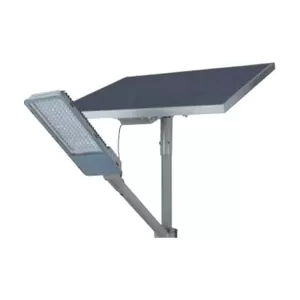
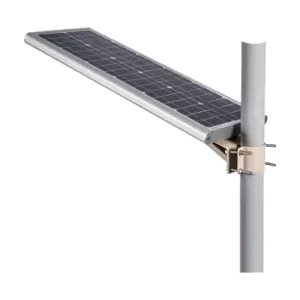
A 50 W solar light needs roughly 1.7 times the battery and nearly twice the panel. That is why solar schemes often accept closer spacing with smaller lights. Our split solar street light SL4830G pairs a 30 W light with a 90 Wp panel and a 50 W light with 160 Wp, with lead-acid batteries; our all-in-one SL series offers a 30 W model with a 45 Wp panel and 18 Ah lithium battery for shorter running hours with motion dimming.
Beware of label watts
Many low-cost “50 W” solar street lights carry far less panel and battery than these numbers. A real 50 W all-night light cannot run from a 20 Wp panel. Check panel Wp and battery Wh, not the label. Our commercial vs cheap solar street lights article explains how to compare.
Quick decision guide
- Lane up to 5 m, 5–6 m poles: 30 W
- Residential street 6–7 m, 7–8 m poles, P2: 50 W
- Quiet road, P3 or P4, budget for close spacing: 30 W
- Solar with limited sun: 30 W at closer spacing, or 50 W with dimming and motion sensing
What to send us
Road width, pole height and the spacing you want (or existing poles), the lighting class or target lux, and whether the lights are grid or solar. We will reply with the size from our calculator and the panel and battery if solar.
Sources
Frequently asked questions
How many lumens is a 30 W LED street light?
At 90 lm/W, about 2,700 lm; at 110 lm/W about 3,300 lm. Compare tested luminaire lumens rather than LED chip figures.
What pole height suits a 30 W or 50 W street light?
30 W suits 5–6 m poles on lanes and estate roads; 50 W suits 6–8 m poles on residential streets up to about 7 m wide. Our LDZ30J is designed for 3–8 m single-arm poles.
Is a 50 W street light enough for a main road?
Usually not. Main roads with M3 or higher classes need 80–150 W on 8–12 m poles. 50 W is a residential and access-road size.
How much does it cost to run a 30 W vs 50 W street light?
At 12 hours a night, 30 W uses about 131 kWh a year and 50 W about 219 kWh. At 0.15 per kWh that is about 20 and 33 a year.