Commercial Solar Street Lights vs Cheap Online Solar Lights: What the ‘300 W’ Label Hides
Why a cheap '300 W' solar street light cannot light a road all night: battery watt-hours, real LED power, panel size and lumens, and what to specify for a commercial project.
Key points
- Wattage labels on cheap solar lights are often 'equivalent' or peak figures; the energy stored and collected tells the real story.
- A typical cheap light with a 3.2 V, 30 Ah battery stores about 96 Wh, less than a third of what a 40 W road light uses in one night.
- In our calculator, a light drawing 20 W on a normal schedule cannot be refilled by a 30 Wp panel even on sunny days.
- For roads, specify LED power, luminaire lumens, battery Wh, panel Wp, autonomy and a photometric layout.
Online marketplaces are full of solar street lights labelled 300 W, 500 W, even 1000 W, for less than the price of a single commercial LED street light. They are fine for a garden or a farm gate. On a road they disappoint: dim after the first hours, dark after a cloudy day. The reason is not a secret. It is in the numbers on the box, once you know which numbers to read.
The label vs the physics
A solar light can only use the energy it collects and stores. Three figures decide that:
- Battery energy in Wh = battery voltage × amp-hours
- Panel energy per day ≈ panel Wp × sun hours × about 0.7 (losses)
- Energy used per night = LED power × hours at each level ÷ driver efficiency
A “300 W” light that really drew 300 W would need several kilowatt-hours of battery and a panel the size of a door. If the box shows a panel the size of a laptop and a battery the size of a book, the 300 W cannot be the power it draws.
A typical cheap light, checked
A common low-cost all-in-one light lists: “300 W”, 30 Wp panel, 3.2 V 30 Ah LiFePO4 battery. Assume it really draws about 20 W, and runs a normal road schedule of 4 hours at full power then 8 hours at 30%. Our battery autonomy calculator gives:
- Usable battery energy: about 86 Wh (3.2 V × 30 Ah × 90%)
- Energy needed per night: about 142 Wh
- Panel energy on a sunny day at 4.5 sun hours: about 97 Wh
- Result: the battery runs out before morning, and the panel cannot refill it even on sunny days
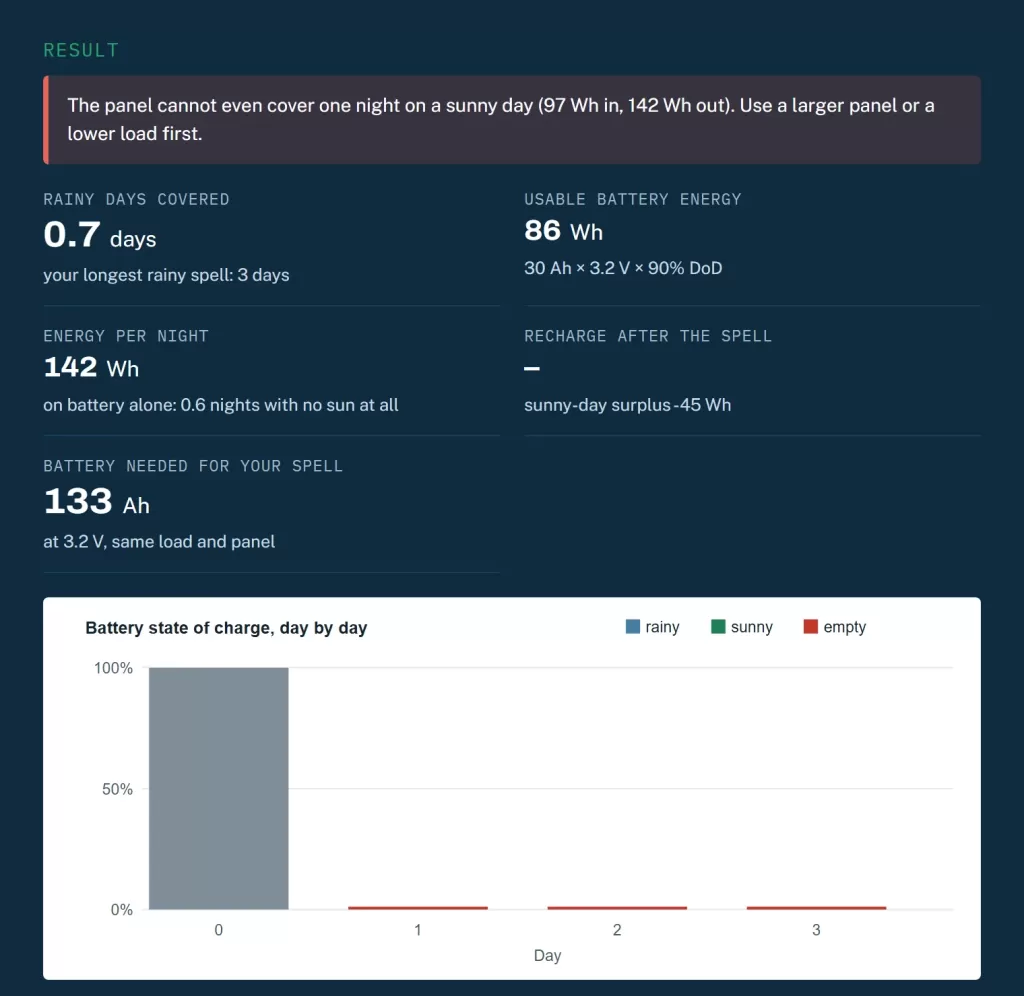
Open this example. In practice such lights cope by dimming themselves heavily or running only on motion, which is why they look bright for the first hour and then fade.
For comparison, a typical commercial 40 W road light with a 12.8 V 100 Ah LiFePO4 battery (1,152 Wh usable) and a 150 Wp panel covers the same type of schedule with 4.7 rainy days of reserve and refills in about 4 sunny days.
What else separates commercial lights
| Typical low-cost online light | Commercial solar street light | |
|---|---|---|
| Wattage | “Equivalent” or peak figure | Real LED power, measured |
| Light output | Rarely stated in tested lumens | Luminaire lumens from a test report |
| Optics | Wide, round pattern | Road optic (Type II/III), photometric file |
| Battery | Small, low-voltage pack; Wh rarely stated | LiFePO4 with BMS, Wh stated, sized for autonomy |
| Panel | Small, fixed on the housing | Sized for the worst month, tilted for the site |
| Controller | Basic, often PWM | MPPT, programmable schedule, low-battery dimming |
| Housing | Plastic or thin aluminium | Die-cast or extruded aluminium, IP65+ |
| Pole and bracket | Not included or light duty | Galvanised pole designed for the wind speed |
| Sizing | One size for every site | Calculated for your location |
| Warranty | Short, informal | Written, with battery terms |
Lumens, not watts
Road lighting is specified in light on the road (lux or luminance), not watts. Ask for the luminaire’s tested lumens and a photometric calculation for your road. A 40 W light with a good road optic at 130 lm/W puts more light on the road than a “300 W” light with a round pattern and no test data. See how many watts LED street light you need for how lumens, pole height and spacing fit together.
Where cheap lights are fine
Low-cost solar lights have their place:
- Garden paths, driveways, farm gates and yards
- Temporary lighting on building sites
- Places where a few hours of light after dusk is enough
- Private use where nobody depends on the light all night
For public roads, estates, car parks and any project with a lighting standard, a budget and an owner who will be blamed when the lights go dark, they are the wrong tool.
What to put in a commercial specification
- LED power and luminaire lumens, with test reports
- Lighting class or target lux and a photometric layout
- Battery chemistry, voltage, Ah and usable Wh
- Panel Wp and the worst-month sun hours used to size it
- Schedule (hours at each level) and autonomy (nights without sun)
- Recovery time after a rainy spell
- Controller type and settings
- Pole and foundation design for the wind speed
- Warranty for luminaire, battery, panel and controller
A supplier who answers all nine points with numbers, rather than a headline wattage, is offering a light that can be checked before it is installed. That check costs an hour; replacing lights that go dark after a cloudy night costs the whole project.
Our solar street light technical specification template covers all of this in a form you can paste into a tender. Size a light for your site with the solar street light calculator, or send us the location and road, and we will size and quote complete sets from our solar street lights.
Sources
Frequently asked questions
Why is my 300 W solar street light so dim?
Because it almost certainly does not draw 300 W. Many low-cost solar lights quote an 'equivalent' or theoretical wattage. The real limit is the battery and panel: a light with a 30 Wp panel and a 3.2 V, 30 Ah battery can only use around 100 Wh a day, which averages about 8–12 W over a night.
What makes a solar street light commercial grade?
Enough panel and battery to run the specified schedule all night through the worst month and several cloudy days, a LiFePO4 battery with BMS, an MPPT controller, road optics with a photometric file, a housing rated for outdoor use (IP65 or better), a pole designed for the wind, and a written warranty.
How do I check a solar street light's real capacity?
Multiply the battery voltage by its amp-hours to get watt-hours, and compare that with the LED power times the hours it must run each night. Check the panel watts against your site's worst-month sun hours. Our free calculators do both.