Backyard Landscape Lighting: A Layout, Wattage and Running-Cost Plan
Plan backyard landscape lighting zone by zone: paths, trees, patio and boundary, with fixture wattages from our garden range, a total load of 123 W and its yearly running cost.
Key points
- Light a backyard in zones (path, feature trees, patio, boundary) and give each zone its own switch or timer; that matters more than the number of fixtures.
- A typical scheme of six 6 W path lights, three 9 W in-ground uplights and two 30 W spotlights totals 123 W.
- Run five hours a night, that scheme uses about 224 kWh a year, roughly USD 34 at USD 0.15 per kWh; old halogen equivalents would use several times more.
- Use 2700–3000 K for planting and patios, aim uplights away from windows and neighbours, and keep path lights low and shielded.
A well-lit backyard extends the useful hours of the garden and makes paths and steps safe. A badly lit one glares at the neighbours and floods everything with the same flat light. The difference is planning. This guide sets out a zone-by-zone plan, chooses fixtures from our garden range for each zone, adds up the load and works out what it costs to run.
Step 1: divide the yard into zones
| Zone | Purpose | Typical fixture |
|---|---|---|
| Paths and steps | Safe movement | Low bollards or lawn lights, step lights |
| Feature trees and walls | Depth and interest | In-ground uplights, spotlights |
| Patio or deck | Use of the space | Wall lights, downlights, string lights |
| Boundary | Sense of enclosure, security | Uplights on hedges, a floodlight with sensor |
Each zone has its own switching. People often want the patio on until late, the trees on for a few hours, and the paths on whenever someone walks out. Our landscape lighting control systems guide covers timers, photocells and smart controllers. For design inspiration by style, see landscape lighting ideas.
Step 2: choose fixtures for each zone
From our garden range, all on AC 100–240 V with IP65:
| Zone | Fixture | Power used here | Light output |
|---|---|---|---|
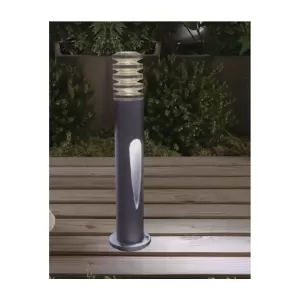
| Path, 6 points | BG-CP lawn light, 0.6 m, 90 lm/W | 6 W each | about 540 lm each |
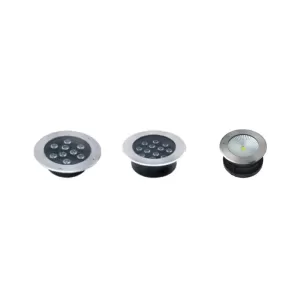
| Trees, 3 points | BG-DMY in-ground uplight, 15°–60° beam, 90 lm/W | 9 W each | about 810 lm each |
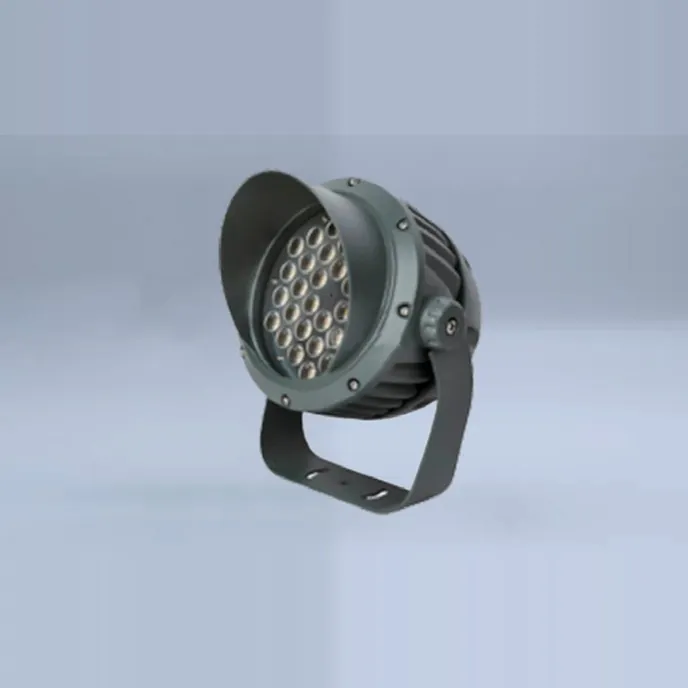
| Large tree or wall, 2 points | BG-TGJ spotlight, 15°–120° beam, 100 lm/W | 30 W each | about 3,000 lm each |
Path lights: place them 3–5 m apart, alternating sides on wider paths, so pools of light meet. Low, shielded fittings light the ground without glare.
Uplights: use a narrow 15° or 25° beam for tall, slim trees and a 60° beam for wide canopies. Place the uplight about a third of the canopy spread away from the trunk.
Spotlights: one or two 30 W spotlights can light a large tree, a wall or a pergola from a distance. Aim them so the source is hidden from the patio. Our landscape spot lights guide covers aiming.
Step 3: add up the load
- path: 6 × 6 W = 36 W;
- uplights: 3 × 9 W = 27 W;
- spotlights: 2 × 30 W = 60 W;
- total: 123 W.
At 230 V this draws about 0.6 A, so one outdoor circuit with RCD protection carries the whole scheme with ample room. Splitting the zones onto separate switched outputs from that circuit is a wiring choice, not a capacity need.
Step 4: running cost
Assume all zones run five hours a night, every night:
- daily energy: 123 W × 5 h = 0.615 kWh;
- yearly: 224 kWh;
- at USD 0.15 per kWh: about USD 34 a year.
With smarter switching, for example paths on a motion sensor and trees off at 10 p.m., the figure drops further.
For comparison, many older gardens lit trees and walls with 300–500 W halogen floodlights. Our LED retrofit savings calculator shows the effect for the two spotlights alone: replacing two 500 W halogen floodlights with 30 W LEDs, five hours a night, cuts use from 1,825 kWh to 110 kWh a year (open the example), a saving of about USD 257 a year.
Step 5: wiring
Mains garden lights need an outdoor circuit installed to local rules, usually by an electrician: buried armoured cable or cable in duct at the required depth, RCD protection and sealed connections at each fixture. Our landscape lighting wiring and wiring garden lights in series guides explain the options. If you prefer a DIY 12 V system, see low voltage landscape lighting.
Light pollution and neighbours
- Aim uplights so the beam does not reach windows, including your own.
- Prefer narrow beams on trees so light stays on the foliage, not the sky.
- Shield path lights so you see the light on the ground, not the source.
- Switch feature lighting off at bedtime.
Common mistakes
- Lighting everything equally. Contrast creates depth; leave some areas dark.
- Too cool a colour. 5000–6000 K makes planting look grey.
- Too few circuits. One switch for everything means everything is on or off.
- Fixtures in the path of the mower. Place lawn lights at the edge of beds, not in the grass.
Maintenance through the year
LED garden fittings need little care, but a short check each spring keeps the scheme looking as designed. Clear leaves and soil from in-ground uplights so water drains and the glass stays clean. Re-aim spotlights and uplights as trees grow; a beam aimed at a young tree may hit only trunk a few years later. Check that path lights still stand upright after mowing and frost, and that seals on fixture bases are intact. Finally, reset timers when the clocks change so lights still come on at dusk.
For installers and developers
If you light many gardens, standardising on a few fixture types and wattages simplifies stock and maintenance. Send us your typical plot layout and the look you want, and we will propose fixtures, beam angles and a load schedule for each zone.
Sources
Frequently asked questions
How do I plan backyard landscape lighting?
Split the yard into zones: paths and steps, feature trees or walls, the patio or deck, and the boundary. Choose a fixture type for each zone, add up the wattage, and put each zone on its own switch, timer or photocell.
How many watts do I need for backyard lighting?
Less than most people expect with LED. A medium backyard is often well lit with 100–150 W in total: low path lights of 3–6 W, uplights of 6–18 W and one or two spotlights of 30 W for large trees or walls.
What colour temperature is best for a backyard?
2700–3000 K for most gardens: it flatters planting, wood and stone and feels relaxed. Cooler 4000 K suits modern architecture or security areas.
Should backyard lights be on all night?
Usually not. A timer that switches feature lights off at bedtime saves energy and reduces light spill for neighbours and wildlife. Keep only path or security lights on later, ideally with a motion sensor.