Landscape Spot Lights: Beam Angle, Wattage and Distance for Trees and Features
How to choose landscape spot lights for trees, statues and walls: the light reaching the top of a 6, 10 or 15 m tree from 9–50 W spots at 15°, 25°, 30° and 60°, with beam widths and aiming tips.
Key points
- For feature lighting, beam angle matters as much as watts: halving the beam angle puts about four times as much light on the target.
- By our calculation, a 9 W in-ground uplight with a 15° beam puts about 105 lux on a point 10 m up; with a 60° beam only about 7 lux.
- A 30 W spot with a 25° beam gives about 140 lux at 10 m and 63 lux at 15 m, enough to make a tall tree stand out in a dark garden or park.
- Beam width grows with distance: a 15° beam is only 2.6 m wide at 10 m, so wide canopies need wider beams or two or three lights.
- Use narrow beams for tall, slim subjects, wide beams for low, broad ones, and keep the light source out of sight lines.
A landscape spot light has one job: to put light on one thing, such as a tree, a statue, a column or a sign, and leave the surroundings dark. Done well, it gives a garden or a plaza depth at night. Done badly, it gives a bright patch at the bottom of a tree, a glaring lamp in people’s eyes, or a beam that misses the subject.
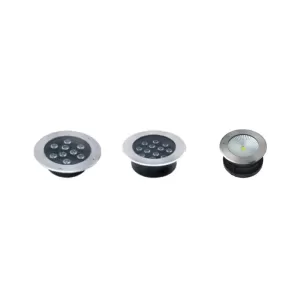
The two choices that matter are the beam angle and the light output. This article shows how they work together, with numbers for our spot and in-ground lights.
Beam angle first
The beam angle is the width of the cone of light. The same lumens spread over a narrower cone give much more light on the target. The area of the light patch grows with the square of the beam width, so going from 30° to 15° puts roughly four times as much light on the same spot.
Beam width at the subject is easy to work out: width ≈ 2 × distance × tan(half the beam angle).
| Beam | Width at 3 m | at 6 m | at 10 m | at 15 m |
|---|---|---|---|---|
| 15° | 0.8 m | 1.6 m | 2.6 m | 3.9 m |
| 25° | 1.3 m | 2.7 m | 4.4 m | 6.7 m |
| 30° | 1.6 m | 3.2 m | 5.4 m | 8.0 m |
| 60° | 3.5 m | 6.9 m | 11.5 m | 17.3 m |
A 15° beam aimed up a 10 m palm covers the trunk and the base of the crown. The same beam on a broad 10 m oak lights a stripe up the middle. That is why big canopies usually get two or three lights.
How much light reaches the subject
We calculated the light at the centre of the beam for four of our fittings: the 9 W and 18 W versions of our in-ground uplight (90 lm/W, 15°/25°/60° optics), and the 30 W and 50 W versions of our landscape spotlight (100 lm/W, 15°–120°). We assumed 70% of the lumens fall inside the stated beam angle, a reasonable figure for a reflector or lens optic, and used the inverse-square law.
Light at the centre of the beam (lux):
| Fitting | Beam | 3 m | 6 m | 10 m | 15 m |
|---|---|---|---|---|---|
| 9 W uplight | 15° | 1,170 | 290 | 105 | 47 |
| 9 W uplight | 25° | 420 | 106 | 38 | 17 |
| 9 W uplight | 60° | 75 | 19 | 7 | 3 |
| 18 W uplight | 25° | 850 | 210 | 76 | 34 |
| 30 W spot | 15° | 4,340 | 1,090 | 390 | 174 |
| 30 W spot | 25° | 1,570 | 390 | 141 | 63 |
| 30 W spot | 60° | 280 | 69 | 25 | 11 |
| 50 W spot | 25° | 2,610 | 650 | 235 | 104 |
| 50 W spot | 30° | 1,820 | 450 | 163 | 73 |
These are centre-beam values. The edge of the beam gets about half. Real fittings vary with the optic, so check the manufacturer’s candela figure or photometric file for a final design.
How bright should a tree or statue be?
There is no single standard for feature lighting; it depends on what surrounds it. As a starting point:
- Dark rural or suburban garden: 20–50 lux on the subject is clearly visible.
- Lit residential street or hotel garden: 50–100 lux.
- City square, lit facade nearby, or a landmark: 100–300 lux or more.
What matters is contrast. A tree at 50 lux in a dark garden looks brighter than a tree at 150 lux next to a floodlit car park.
Matching fittings to subjects
From the tables, some practical pairings:
| Subject | Suggested light |
|---|---|
| 4–6 m ornamental tree, home garden | 9 W uplight, 15° or 25°, one light |
| 6–10 m palm or slim tree | 9–18 W uplight, 15°, close to the trunk |
| 10 m broad tree, hotel garden | Two or three 18 W uplights at 25°, or 30 W spots at 30° |
| 15 m tree in a park | 30–50 W spot, 25°, two lights from different sides |
| 3 m statue | 9 W, 25°, from 2–3 m away, slightly to one side |
| Flagpole or column, 10–12 m | 9–18 W, 15°, at the base |
| Low hedge or wall, 10 m long | Several wide 60° lights, 2–3 m apart |
Placement and aiming
- Grazing: a narrow beam close to the trunk or wall brings out bark and texture.
- Front lighting: a wider beam from 2–3 m away shows the shape of the canopy.
- Two directions: two lights from different angles avoid a flat, one-sided look and reduce hard shadows.
- Back lighting: a light behind a shrub or screen gives a silhouette against a lit wall.
- Hide the source. Set uplights flush in the ground or behind low planting, and aim spots so they cannot be seen from paths, windows or the road.
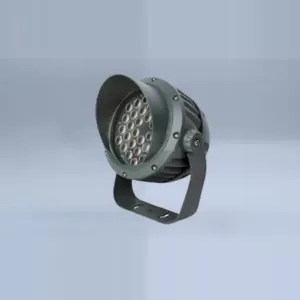
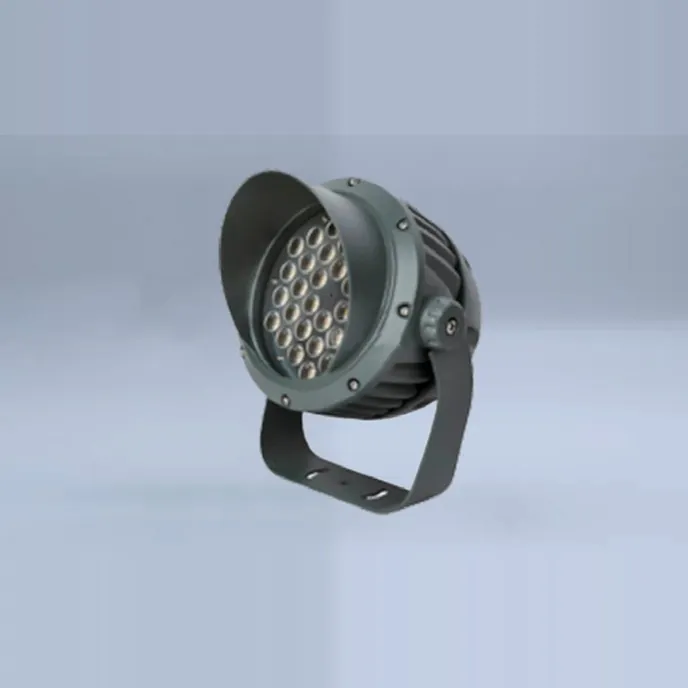
Our spotlight’s bracket has an angle scale, which helps when a site has dozens of lights to aim consistently. Our guide to LED flood light beam angles explains how beam angle is measured, and the article on landscape lighting ideas shows different effects.
Glare and spill
Light that misses the tree goes into the sky or into neighbours’ windows. To keep it on the subject:
- choose the narrowest beam that covers the subject;
- aim uplights so the beam stays within the canopy, not past it into the sky;
- use glare shields or snoots on spots near paths;
- turn feature lights off or down late at night with a timer.
Colour temperature
Warm white (2700–3000 K) suits most planting, stone and brick. Cooler white (4000 K) makes green leaves look fresher and suits modern architecture. Mixing colour temperatures in one garden usually looks untidy; pick one and keep to it.
Mains, low voltage or solar?
Home gardens often use 12 V spots on a transformer, which are safe to install and move. Parks, hotels and public spaces usually use mains-powered fittings with higher wattage and stronger housings. Solar spot lights work for small accent lights, but a solar panel the size of a hand cannot run a 30 W spot all evening. Our landscape lighting plan article explains how to lay out cable runs and circuits.
For landscape designers and contractors
Send us the subject heights, the distances from the lights and the effect you want, and we will pick beam angles and wattages from our in-ground and spot ranges and check the centre-beam values. For large sites, ask for the photometric files of the chosen fittings so the design can be checked in lighting software before ordering.
Sources
Frequently asked questions
What beam angle is best for landscape spot lights?
15° for tall, narrow trees, columns and flagpoles; 25–30° for medium trees and statues; 60° for wide shrubs, hedges and low walls. For a broad canopy, two or three wider lights usually look better than one narrow one.
How many watts do I need for a landscape spotlight?
It depends on the height and the beam. In a dark garden, a 9 W uplight with a narrow beam lights a 6 m tree well; a 15 m tree in a park needs about 30–50 W with a 25° beam to stand out.
How far from a tree should a spotlight be?
For uplighting, place it 0.5–1 m from the trunk for a narrow beam that grazes the bark, or 2–3 m away with a wider beam to light the canopy from the front.
Are landscape spot lights low voltage?
Many residential spots run on 12 V. Commercial spots for parks, hotels and facades usually run on mains power at higher wattages.