
Landscape Lighting Ideas: 12 Techniques for Gardens, Paths and Buildings
Landscape lighting ideas for homes, hotels and parks: uplighting trees, grazing walls, path and step lights, silhouettes, water and facades, with fixtures and beams.
Key points
- Good landscape lighting starts from what should be seen at night, not from the fixtures: pick a few features and light them well.
- Most effects come from six techniques: uplighting, downlighting, grazing, washing, silhouetting and path lighting.
- Beam angle matters as much as watts: 10–25° for tall trees and columns, 30–60° for shrubs and walls, wide for lawns and paths.
- Use one warm colour temperature (2700–3000K) across a garden; save cooler light and colour for special features.
The gardens that look best at night are rarely the ones with the most lights. They have a handful of well-chosen features lit carefully, paths you can walk safely, and dark areas left dark so the lit ones stand out. These ideas work for homes, hotels, office campuses and public parks; the scale changes, not the principles.
Start with a night walk
Before choosing a fixture, walk the site after dark and decide:
- Focal points: a specimen tree, a sculpture, a water feature, the entrance
- Movement routes: paths, steps, drives, bridges
- Views: what is seen from the terrace, the lobby or the road
- Areas to leave dark: neighbours’ windows, wildlife corridors, the sky
Three to five focal points are enough for most gardens. A park or hotel might have twenty, grouped into zones.
1. Uplighting trees
A spotlight at the base of a tree, aimed up into the canopy, is the classic landscape effect.
- Tall, narrow trees and palms: 10–25° beam, one or two fixtures
- Wide canopies: 30–60° beam, two or three fixtures around the trunk
- Distance: 0.5–1.5 m from the trunk; closer for grazing bark, further for the whole canopy
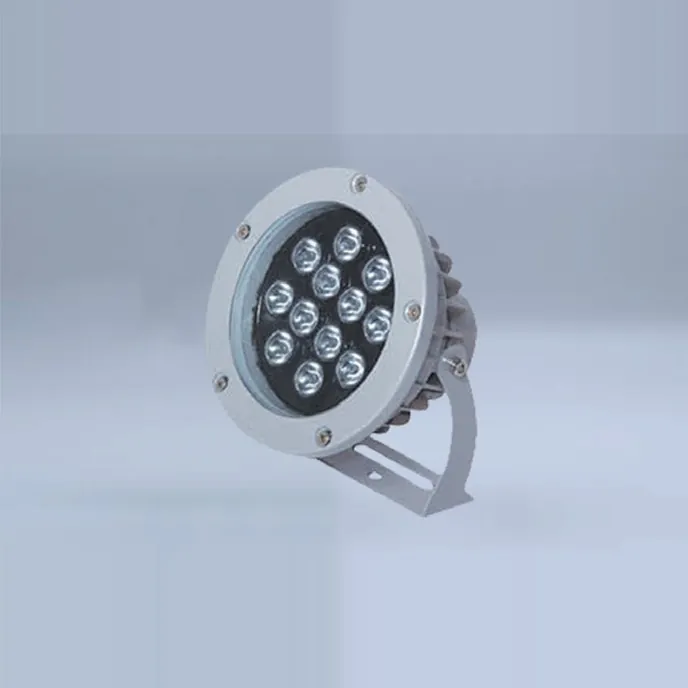
Large trees in parks may need 30–100 W; our landscape spotlights and floodlights come with 15° to 120° optics and an angle scale on the bracket for aiming.
2. In-ground uplights
Where a fixture on a stake would be in the way, such as lawns that are mown, plazas and steps, use a buried uplight. Our in-ground uplights come round or square, 3–36 W, with tempered glass tops. Check drainage under each one; a buried fixture standing in water fails early.
3. Moonlighting (downlighting from trees)
Fixtures mounted high in a tree, aimed down, throw soft light and leaf shadows on the ground, like moonlight. It is one of the most natural-looking effects and lights seating areas without glare. Use wide beams and low wattage, and protect cables from tree growth.
4. Grazing textured walls
A light placed close to a stone wall, brick or bark, aimed along the surface, brings out texture with strong shadows. Keep fixtures 15–30 cm from the wall. For long walls, a linear grazer gives an even line of light.
5. Washing walls and facades
Smooth walls, hedges and building faces look best with an even wash from further away, 0.5–1.5 m back. Linear wall washers are made for this, in white or RGB with DMX control for buildings and bridges that change colour for events.
6. Silhouetting
Light the wall or fence behind a plant, not the plant: its shape stands out dark against a bright background. It suits sculptural plants, cacti and small trees in front of plain walls.
7. Shadowing
The opposite of silhouetting: light the plant from the front, and its shadow falls large on the wall behind. Move the light closer to make the shadow bigger.
8. Path lighting
Paths need light on the ground, not in people’s eyes.
- Low path lights and bollards: about 2–3 m apart for low fittings, 4–6 m for brighter bollards
- Staggered on alternate sides for wide paths
- Shielded so the light goes down
Our lawn and bollard lights come in modern, classical and European designs, 3–30 W, in stainless steel or aluminium.
9. Step lighting
Steps are where people fall. Light every step or every second step with small recessed lights in the riser or side wall, aimed down onto the tread. Keep the light low and even, without glare towards people walking down.
10. Water features
- Underwater lights for fountains and pools need IP68 and a design for continuous immersion
- Light the water from outside for reflective ponds; underwater light makes still ponds look murky
- Moving water catches light best: aim at falls and jets
For the difference between IP65, IP67 and IP68, see our IP rating guide.
11. Post-top lights for larger sites
Parks, estates and campuses need walking light over long paths. Post-top lights at 3–5 m, 12–20 m apart, light the path and help people recognise faces. Our garden post lights come in modern, classical and European styles, with solar versions where cabling is difficult.
12. Accent points and lines
Small point-source lights, strips under benches and handrails, and lines along edges add rhythm and guide people without lighting large areas. Use them sparingly; a few lines read as design, many read as clutter.
Colour temperature and colour
| Use | Suggested CCT |
|---|---|
| Gardens, homes, hotels | 2700–3000K |
| Foliage that should look green | 3000–4000K on that feature only |
| Paths in public parks | 3000K |
| Facades and monuments | Matches the stone: 2700K for warm stone, 4000K for white |
| Events, bridges | RGB / RGBW with control |
Mixing colour temperatures across a garden looks accidental. Pick one and keep it.
Glare and neighbours
- Aim lights away from windows, roads and paths
- Use shields, louvres or recessed fixtures
- Do not over-light: bright gardens look flat and waste energy
- Switch decorative lighting off late at night with a timer, leaving path lights on
Dark-sky guidance is a good checklist: light only what is needed, only when needed, no brighter than needed, with warm light and shielded fixtures.
Mains, low voltage or solar?
- Low voltage (12 V) for homes and small gardens: safe and flexible
- Mains (100–240 V) for parks, hotels and long distances
- Solar for remote paths and places where cabling is too expensive
Planning a project
Send a site plan with the features you want lit, path routes, photos by day and the look you like. We will propose fixtures, beams and circuits for each zone, with mains, low-voltage or solar options as the site allows.
Sources
Frequently asked questions
What is the best lighting for landscaping?
Warm white LED fixtures (2700–3000K) with the right beam for each feature: narrow spotlights for tall trees, wider floods for shrubs and walls, bollards or path lights along walkways and in-ground uplights where fixtures should be hidden.
How do I make my landscape lighting look professional?
Light fewer features but light them well, hide the fixtures, avoid glare towards paths and windows, keep one colour temperature, balance bright and dark areas, and aim each light at night rather than during the day.
How far apart should landscape path lights be?
For low path lights, about 2–3 m apart, staggered on alternate sides for wide paths. Bollards with more output can be 4–6 m apart. Aim for pools of light that just overlap rather than a continuous bright strip.