Linear Facade Lighting: Outlining a Building with 24 V LED Bars
How to plan linear facade lighting: bar lengths and power, how many 24 V supplies a 120 m outline needs, feed cable sizes from a voltage-drop calculation, control, and running cost.
Key points
- Linear facade lights trace edges, eaves, parapets and window frames; they define the shape of a building rather than flooding its walls.
- With 10 W, 1 m bars, a 120 m outline draws 1.2 kW and needs eight 200 W supplies at 80 % load, 16 bars each.
- Voltage drop decides the cable: a 10 m feed carrying 7.4 A at 24 V drops 7.4 % on 1.5 mm² but 2.8 % on 4 mm², by our calculation.
- Running five hours a night, the 1.2 kW outline uses about 2,190 kWh a year.
Linear facade lighting is the line of light along a roof edge, a parapet or a tower’s corners that makes a building recognisable at night. It is cheaper to run than flooding whole walls, works well on glass and modern buildings, and is easy to change in colour. It also has its own engineering problems: low-voltage power, long cable runs and access for maintenance. This guide covers how to lay it out and size the power, using our own linear bar as the example.
Where linear lights go
- Eaves and parapets — the roofline, the most common outline.
- Vertical corners — edges of towers, which give height at night.
- Window frames and bands — repeated lines across floors.
- Signs and canopies — the edge of a billboard or entrance canopy.
Linear outlines are one of four main facade techniques, alongside wall washing, grazing and point-source patterns. Our building facade lighting guide compares them and shows how to combine them.
The fitting
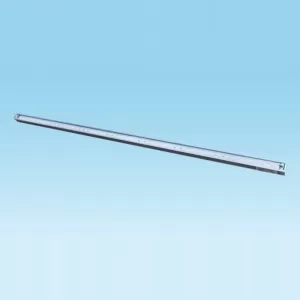
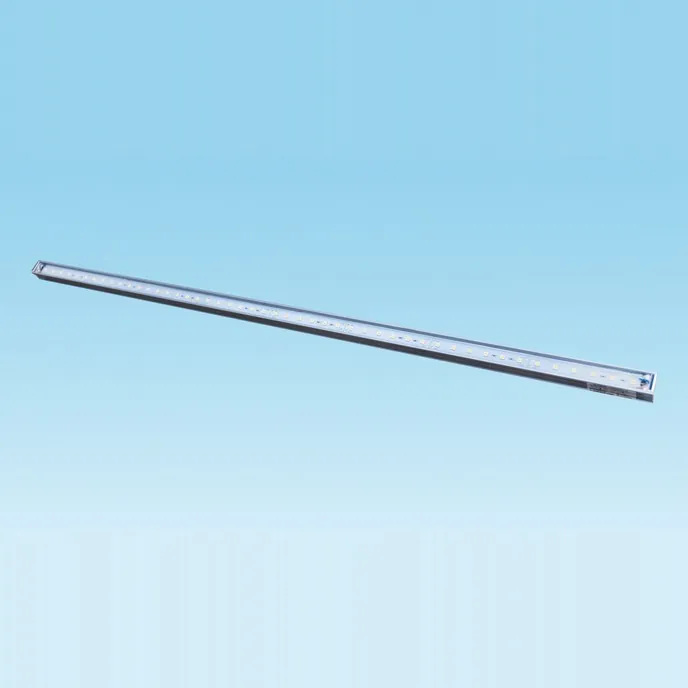
Our BG-XTT linear facade light:
| Model | Power | Length | Current at 24 V |
|---|---|---|---|
| BG-XTT12005 | 5 W | 500 mm | 0.23 A |
| BG-XTT12010 | 10 W | 1000 mm | 0.46 A |
| BG-XTT12012 | 12 W | 1000 mm | 0.56 A |
It runs on DC 24 V, has a 120° beam, 80 lm/W, IP65, an aviation-aluminium body with a PC cover, white from 2700 to 6500 K or RGB/RGBW, and a rated life of 30,000 h. At 10 W per metre, each bar gives about 800 lm.
Worked example: a 120 m outline
A five-storey office building: 30 × 20 m footprint, 100 m of roofline plus four vertical corners of 5 m each at the top floor, 120 m in total. We use the 10 W, 1 m bar throughout.
Power and supplies
- Load: 120 bars × 10 W = 1,200 W.
- Supplies: a 200 W, 24 V supply at 80 % load carries 160 W, or 16 bars. 120 ÷ 16 = 7.5, so eight 200 W supplies, each feeding 15 bars. Four 400 W supplies would also work, with longer runs.
Spread the supplies along the roofline rather than putting them all in one plant room. That keeps each 24 V run short, which matters for the next step.
Feed cable: the voltage-drop check
At 24 V, currents are high and small voltage losses are a large share of the supply. A 15-bar run draws about 15 × 0.46 = 6.9 A; we use 7.4 A (16 bars) as the worst case. For a 10 m feed from the supply to the first bar, the loop length is 20 m. Using the copper conductor resistances in IEC 60228:
| Cable | Resistance per km | Loop resistance (20 m) | Voltage drop at 7.4 A | Share of 24 V |
|---|---|---|---|---|
| 1.5 mm² | 12.1 Ω | 0.242 Ω | 1.79 V | 7.4 % |
| 2.5 mm² | 7.41 Ω | 0.148 Ω | 1.10 V | 4.6 % |
| 4 mm² | 4.61 Ω | 0.092 Ω | 0.68 V | 2.8 % |
The drop continues along the bars themselves, so the far end of a run sees less than the first bar. For white light, a few percent is acceptable; for RGB, a large drop shifts colour at the far end. In this case we would use 4 mm² feeds, or move the supply closer and use 2.5 mm². Feeding long runs from the middle, or from both ends, halves the drop along the bars.
Running cost
Facade lighting is usually switched on at dusk and off around 23:00, about five hours. Our LED retrofit savings calculator uses the same arithmetic: 1.2 kW × 5 h × 365 days = 2,190 kWh a year, about 330 at 0.15 per kWh. Dimming to 50 % for the last two hours, from 21:00, cuts that by about 20 %.
Control
- White only: a time switch or astronomical clock with a photocell is enough.
- Tunable white or RGB/RGBW: a DMX controller, with decoders near the bars. Plan the data cable route with the power route; data runs have their own length limits.
- Scenes: festivals, national days and brand colours are the usual reason for RGB.
Keep the controller and supplies where they can be reached without a crane. Access is the most common oversight on facade projects.
Installation details
- Mounting: fix bars with stainless clips at the spacing the datasheet gives, with a slight downward tilt on eaves so rain runs off the cover.
- Joints: use waterproof connectors and keep joints off horizontal surfaces where water sits.
- Expansion: leave the small gap between bars that aluminium expansion needs on long runs.
- Sealing: IP65 resists jets and rain; for bars that may sit in standing water, choose a higher rating. See IP65 vs IP66 vs IP67.
Light pollution and neighbours
Linear outlines face outward and are visible from far away. Keep brightness modest, avoid aiming bars at windows or the sky, and switch off late at night. CIE 150 gives limits for obtrusive light by environmental zone.
Related lighting
For the walls between the lines, see wall washer downlights and our linear wall washer. For landscape around the building, see commercial-grade landscape lighting.
What to send us
Elevations or photos with dimensions, the lines you want lit, white or colour, and where power is available. We will return a bar layout, the supply count and the feed cable sizes from the calculation above.
Sources
Frequently asked questions
What is linear facade lighting?
Lighting that uses slim LED bars mounted along the edges of a building, such as eaves, parapets, corners and window frames, to draw its outline at night. It is often combined with wall washers or floodlights for the surfaces.
How many power supplies does linear facade lighting need?
Add up the watts and load each supply to about 80 %. With 10 W bars, a 200 W supply takes 16 bars. A 120 m outline of 1 m bars needs about eight 200 W supplies or four 400 W supplies, spread along the building.
What cable size is needed for 24 V facade lights?
It depends on current and distance. In our calculation, a 10 m feed carrying 7.4 A drops 7.4 % on 1.5 mm² copper, 4.6 % on 2.5 mm² and 2.8 % on 4 mm². Keep the drop below about 3–5 % so the far bars do not dim or shift colour.
Can linear facade lights change colour?
Yes. Our BG-XTT comes in white from 2700 to 6500 K and in RGB or RGBW versions, which are controlled by a DMX or similar controller for colour changes and scenes.
How much does linear facade lighting cost to run?
A 1.2 kW outline running from dusk to about 23:00, roughly five hours, uses about 2,190 kWh a year, or about 330 at 0.15 per kWh.