Commercial Grade Landscape Lighting: What Separates It from Residential Kits, with the Numbers
Commercial landscape lighting design in five steps, how to compare commercial metal spotlights, and what makes a fitting commercial grade, with voltage-drop, beam and path-spacing numbers.
Key points
- Commercial-grade landscape lights are built for parks, hotels, campuses and public spaces: die-cast aluminium or stainless housings, tempered glass, IP65–IP68, rated drivers and replaceable parts.
- On a 30 m run, 108 W of fittings on 12 V cable loses about 31% of the voltage; on 24 V about 8%; on 230 V about 0.1%. Large sites therefore run on mains or 24 V.
- Beam angle sets the result: a 30 W, 3,000 lm spotlight 6 m below a tree canopy gives a 1.6 m spot with a 15° beam and a 6.9 m spot with 60°.
- Design a commercial scheme in five steps: zone the site, set light levels, choose techniques, pick the supply, then calculate and aim; for a 4 m path with 4 m posts, our calculator gives 14 m spacing and about 14 lux with 20 W fittings.
- To compare commercial metal spotlights, put power, lumens, beam options, housing material, IP rating, gland, driver and temperature range side by side, not just the wattage.
The difference between a residential landscape kit and commercial-grade landscape lighting is not mainly brightness. It is what happens after five years of rain, sprinklers, lawnmowers, cleaning contractors and every-night operation. A hotel garden, a university campus or a city park cannot replace its fittings each spring, and it needs every light to look the same. This guide explains what to look for, and puts numbers on two decisions that often go wrong: the supply voltage and the beam angle.
Commercial landscape lighting design in five steps
A commercial scheme is designed, not assembled from a kit. A practical process for hotels, campuses and public grounds:
- Zone the site. Split it into areas with different jobs: entrance and drop-off, main paths, car parking, feature planting, building facades, quiet garden areas. Each zone gets its own light level, colour temperature and technique.
- Set light levels. Paths and steps need enough light for safe walking; EN 13201 pedestrian classes run from about 2 lux (P6) to 15 lux (P1) average. Entrances and drop-off areas are brighter; feature planting is about contrast, not lux.
- Choose techniques per feature. Uplight trees and columns, graze textured walls, wash smooth facades, moonlight from high in trees, and use bollards or low posts along paths. The beam angle table below shows how the choice of beam changes the effect.
- Pick the supply. Long runs and many fittings favour mains or 24 V; the voltage-drop table below shows why.
- Calculate, then aim on site. Paths and roads can be calculated; features are set by eye during a night-time aiming visit, with the angles recorded on the as-built drawing.
A path example from our calculator
For a 4 m wide main path lit from one side by BG-TYO45 post-top garden lights on 4 m poles at 100 lm/W, aiming for class P3 (7.5 lux average), our pole spacing calculator gives:
| Fitting | Spacing | Average illuminance |
|---|---|---|
| 20 W | 14 m (capped at 3.5 × height) | about 14.5 lux |
| 30 W | 14 m | about 21.7 lux |
| 40 W | 14 m | about 29.0 lux |
Spacing is limited by the pole height, not the wattage: about 10 W would already reach P3 at 14 m. On a commercial path, 20 W is a sensible choice, giving P1-level light near entrances and room to dim to 50 % late at night. Bigger fittings only add glare.
How to compare commercial metal landscape spotlights
Spotlights from different suppliers often look alike in photographs. Put the data side by side:
| Check | What to ask for | Why it matters |
|---|---|---|
| Output | Watts and measured lumens of the whole fitting | Wattage alone says little; compare lm/W |
| Beam options | Available angles, e.g. 15°, 30°, 60°, 90° | One product family should cover narrow and wide features |
| Housing | Die-cast aluminium or stainless steel, wall thickness, coating | Thin or painted-only housings corrode within a few seasons |
| Lens | Tempered glass, not plastic | Plastic yellows under sun and garden chemicals |
| Ingress | IP65 minimum above ground, IP67 if it can stand in water | Stated on the label, not just in a brochure |
| Cable entry | Gland sized for the cable, silicone gaskets | Most water enters through the cable, not the glass |
| Driver | Supply range (e.g. 100–240 V or 24 V), power factor, surge protection | Long cable runs and lightning cause most driver failures |
| Temperature | Rated ambient range | Fittings in hot climates or sealed in planting beds run hot |
| Mounting | Spike, surface base, adjustable knuckle with locking | Aiming must survive mowers and gardeners |
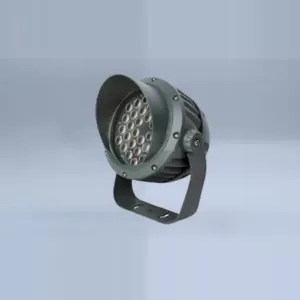
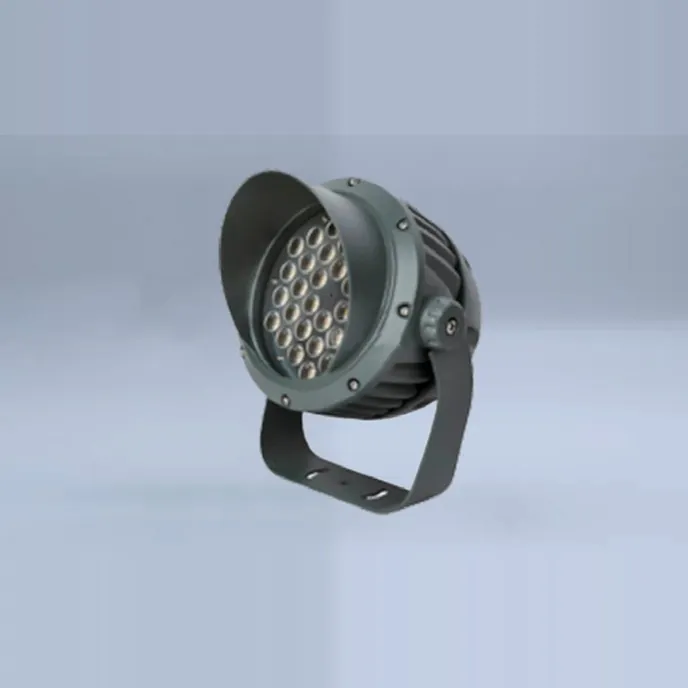
Our BG-TGJ and BG-TGF spotlights publish each of these values, which is what makes a fair comparison possible.
What makes a fitting commercial grade
| Feature | Residential kit | Commercial grade |
|---|---|---|
| Housing | Plastic or thin aluminium | Die-cast aluminium or stainless steel |
| Lens | Plastic | Tempered glass |
| Ingress protection | Often IP44–IP65, sometimes unstated | IP65 above ground, IP67 in-ground, IP68 underwater |
| Supply | 12 V from a plug-in transformer | Mains (100–240 V) or 24 V systems |
| Optics | One beam | Choice of beams, often 15°–120° |
| Data | Brightness claims | Watts, lumens, lm/W, CCT, CRI, beam, IP, temperature range |
| Service | Replace the unit | Replaceable drivers, lenses and gaskets |
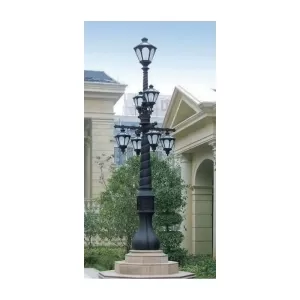
Our garden and landscape range is built to the right-hand column: BG-TGJ and BG-TGF landscape spot and floodlights, 30–200 W, aluminium with tempered glass, IP65, 100 lm/W and beams of 15°, 30°, 60°, 90° and 120°; BG-DMY in-ground uplights, 3–36 W, IP65 with IP67 on request; BG-CP lawn and bollard lights, 3–30 W, stainless steel or aluminium; and BG-TYO45 post-top garden lights, 20–80 W on 2.5–5 m poles.
Supply voltage: the numbers behind the choice
Low-voltage systems are popular because the cable is safe to bury shallow and easy to handle. The trade-off is current. Take 12 fittings of 9 W, 108 W in total, at the end of a 30 m run of 2.5 mm² copper cable (60 m of conductor there and back, about 0.42 Ω):
| Supply | Current | Voltage drop | Drop as % of supply |
|---|---|---|---|
| 12 V | 9.0 A | 3.8 V | 31% |
| 24 V | 4.5 A | 1.9 V | 8% |
| 230 V | 0.47 A | 0.2 V | 0.1% |
At 12 V, the far fittings are starved, and they will be dimmer or flicker. On a residential garden with 10 m runs it works; on a 2-hectare hotel garden it does not, unless the site is split into many small transformer zones. That is why commercial projects usually run on mains, with fittings that accept 100–240 V, or on 24 V with transformers placed close to each group. Our guide to low voltage landscape lighting covers transformer sizing for smaller sites, and landscape lighting wiring explains cable layouts.
Mains outdoor installations must follow the local wiring rules, such as IEC 60364-7-714 for external lighting, including residual-current protection, cable depth and earthing.
Beam angle: the numbers behind the effect
A 30 W BG-TGJ spotlight at 100 lm/W gives about 3,000 lumens. Aimed up into a tree whose canopy is 6 m above the fitting, the beam angle decides what you see:
| Beam | Spot diameter at 6 m | Spot diameter at 10 m | Brightness in the spot at 6 m (upper limit) |
|---|---|---|---|
| 15° | 1.6 m | 2.6 m | about 1,500 lux |
| 30° | 3.2 m | 5.4 m | about 370 lux |
| 60° | 6.9 m | 11.5 m | about 80 lux |
| 90° | 12.0 m | 20.0 m | about 27 lux |
The brightness column assumes all the lumens land in the spot, so real values are lower, but the comparison holds. A narrow beam turns a tall palm or a flagpole into a bright vertical line; a wide beam washes a broad canopy evenly. A 60° beam suits a typical 6–8 m shade tree; a 15° beam suits a column, a tall slim tree or a monument. Using the wrong beam is the most common reason a commercial landscape scheme looks flat or patchy. Our landscape lighting ideas show the techniques in practice.
Durability details that matter on commercial sites
- Sealing. Gaskets in silicone, not foam; cable glands sized for the cable; breather valves on larger fittings to stop condensation.
- In-ground fittings. A drainage layer of gravel below the housing, a glass rated for foot traffic or vehicles where needed, and a surface temperature that will not burn a child’s hand. See our guide to landscape well lights.
- Corrosion. Near the sea and around pools, choose stainless steel or marine-grade coatings, and stainless fixings.
- Vandal resistance. In parks and campuses, bollards with tamper-proof screws and fittings mounted out of reach.
- Heat. Drivers rated for the site’s summer temperatures; our BG-TGJ and BG-TGF spotlights are rated from −30 °C to +50 °C.
Colour consistency
On a commercial site, twenty fittings of slightly different white look worse than ten matching ones. Specify one colour temperature per area (2700–3000 K for gardens, hotels and residential estates; 4000 K for plazas and car parks) and a CRI of 80 or more where people and planting are seen up close. Buy from one batch for each phase, and keep spares from the same batch.
Maintenance planning
Commercial schemes are maintained by contractors who were not there when they were designed. Make their job easy: a drawing showing each fitting, its beam and aiming angle; spare lenses and gaskets; fittings that can be opened without breaking the seal; and a cleaning interval, typically once or twice a year for uplights, which collect leaves and soil. Our landscape lighting repair guide covers the common faults.
A real site
Around the administrative centre of the Xianggang steel group in Xiangtan, thousands of employees walk the paths after their shifts. In December 2025 we replaced the old garden lights there with new LED post-top fittings. See the Xianggang garden light retrofit.
Ordering for projects
Send us the site plan, the features you want lit, the supply available and the look you want. We will propose fittings, beams and colour temperatures, calculate the main areas and quote our garden and landscape lights with matching specifications. For paths and roads within a site, our pole height and spacing calculator gives a first spacing for post-top lights.
Sources
Frequently asked questions
What is commercial grade landscape lighting?
Outdoor lighting built for public and commercial sites, which are lit every night for years and maintained by contractors: metal housings, tempered glass, high ingress protection, quality drivers, defined beam angles and published specifications for every fitting.
Is low voltage landscape lighting suitable for commercial projects?
For small areas, yes, if the cable runs are short. On long runs the voltage drop is large: in our example 108 W on 12 V over 30 m loses about a third of the voltage. Large sites use mains fittings or 24 V systems with several transformers.
What IP rating should commercial landscape lights have?
At least IP65 for fittings above ground, IP67 for in-ground uplights that may stand in water after rain, and IP68 for fittings in ponds and fountains.
How long do commercial landscape lights last?
LED landscape fittings are typically rated for tens of thousands of hours; our garden and lawn lights are rated at 50,000 hours. Real life depends more on sealing, heat and corrosion than on the LED itself.