
Landscape Well Lights and In-Ground Uplights: Placement, Drainage and Beams
How to use landscape well lights and in-ground uplights: where they work best, beam angles for trees and walls, drainage and burial, glare control, IP ratings, and maintenance.
Key points
- Well lights and in-ground uplights sit flush with the ground, lighting trees, walls and columns while staying out of the way of mowers and feet.
- Drainage is the most important detail: a buried light standing in water fails early.
- Choose narrow beams (10–25°) for columns and tall trees, medium (30–40°) for trees and shrubs, wide (60°) for walls.
- Glare is a risk when people walk over or near uplights; use deep-set or louvred versions near paths.
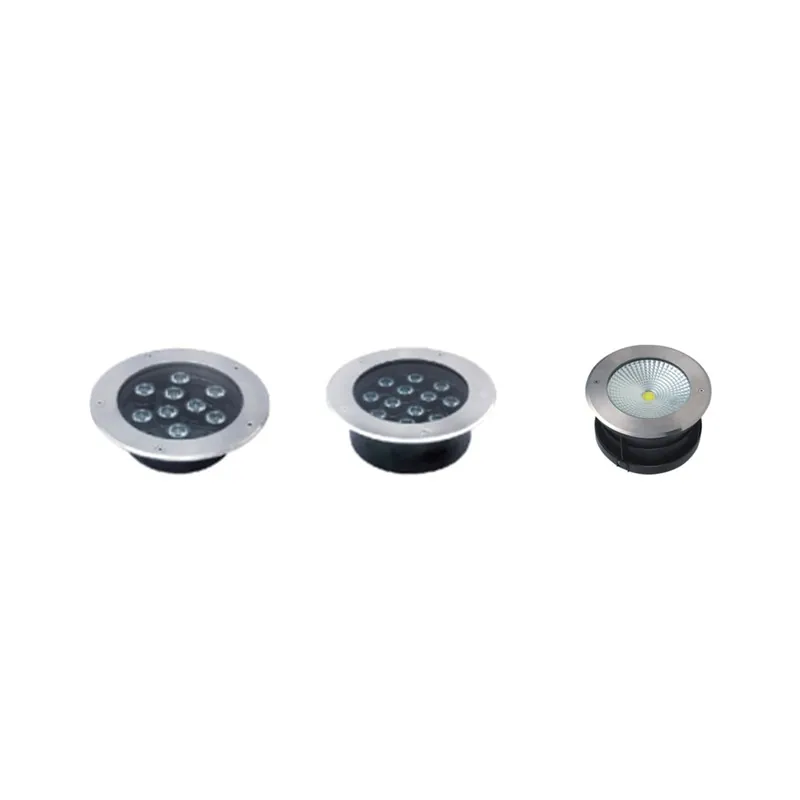
In-ground uplights, often called well lights, put the light source below ground level. The result is clean: trees, walls and columns glow with no fixture in sight, and nothing for mowers or feet to hit. Getting them right depends on choosing the right beam and, above all, on drainage.
Where well lights work best
- Lawns where stake lights would be in the way of mowing
- Plazas and paved areas where people walk
- Tree bases in paved or grassed areas
- Facade bases to graze or wash walls
- Columns and sculptures where a hidden source looks best
- Steps and edges as low-level markers
In planted beds, stake-mounted spotlights are often simpler, easier to re-aim as plants grow, and cheaper.
Beam angles
- 10–15°: tall columns, flagpoles, slender trees
- 25°: medium trees, palms, narrow facade features
- 40°: wider trees, shrubs
- 60°: wall washing, broad canopies
Our in-ground uplights come round or square, 3–36 W, with 15°, 25° and 60° beams and tempered glass tops.
Drainage: the critical detail
Buried lights fail mostly because water collects around them. Good practice:
- Dig deeper than the housing and add 100–200 mm of gravel below it
- In clay soils, add a drainage pipe or soakaway
- Set the top slightly above finished ground so surface water runs off
- Avoid low points in lawns where water ponds
- Use IP67 versions where flooding is possible
- Seal cable glands and use gel-filled connectors in a separate junction box
Our landscape lighting installation guide covers cable burial and connections.
Glare and safety
An uplight under a path shines straight into the eyes of anyone walking over it. Reduce glare by:
- Placing uplights off main walking routes
- Using deep-set optics or honeycomb louvres
- Choosing lower output near paths
- Tilting adjustable optics away from viewpoints
Glass tops get warm with high-power lights; LED keeps temperatures much lower than old halogen well lights, but check surface temperature where children play.
Load ratings
In driveways and areas with vehicles, choose fixtures rated for the load. Light pedestrian-rated fittings can crack under cars. Check the specified load rating before installing in drives and car parks.
Placement around trees
- Place one to three uplights around the trunk, 0.5–1.5 m from it
- Avoid damaging roots when digging; use small housings near large trees
- Aim into the canopy, not past the tree into the sky
- Re-aim as the tree grows
For other tree lighting techniques, see landscape lighting ideas.
Lighting walls and facades
For grazing textured stone, place uplights 15–30 cm from the wall with narrow beams. For washing smooth walls evenly, place them further away (50–100 cm) with wider beams, or use linear wall washers.
Colour temperature
Warm white (2700–3000K) suits most gardens and stone. Neutral white (4000K) can make foliage greener and suits modern buildings. Keep one colour temperature across the site.
Maintenance
- Clean lenses every few months; leaves and soil collect on them
- Trim grass around the edges so it does not shade the light
- Check seals and replace gaskets if moisture appears inside
- Keep the area above clear of mulch
Common mistakes
| Mistake | Result |
|---|---|
| No drainage | Water inside, failure within months |
| Wrong beam | Light misses the feature or spills into sky |
| Uplights in walkways | Glare and complaints |
| Pedestrian-rated fixtures in driveways | Cracked lenses |
| Cable connections underground without sealing | Corrosion |
Solar in-ground lights
Small solar in-ground lights mark edges but cannot power real uplighting; their panels are small and get dirty. For uplighting trees and walls, use mains or low-voltage fixtures.
Planning a scheme with well lights
Start by deciding which features deserve light: a specimen tree, a group of palms, a stone wall, columns at an entrance. Then mark positions on the plan with distances from each feature. Check the ground at each point for roots, pipes and cables before digging, and choose fixture sizes that fit. Plan the cable route to connect all positions to a junction box or transformer, and keep connections above ground in accessible, sealed boxes.
Power and wattage
Small features need only 3–9 W; medium trees 9–18 W; large trees and tall facades 18–36 W, sometimes in pairs. Too much power in an uplight makes the lit feature look flat and causes glare, so start lower and add fixtures if needed.
Low voltage or mains
Low-voltage (12–24 V) well lights are safer in gardens and allow small cables; mains-voltage lights suit large public sites with long cable runs. Both need sealed connections and proper burial depth for the cable.
Lighting palms and tall trees
Palms are among the most popular features to uplight in hotels and resorts. A single narrow-beam uplight at the base lights the trunk, and a second, wider uplight a little further out lights the crown. For very tall palms, use higher power and narrow optics so the light reaches the fronds rather than fading halfway up. Keep fixtures out of irrigation spray where possible, and check after storms that fronds have not covered the lens.
Combining with other fixtures
In-ground uplights work well with other landscape lights: bollards along paths, spotlights in planted beds and wall washers on buildings. Keep colour temperature consistent across all of them, and balance brightness so no single feature overwhelms the rest of the scheme.
Ordering
Send the site plan with features to light, surface types and whether vehicles pass over the area. We will propose in-ground uplights with suitable beams, power and load ratings.
Sources
Frequently asked questions
What is a landscape well light?
A light installed in a housing (the 'well') buried in the ground, with only its lens at ground level. It shines upward to light trees, walls or features without a visible fixture above ground.
How do you stop in-ground lights from filling with water?
Install them on a bed of gravel with good drainage, set the top slightly above the finished ground, avoid low spots where water collects, use IP67-rated fixtures where flooding is possible, and seal cable entries properly.
Are in-ground lights better than spotlights?
They are better where fixtures must be hidden or where mowers and people pass, such as lawns and plazas. Spotlights on stakes are easier to aim and maintain and usually cheaper, so they suit planted beds.