LED Flood Light Beam Angle: How to Choose 25°, 40°, 60°, 90° or 120°, With Spot Size Tables
How beam angle decides where a floodlight's light lands: spot diameter and rough lux at 10, 20 and 30 m for 25°–90° beams, which angle suits which job, and mistakes to avoid.
Key points
- Beam angle is measured where intensity falls to half of the peak; it sets the size of the lit patch, not the total light.
- Spot diameter = 2 × distance × tan(beam angle ÷ 2). At 20 m, a 25° beam lights a patch about 9 m across and a 90° beam about 40 m.
- The same 1,000 W floodlight gives roughly 1,500 lux in a 25° spot at 20 m but only about 70 lux spread over a 90° patch.
- Narrow beams suit long throws from tall masts; wide beams suit short throws onto walls, yards and courts from low poles.
Two floodlights with the same wattage and lumens can give completely different results. One lights a whole yard softly; the other throws a bright, tight patch 30 m away and leaves the rest dark. The difference is the beam angle. Choosing it is the single most important decision after wattage, and the one we see most often got wrong in enquiries. This guide gives the geometry, spot size tables and a simple rule for each type of job.
What beam angle means
A floodlight does not cut off its light sharply. Intensity is highest along the centre line and falls away towards the edges. The beam angle is the full angle between the two directions where intensity has fallen to 50% of the peak. The field angle is the same at 10%.
So a “60° floodlight” puts most of its light inside a 60° cone, with a softer fringe outside it. When floodlights are laid out, their beams should overlap so the fringes fill the gaps.
Spot size at a distance
The lit patch grows with distance. For a round beam aimed straight at a surface:
Spot diameter = 2 × distance × tan(beam angle ÷ 2)
| Beam angle | Spot diameter at 10 m | at 20 m | at 30 m |
|---|---|---|---|
| 25° | 4.4 m | 8.9 m | 13.3 m |
| 40° | 7.3 m | 14.6 m | 21.8 m |
| 60° | 11.5 m | 23.1 m | 34.6 m |
| 90° | 20.0 m | 40.0 m | 60.0 m |
Aimed at an angle, as on a sports field, the patch stretches into an ellipse, longer on the far side. The principle is the same.
How brightness changes with beam angle
Now take a 1,000 W LED floodlight at 130 lm/W, about 130,000 lumens. As a rough estimate, assume about 70% of the light falls inside the beam angle and spread it evenly over the spot:
| Beam angle | Average lux in the spot at 10 m | at 20 m | at 30 m |
|---|---|---|---|
| 25° | about 5,900 | about 1,500 | about 650 |
| 40° | about 2,200 | about 550 | about 240 |
| 60° | about 870 | about 220 | about 100 |
| 90° | about 290 | about 70 | about 30 |
These are not design values; real beams are brighter in the centre than at the edge, and the share inside the beam varies by optic. But the pattern is the point: at 30 m, the 25° version puts about twenty times more light on its patch than the 90° version. Wattage alone tells you nothing about how bright a target will be.
Which angle for which job
| Job | Typical throw | Usual beam |
|---|---|---|
| Wall washing, signs, facades from close by | 1–5 m | 90°–120°, or asymmetric |
| Yards, car parks, loading bays from 6–10 m poles | 6–15 m | 90°–120°, or 120° × 60° |
| Tennis, basketball, five-a-side courts | 8–15 m | Asymmetric, e.g. 140° × 80° |
| Football training pitches from 15–20 m poles | 15–40 m | 40°–60°, mixed |
| Stadiums, ports, high masts of 25–40 m | 30–100 m | 15°–40° |
| Tower cranes lighting the work area below | 20–60 m | 30°–60° |
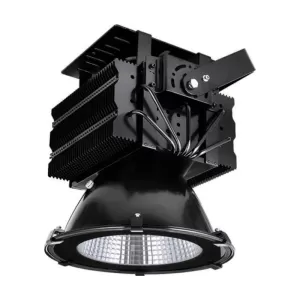
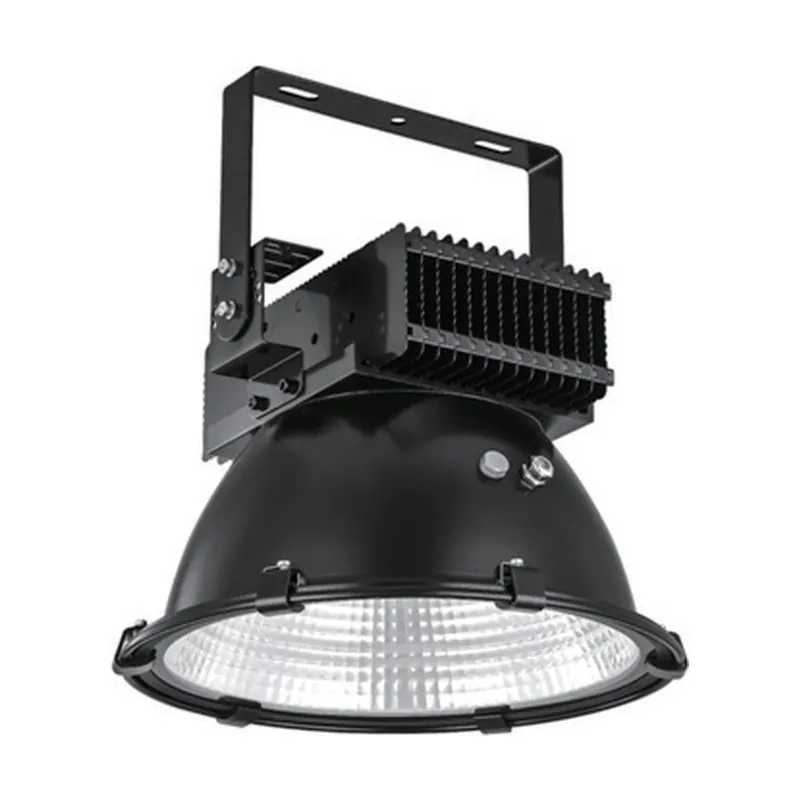
Our heat-pipe LED stadium floodlight comes with 25°, 40°, 60° and 90° reflectors, so one fitting family covers most of a field design. The BG-FZD crane floodlight offers 30°, 70° × 60°, 90° × 60°, 120° × 80° and 155°.
Mixing beam angles
Large areas are rarely lit with one angle. On a football pitch lit from the sides, designers use narrow beams aimed at the far half of the pitch, where the throw is long, and wider beams aimed at the near half. On a high mast, a ring may mix 25° and 40° fittings so the far edge of the yard gets as much light as the area at the foot of the mast. Our high mast flood light system guide shows a worked mast layout.
Common mistakes
- Wide beam from a tall pole. A 120° floodlight on a 20 m mast spills light into the sky and onto neighbours, and the ground gets little of it.
- Narrow beam from a low pole. A 25° floodlight on a 6 m pole makes a bright pool and dark gaps.
- Ignoring glare. Narrow beams are very intense along their axis. Aim them so the axis does not cross roads or windows, and keep the aiming angle below about 70° from vertical where you can.
- Buying by wattage. “200 W flood light” says nothing about whether it will reach the far end of your yard. Ask for the beam angle and, for real projects, a lighting calculation.
If you are still choosing the wattage, see our LED flood light wattage guide, and for brackets and aiming hardware, flood light mounting.
How to specify it
In an enquiry or tender, give:
- The mounting height and the distance to the farthest point to be lit.
- The area size and shape.
- The target lux, or the use (security, loading, sport level).
- Any limits on spill light and glare, such as nearby houses or roads.
With that, we can suggest the beam angles and number of fittings, or you can check them yourself with the tables above.
Summary
Beam angle decides where a floodlight’s light goes. Narrow beams concentrate light on a small, distant patch; wide beams spread it over a near, large one. Use the spot diameter formula to size the patch, choose narrow beams for long throws and wide beams for short ones, and mix angles on big areas so every part of the field gets its share.
Sources
Frequently asked questions
What is the best beam angle for a flood light?
There is no single best angle. For a throw of under about 10 m onto a wall, yard or court, 90°–120° is common. For 15–30 m from poles and masts, 40°–60°. For long throws from high masts or stadium roofs, 15°–30°.
Does a narrower beam make a flood light brighter?
It makes the lit area brighter, because the same lumens are concentrated on a smaller patch. The total light output does not change.
What is the difference between beam angle and field angle?
Beam angle is where intensity drops to 50% of the peak; field angle is where it drops to 10%. Light still falls outside the beam angle, which is why neighbouring beams should overlap.
What does a 120° × 60° beam mean?
It is an asymmetric or elliptical beam: 120° wide in one direction and 60° in the other. These suit roads, long walls and sports courts, where the area is longer than it is wide.