
High Mast Pole with LED Flood Lighting System: How Many Floodlights per Mast?
How to size a high mast LED flood lighting system: floodlights per mast from area and lux, ring layouts, wattage choice, and a real 32 m two-mast steel yard with 18 × 600 W floodlights.
Key points
- Floodlights per mast = target lux × area ÷ (lumens per floodlight × utilisation × maintenance). With UF 0.5 and MF 0.8, a 120 × 100 m yard at 30 lux needs about twelve 600 W floodlights at 130 lm/W.
- Our 32 m steel pipe yard project uses two masts: a full ring of 10 × 600 W and a three-quarter ring of 8 × 600 W, 10.8 kW in total.
- By the same estimate, a full ring of ten 600 W floodlights covers roughly 10,000 m² at 30 lux, a circle of about 58 m radius, or 1.8 times the mast height.
- Fewer, larger floodlights reduce head-frame load and maintenance; more, smaller ones give better uniformity and redundancy. Most yards land at 6–12 per mast.
A high mast is only as good as the floodlights on top of it. The mast, foundation and lowering gear are bought once; the number, wattage and aiming of the floodlights decide whether the yard below is evenly lit, over-lit or patchy. This guide shows how to size the flood lighting system for a mast, using a project of ours as the worked example.
A real example: two 32 m masts in a steel pipe yard
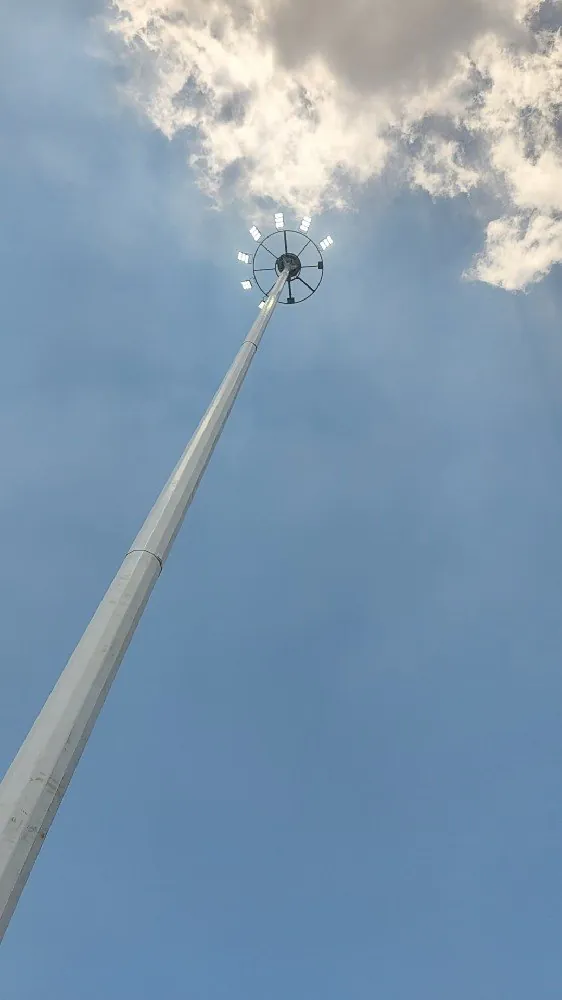
In September 2025 we installed two 32 m high masts in the outdoor yard of a steel pipe plant in Xiangtan. Pipes are stacked, lifted and loaded there at night, so many short poles would have been in the way of cranes and trucks.
| Item | Mast 1 | Mast 2 |
|---|---|---|
| Height | 32 m | 32 m |
| Ring | Full ring | Three-quarter ring |
| Floodlights | 10 × 600 W LED | 8 × 600 W LED |
| Connected load | 6.0 kW | 4.8 kW |
The second mast uses a three-quarter ring because it stands closer to the edge of the yard: there is nothing to light behind it, so two floodlights’ worth of light and power is simply not installed.
The sizing formula
For a first estimate of how many floodlights an area needs, use the lumen method:
N = E × A ÷ (Φ × UF × MF)
- E = target average illuminance (lux)
- A = area (m²)
- Φ = luminous flux per floodlight (lumens) = watts × lm/W
- UF = utilisation factor, the share of light that lands on the area. For floodlights aimed down from a tall mast, about 0.5 is a reasonable planning value
- MF = maintenance factor for dirt and lumen depreciation, about 0.8
The result is a starting point. The final number and aiming angles come from a point-by-point photometric calculation, which checks uniformity, glare and spill over the boundary.
Target lux for typical high mast areas
| Area | Typical average lux |
|---|---|
| Storage yards, slow vehicle movement | 20 |
| Industrial yards with handling, truck parks | 30 |
| Container handling, active loading areas | 50 |
| Large road interchanges | Road class, often 15–30 |
Outdoor workplace values come from EN 12464-2; your client or port authority may set its own. Choose the target first, because doubling the lux doubles the floodlights.
Floodlights needed: worked table
With 130 lm/W floodlights, UF 0.5 and MF 0.8:
| Area | Size | Lux | 400 W units | 600 W units | 1,000 W units |
|---|---|---|---|---|---|
| Truck park | 80 × 60 m (4,800 m²) | 30 | 7 | 5 | 3 |
| Road junction | 40 m radius (5,027 m²) | 30 | 8 | 5 | 3 |
| Port yard | 120 × 100 m (12,000 m²) | 30 | 18 | 12 | 7 |
| Port yard | 120 × 100 m (12,000 m²) | 50 | 29 | 20 | 12 |
| Stockyard | 200 × 80 m (16,000 m²) | 30 | 24 | 16 | 10 |
Turned around, the formula also tells you what a mast covers. A full ring of ten 600 W floodlights is 780,000 lm. At 30 lux:
780,000 × 0.5 × 0.8 ÷ 30 ≈ 10,400 m², a circle of about 58 m radius
That is about 1.8 times the 32 m mast height, which is why the usual rule of thumb says a mast lights a radius of 1.5–2 times its height. In practice the area is not a circle, so the ring is often split into groups aimed at different parts of the yard.
Fewer big floodlights or more small ones?
| Fewer, larger (800–1,500 W) | More, smaller (300–600 W) | |
|---|---|---|
| Head-frame load | Lower, fewer units | Higher |
| Maintenance | Fewer heads to inspect | More heads |
| Uniformity | Harder; each spot covers more | Easier to fill gaps |
| Failure of one unit | Larger dark patch | Small loss |
| Aiming flexibility | Limited | High |
Most industrial yards and junctions end up with 6–12 floodlights per mast of 400–1,000 W each. Ports with very large areas sometimes go higher.
Choosing the floodlight
What matters for a mast floodlight, roughly in order:
- Beam angles. A mix of narrow (25–40°) for the far zone and wider (60–90°) for near the mast gives the best uniformity. A single wide beam lights the base of the mast too brightly and leaves the edge dim.
- Efficacy. At 130 lm/W instead of 100 lm/W, the yard above needs about 23% fewer floodlights or watts.
- Thermal design. Floodlights at 30 m are hard to reach. Heat-pipe cooling keeps the LED junction cool in a compact body.
- Wind and vibration. The head frame swings; brackets and glass must survive it for decades.
- Ingress protection. IP66–IP67, because rain at height is driven sideways.
- Aiming marks. A protractor or scale on the bracket lets the installer set each head to the angle in the calculation.
Our heat-pipe stadium and port floodlights come in 200 W to 1,500 W with 25°, 40°, 60° and 90° beams, IP67, and the port version (BG-TS) is rated above 130 lm/W, the value used in the table.
The rest of the system
A high mast flood lighting system is more than the lights:
- Lowering device. A winch and carriage lower the head frame to the ground for maintenance, so nobody works at 30 m. See our high mast installation guide.
- Head frame. Sized for the number and weight of floodlights, with spare positions if the area may grow.
- Cabling. A trailing cable on the carriage, plus a junction box at the base.
- Control. A photocell or timer, and often two circuits so that half the floodlights can be switched off when the yard is quiet.
- Lightning protection. An air terminal on top and a proper earth at the foundation.
Our high mast lighting guide covers masts, heights and foundations; the airport high mast lighting article shows how apron requirements change the design.
Common mistakes
- Picking a wattage before the area and lux. Start with the target and the formula.
- All floodlights at one angle. It gives a bright pool at the base and dark edges.
- Full rings at the boundary. A three-quarter or half ring stops spill onto neighbours and roads, and saves power.
- No spare capacity. Add one or two spare positions on the head frame; it costs little now.
Send us the site plan, the mast positions you are considering and the target lux, and we will return a photometric layout and a set of high mast lights and floodlights to match.
Sources
Frequently asked questions
How many floodlights go on a high mast?
Usually 4 to 12 for 20–35 m masts, sometimes more on port masts. The number comes from the area, the target lux and the floodlight lumens. Our two 32 m masts in a steel pipe yard carry 10 and 8 floodlights of 600 W.
What wattage floodlight is used on a high mast?
Typically 400–1,000 W LED floodlights at 25–35 m. Larger units mean fewer heads to maintain and less frame load; smaller units give better uniformity and keep part of the area lit if one fails.
How large an area does a high mast light?
As a first estimate, a well-designed mast lights a circle of radius about 1.5 to 2 times its height at typical outdoor working levels. A 32 m mast with ten 600 W floodlights covers roughly 10,000 m² at 30 lux in our estimate.
What is a three-quarter ring high mast?
A mast whose floodlights face only three quarters of the circle, used when the mast stands near the edge of the area or a boundary. Light is not wasted on land or neighbours behind it.
