
High Mast Lighting Winches: Types, Load Rating and How to Specify One
How high mast lowering winches work, single and multi-rope designs, how to work out the ring load and rope tension, motor power and lowering time, and what to write in a winch specification.
Key points
- The winch in the mast base raises and lowers the floodlight ring on two or three wire ropes, so lamps are serviced at ground level instead of at 25–40 m.
- Size the winch on the total ring load: floodlights, brackets, ring, gear and the trailing cable, plus a margin for future upgrades.
- In our example, ten 500 W heat-pipe floodlights (154 kg) on a ring with an assumed 200 kg of ring, brackets and cable give about 354 kg, or 118 kg per rope on a three-rope system.
- Lifting 354 kg at 3 m/min needs under 0.2 kW of mechanical power at an assumed 60 % drive efficiency; real motors are larger to start under load and cover friction.
- A specification should state ring load, rope count and diameter, rope design factor, lifting speed, brake type, motor (fixed or portable) and the torque limiter.
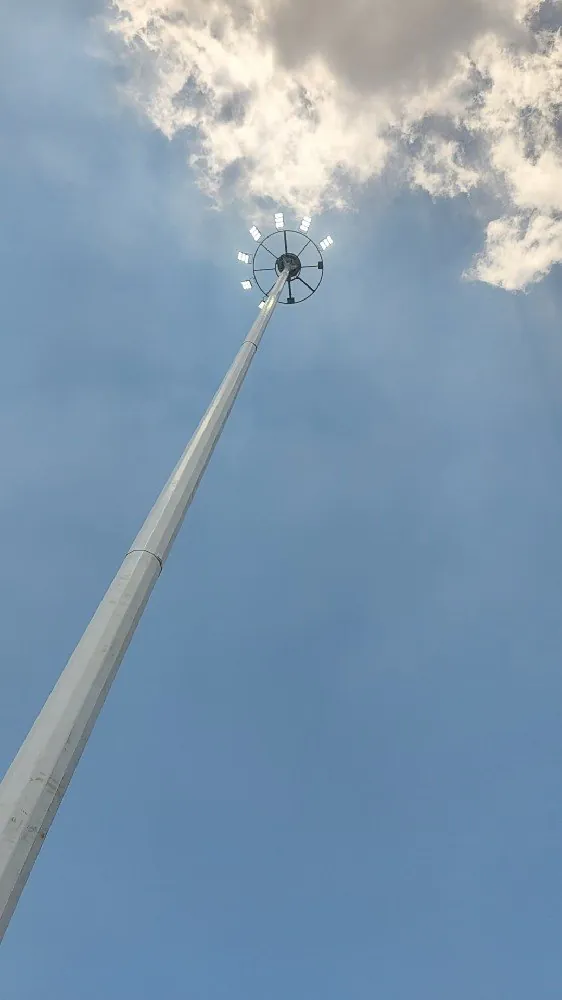
On a 30 m high mast, the floodlights are out of reach of most ladders and many access platforms. The lowering winch is what makes the mast maintainable: it brings the whole ring of floodlights down to a working height near the ground. When a tender says “high mast with lowering system”, it is really specifying a small hoist built into the pole. This guide explains the parts, works out the loads for a real ring configuration, and lists what a winch specification should contain.
The parts of a lowering system
| Part | Location | Function |
|---|---|---|
| Winch (drum, gearbox, brake) | Mast base, behind the service door | Winds the wire ropes |
| Motor | Fixed on the winch, or a portable unit plugged in | Drives the winch |
| Wire ropes (2 or 3) | Inside the shaft, over the head-frame pulleys | Carry the ring |
| Head frame with pulleys | Top of the mast | Turns the ropes down outside the shaft |
| Ring (carriage) | Around the shaft at the top | Carries floodlights and junction boxes |
| Latching / docking | Head frame and ring | Holds the ring at the top so ropes are unloaded in service (on many designs) |
| Trailing cable | From base to ring | Supplies the floodlights while the ring moves |
| Torque limiter and limit switches | Motor and winch | Stop overload and overtravel |
Our high mast lighting guide covers the mast as a whole, and the high mast light maintenance guide lists the yearly inspection of ropes, pulleys and latches.
Winch types
| Design | How it works | Typical use |
|---|---|---|
| Single drum, ropes joined below | One drum winds a single rope that splits into 2–3 ropes via a junction | Light to medium rings |
| Multi-drum or grooved drum | Each rope has its own drum section, wound in step | Medium to heavy rings, better levelling |
| Worm-gear winch | Self-locking gearbox holds the load when stopped | Common; adds safety if the brake slips |
| Spur or planetary gear with brake | Higher efficiency, relies on a mechanical brake | Heavier loads, faster speeds |
Whatever the design, the ring must stay level as it moves. Uneven rope stretch or winding tilts the ring, which can jam it against the shaft.
Worked example: ring load and rope tension
Take a ring of ten 500 W heat-pipe floodlights. From the weights of our heat-pipe stadium and port floodlights, each 500 W unit weighs about 15.4 kg:
- Floodlights: 10 × 15.4 kg = 154 kg
- Ring, brackets, junction boxes and trailing cable: assume 200 kg for this example. The real figure comes from the mast maker’s drawings and varies a lot with ring diameter and material.
- Total ring load: 154 + 200 = 354 kg
- Per rope on a three-rope system: 354 ÷ 3 = 118 kg, about 1.16 kN per rope
Rope selection. Wire ropes for lifting are chosen with a design factor between the minimum breaking load and the working load. A factor of 5 or more is common for hoisting duty; the mast maker’s standard sets the exact value. With a factor of 5, each rope would need a minimum breaking load of at least 5 × 1.16 ≈ 5.8 kN, before allowances for shock loads and rope wear. Stainless ropes of modest diameter meet that easily, which is why rope failures are almost always about corrosion and wear, not original strength.
Future upgrades. If the same ring were later fitted with ten 1,000 W floodlights (32.2 kg each, 322 kg in total), the total would rise to about 522 kg, almost 50 % more. Specify the winch with margin for the heaviest floodlight you might fit, or check the rating before any upgrade.
Motor power and lowering time
Lifting power is weight × lifting speed ÷ efficiency.
- Load: 354 kg × 9.81 m/s² ≈ 3.47 kN
- Lifting speed: assume 3 m/min, i.e. 0.05 m/s
- Mechanical power at the ring: 3.47 kN × 0.05 m/s ≈ 174 W
- With an assumed overall efficiency of 60 % for the gearbox, drum and pulleys: 174 ÷ 0.6 ≈ 290 W at the motor shaft
Real motors are usually larger than this because they must start the load from rest, overcome friction in the shaft guides and cope with cold, stiff grease. But the calculation shows a lowering system is not a heavy electrical load; the supply for a portable motor is easy to arrange.
Lowering time. At 3 m/min, a 32 m mast takes about 11 minutes each way. Over a year of planned maintenance that is a few hours of lowering per mast, which is the real case for LED: fewer lamp failures mean fewer lowerings.
Fixed or portable motor?
| Fixed motor | Portable motor | |
|---|---|---|
| Cost per mast | Higher | Lower, one drive for many masts |
| Theft and vandal risk | Motor stays in the mast | Drive kept in a vehicle or store |
| Speed of response | Immediate | Drive must be brought to site |
| Best for | Isolated masts, frequent lowering | Highways, ports, cities with many masts |
A real configuration
Our 32 m high mast project at a steel pipe plant used two masts: one full ring with 10 × 600 W LED floodlights and one three-quarter ring with 8 × 600 W. A three-quarter ring is lighter and loads the ropes unevenly, so the winch, ropes and ring guides must be checked for that offset load, not just the total weight. Our high mast lighting range is offered with an optional lowering system; we size it to the ring you choose.
What to write in a winch specification
- Total ring load with floodlights, brackets, ring, gear and cable, plus the upgrade margin
- Number and diameter of wire ropes, material (stainless or galvanised) and design factor
- Lifting speed and maximum lowering time
- Brake type (self-locking worm gear and/or mechanical brake)
- Motor: fixed or portable, supply voltage and phase, enclosure rating
- Torque limiter setting and overtravel limit switches
- Latching system at the top, and whether ropes are unloaded in service
- Trailing cable type and how it is guided as the ring moves
- Inspection access: door size, lighting and space to work on the winch
Our high mast lighting survey form collects the site data we need to size the mast and its lowering system.
What to send us
Send the mast height, the floodlights you plan (or the lighting level we should design for), whether you want a fixed or portable drive, and the supply voltage. We will return the ring load, the floodlight layout and the lowering system specification with the quotation.
Sources
Frequently asked questions
What does a winch do on a high mast light?
It raises and lowers the ring carrying the floodlights. Wire ropes run from the winch drum in the base, up through pulleys in the head frame, and down to the ring. Lowering the ring lets the floodlights be cleaned, re-aimed or replaced from the ground.
How much weight can a high mast winch lift?
It depends on the design. The rating must cover the full ring load: floodlights, brackets, the ring itself, gearboxes and cables. As an example, ten 500 W LED floodlights weigh about 154 kg before the ring and brackets, and ten 1,000 W about 322 kg.
Should a high mast have a fixed or portable winch motor?
A portable motor is common when one owner has many masts: one drive unit serves them all, which lowers cost and theft risk. A fixed motor suits isolated masts, sites that lower the ring often, or where carrying a drive unit is impractical.
How long does it take to lower a high mast ring?
At a typical lifting speed of a few metres per minute, a 30 m mast takes about 10 minutes each way. Check the speed in the winch specification.
Do I need a winch on every high mast?
Masts above about 20 m are usually fitted with a lowering system. Shorter semi high masts with a fixed head frame are often serviced from a truck-mounted platform instead.
