
High Mast Light Maintenance: Winch, Motor, Ropes and Floodlights
A high mast maintenance plan: what to inspect on the lowering winch, motor, wire ropes, ring and floodlights, fault-finding, and how LED changes the number of ring lowerings over ten years.
Key points
- A high mast has three systems to maintain: the structure (shaft, base, bolts), the lowering system (winch, motor, ropes, pulleys, ring latching) and the electrical side (cabinet, trailing cable, floodlights).
- Inspect the wire ropes and latching every year: broken wires, kinks and corrosion are the main causes of serious lowering incidents.
- Ring loads vary widely: ten of our 500 W heat-pipe floodlights weigh about 154 kg, ten 1,000 W about 322 kg, before brackets and the ring itself; the winch and ropes must be rated for the actual load.
- With metal halide lamps changed every 2.7–4.6 years at 12 hours a night, a mast needs two or three relamping lowerings in ten years; LED floodlights rated for 50,000 hours need none in that period.
- Keep a log per mast: inspection dates, rope condition, motor current and any faults; it is the best guide to when parts need replacing.
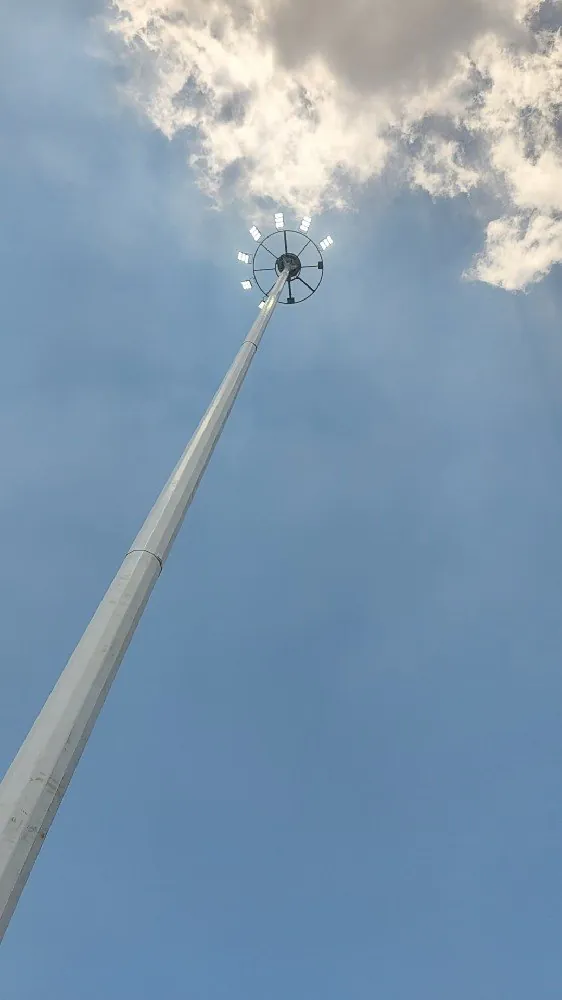
High masts are built to stay up for decades, but they are machines as well as structures. The ring of floodlights rides up and down on wire ropes driven by a winch, and when something fails at 30 m it is expensive and dangerous to put right. A simple, regular maintenance plan prevents most problems.
The three systems
| System | Parts | Main risks |
|---|---|---|
| Structure | Shaft sections, base plate, anchor bolts, foundation, door | Corrosion, loose bolts, impact damage, fatigue cracks |
| Lowering system | Winch, gearbox, motor (often portable), wire ropes, head-frame pulleys, ring, latching or docking | Rope wear, jamming, failed latch, motor faults |
| Electrical | Base cabinet, breakers, surge protection, trailing cable, plug and socket, floodlights | Water ingress, damaged cable, failed drivers, lightning |
The lowering system
Most masts lower the floodlight ring with a winch in the base of the shaft. The motor is either fixed or portable: many owners use one portable drive unit for several masts, plugged into the winch when needed. The ring hangs on two or three stainless wire ropes running over pulleys in the head frame. At the top, the ring docks and latches, so the ropes carry no load in normal use on many designs.
What to inspect every year
- Wire ropes: run the full length past an inspector during lowering. Look for broken wires, kinks, crushing, bird-caging, corrosion and reduction in diameter. ISO 4309 gives discard criteria for wire ropes.
- Rope terminations: swaged fittings and thimbles for cracks and slippage.
- Head-frame pulleys: free rotation, groove wear, guards in place.
- Latching or docking: the ring must lock positively at the top and release cleanly.
- Winch and gearbox: oil level, brake operation, drum condition, rope spooling evenly.
- Motor: insulation resistance, running current under load compared with previous readings, torque limiter setting.
- Ring: straight and level, guide rollers or buffers intact, no corrosion at welds.
Record the motor current at each lowering. A rising current over the years points to a binding pulley, a rope rubbing, or a gearbox wearing.
Ring load
The winch, ropes and motor are rated for a maximum ring load. When floodlights change, the load changes. As an example with our heat-pipe floodlights:
| Heads on the ring | Floodlight weight |
|---|---|
| 8 × 500 W (15.4 kg) | about 123 kg |
| 10 × 400 W (13.2 kg) | about 132 kg |
| 10 × 500 W | about 154 kg |
| 10 × 1,000 W (32.2 kg) | about 322 kg |
Add brackets, the ring, gear boxes and cables. Confirm the total with the mast maker before upgrading.
The structure
- Base and anchor bolts: check nuts for tightness and corrosion; look for cracks in the grout and water collecting around the base plate.
- Shaft: look for rust at section joints, damaged galvanising and impact marks from vehicles.
- Door and gasket: the door keeps water and vandals out of the winch and cabinet.
- After storms: look along the shaft for any lean and check the base.
Our article on high mast pole specifications explains the galvanising and section design, and light pole maintenance covers inspection of smaller poles.
The electrical side
- Base cabinet: dry, clean, no insect nests; breakers labelled; surge protection status indicator checked.
- Trailing cable: the flexible cable that follows the ring up and down is the most stressed electrical part. Look for abrasion, kinks and cracked sheath during every lowering.
- Plugs and sockets on the ring: corrosion and water.
- Earthing: continuity from floodlights to the mast and the earth electrode.
- Floodlights: glass clean, gaskets intact, brackets tight, aiming unchanged.
Lightning is a frequent cause of failures on tall masts. Our article on surge protection for LED street lights explains protection levels; the same principles apply on masts.
Fault-finding
| Symptom | Likely causes | First checks |
|---|---|---|
| Ring will not lower | Motor protection tripped, latch not released, ring jammed | Motor supply and protection; latch mechanism; look up for snagging |
| Ring lowers unevenly | Rope stretched or slipping, pulley seized | Rope length marks; pulley rotation |
| Motor runs, ring does not move | Coupling or gearbox failure | Drive coupling, gearbox |
| Some floodlights off | Driver or lamp failure, connection fault on ring | Lower and test each head |
| All lights off | Supply, breaker, photocell or timer | Base cabinet first |
| Lights flicker | Loose connection, failing driver or lamp | Ring connectors, then floodlights |
Never stand under a ring while it moves, and never try to free a jammed ring by forcing the winch.
Floodlights: metal halide versus LED
On masts with discharge lamps, most lowerings are for relamping. At 12 hours a night (about 4,380 hours a year), lamps rated around 12,000–20,000 hours need changing every 2.7–4.6 years, so a mast needs two or three relamping lowerings in ten years, plus visits for failed ignitors and ballasts.
LED floodlights rated for 50,000 hours run about 11 years at that use. The ring still comes down for the annual inspection, but not for lamps. Our article on high mast light bulbs works through the energy savings of the change.
A maintenance schedule
| Interval | Task |
|---|---|
| Monthly (or with night patrols) | Check all floodlights are working |
| Every 3–6 months | Visual check of base, door, cabinet, shaft from the ground |
| Yearly | Full lowering: ropes, pulleys, latch, winch, motor current, trailing cable, floodlight cleaning and aiming check |
| Every 5 years or per inspection | Detailed structural inspection, anchor bolt torque, corrosion survey |
| After storms or impact | Base, shaft alignment, lowering test |
Our article on high mast installation covers the commissioning tests that make a good baseline for later inspections.
Safety
- Only trained people should operate the lowering system.
- Close off the area under the ring before lowering.
- Isolate the floodlight supply before working on the ring.
- Use the correct portable motor for the winch, with its torque limiter set.
- Keep the log, and replace ropes as a set when any rope reaches discard criteria.
For site owners
Send us the mast heights, number of heads and current floodlights. We will propose LED floodlights within the ring’s rated load, give head weights and power for the electrical check, and help plan the change so it fits into a scheduled lowering.
Sources
Frequently asked questions
How often should a high mast be inspected?
A visual check from the ground every few months, and a full inspection of the lowering system, ropes, structure and electrics at least once a year, plus after severe storms or any impact to the base.
Why will my high mast not lower?
Common causes are a tripped motor protection, a failed motor or gearbox, a jammed or misaligned ring, a latching mechanism that has not released, or a fault in the portable motor connection. Never force the winch; find the cause first.
Do high mast wire ropes need replacing?
Yes, when inspection shows broken wires beyond the discard criteria, kinks, crushing, corrosion or loss of diameter. Many owners also set a maximum age. Ropes are always replaced as a set.
Can high mast floodlights be maintained without lowering the ring?
Only from a suitable mobile elevating platform, where it reaches. Lowering the ring is the normal method and the reason masts have a lowering system.
