
High Mast Light Bulbs: From 1,000 W Metal Halide to LED Floodlights
What lamps old high masts use, why LED floodlights replace them, and the savings for a 10-head 1,000 W metal halide mast changed to 600 W or 500 W LED, by our retrofit calculator.
Key points
- Older high masts carry 400 W or 1,000 W metal halide or high-pressure sodium lamps in reflector floodlights; the modern replacement is a complete LED floodlight on the same ring.
- By our retrofit calculator, a mast with 10 × 1,000 W metal halide (about 1,100 W each with ballast) changed to 10 × 600 W LED saves about 21,900 kWh a year at 12 hours a night: 45%.
- With 500 W LED heads, where the light level allows, the saving is about 26,300 kWh, 55%.
- Our 32 m steel pipe plant project uses 600 W LED floodlights: 10 on a full-ring mast and 8 on a three-quarter ring.
- At 4,380 hours a year, metal halide lamps need changing every few years, each time lowering the ring; LED floodlights rated for 50,000 hours run about 11 years at that use.
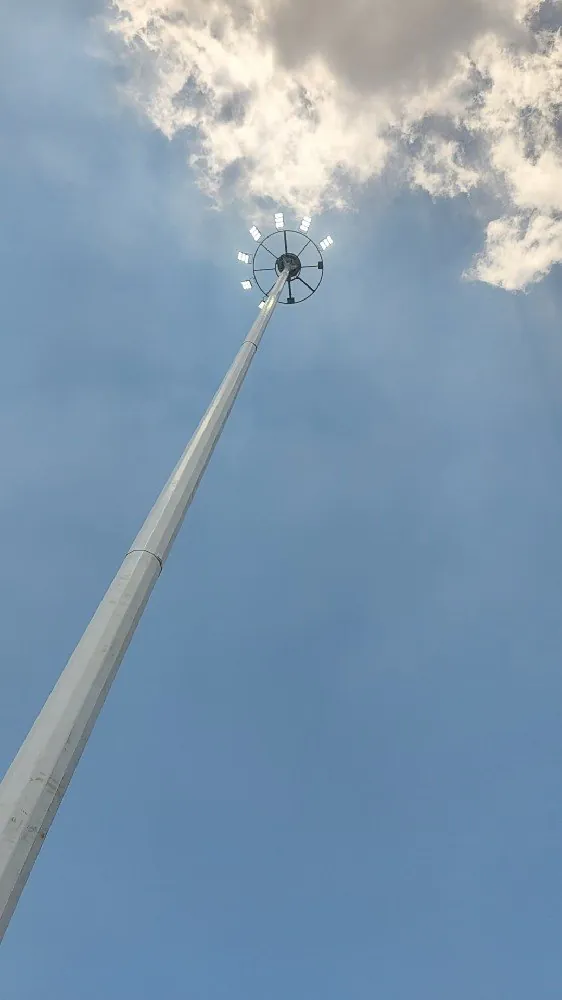
High masts light ports, interchanges, industrial yards and large car parks from 20–40 m up. For decades the light came from big discharge lamps: 400 W or 1,000 W metal halide for white light, or high-pressure sodium for the familiar orange. Owners searching for a “high mast light bulb” today are usually facing the same choice: buy another lamp, or change to LED.
What is on an old high mast
On the ring of a traditional mast, each position has:
- a floodlight housing with a reflector and glass front;
- a metal halide or sodium lamp, usually 400 W or 1,000 W;
- a ballast and ignitor, either in the floodlight or in a gear box on the ring;
- a cable back down the mast to the base cabinet.
With the ballast, a 1,000 W lamp draws about 1,100 W. Ten of them on a ring make an 11 kW load running all night.
Why LED replaces the floodlight, not the bulb
LED retrofit lamps exist for metal halide sockets, but on a high mast they make little sense:
- The reflector was shaped around a small arc. A large LED lamp in it gives an uncontrolled beam, so light that used to reach the far side of the yard is lost.
- The lamp has to dissipate its heat inside a housing built for a discharge lamp.
- The ballast must be bypassed and the wiring changed at every head.
- The ring has to be lowered anyway, so the labour is the same as fitting a new floodlight.
A complete LED floodlight comes with optics designed for long throws. Our heat-pipe stadium and port floodlight offers 25°, 40°, 60° and 90° reflectors, IP67 and over 130 lm/W in the port version.
What the change saves
We used our LED retrofit savings calculator for one mast with 10 floodlights, 12 hours a night, every night, at an example tariff of $0.15/kWh and 0.5 kg CO₂ per kWh:
| Change per mast | Energy before | Energy after | Saved per year | Saving | Value | CO₂ |
|---|---|---|---|---|---|---|
| 10 × 1,000 W MH → 10 × 600 W LED | 48,180 kWh | 26,280 kWh | 21,900 kWh | 45% | about $3,290 | 10.9 t |
| 10 × 1,000 W MH → 10 × 500 W LED | 48,180 kWh | 21,900 kWh | 26,280 kWh | 55% | about $3,940 | 13.1 t |
| 10 × 400 W MH → 10 × 200 W LED | 19,272 kWh | 8,760 kWh | 10,512 kWh | 55% | about $1,580 | 5.3 t |
For a two-mast site with 18 heads, the 1,000 W to 600 W change saves about 39,400 kWh a year, about $5,900 at the same tariff.
These figures count energy only. The lamp changes avoided are often worth as much.
A real configuration
Our 32 m high mast project at a steel pipe plant in Xiangtan uses two masts with 600 W LED floodlights: one full ring with 10 floodlights and one three-quarter ring with 8, installed in September 2025. The yard was lit with LED from the start; the table above shows what the same masts would have used with 1,000 W metal halide heads.
At 130 lm/W, a 600 W LED floodlight gives about 78,000 lumens. Because LED output falls slowly and the beam is better controlled, it can replace a 1,000 W metal halide head on many sites. Where the yard needs less light, 500 W is worth checking.
Maintenance: the hidden cost of bulbs
At 12 hours a night, a mast runs about 4,380 hours a year. Metal halide lamps rated in the range of 12,000–20,000 hours therefore need changing every 2.7–4.6 years, and their light falls well before they fail. Many owners change all lamps on a ring at once to save lowering visits.
Each visit means:
- lowering the ring with the winch, with the area below closed;
- an electrician and often a second person for safety;
- lamps, which for 1,000 W metal halide are not cheap;
- for sodium and metal halide, disposal of mercury-containing lamps.
An LED floodlight rated for 50,000 hours lasts about 11 years at the same use. Our article on high mast installation describes the lowering system and safety steps.
Weight and the lowering winch
Before changing floodlights, check that the ring, winch and ropes are rated for the new heads. Our heat-pipe floodlights weigh 13.2 kg at 400 W, 15.4 kg at 500 W and 28.2 kg at 800 W. Ten 500 W heads weigh about 154 kg. Old metal halide floodlights with integral gear are often heavier, but confirm with the mast maker.
Aiming after the change
Do not copy the old aiming angles blindly. LED beams are tighter and better defined; a new aiming plan based on a photometric calculation uses the light better and cuts glare towards roads and neighbours. Our article on high mast coverage area gives the areas a mast can light at 10, 20 and 50 lux.
Sodium masts
Masts with high-pressure sodium lamps convert the same way. Sodium is more efficient than metal halide, so the energy saving is smaller, but the change from orange to white light improves colour recognition on yards and at ports. Our HPS to LED conversion chart lists typical wattage pairs.
For site owners and contractors
Send us the number of masts, heads per mast, current lamp wattage and the area each mast lights. We will run the retrofit calculation with your tariff and hours, propose LED wattages and beams, and give the head weights for checking the ring and winch.
Sources
Frequently asked questions
What kind of bulb is in a high mast light?
Older masts usually have 400 W or 1,000 W metal halide (white light) or high-pressure sodium (orange light) lamps in floodlight housings on the ring. Newer masts use LED floodlights with built-in LEDs and no separate bulb.
Can I put LED bulbs in my high mast floodlights?
It is possible with some retrofit lamps, but the reflector, cooling and gear were designed for the old lamp, so the beam and lifetime suffer. Replacing the whole floodlight is more reliable, and the ring has to be lowered either way.
What wattage LED replaces a 1,000 W metal halide on a high mast?
Typically 400–600 W of LED at around 130 lm/W, depending on the light level and how far the masts are apart. A photometric check of the site confirms it.
How often do high mast lamps need replacing?
Metal halide and sodium lamps are rated in the low tens of thousands of hours. At 12 hours a night, that means a change every few years, often sooner where output has fallen. LED floodlights rated for 50,000 hours last about 11 years at the same use.
