500W LED Flood Light: Lumens, What It Replaces, Reflector vs Lens, and Where It Fits
500W LED flood light guide: lumens at real efficacies, which metal halide it replaces, reflector vs lens optics, beam angles, sizes and weights, and a worked yard and retrofit example.
Key points
- A 500 W LED flood light at 110 lm/W emits about 55,000 lumens; at 130 lm/W about 65,000. Always compare lumens and beam, not watts.
- It usually replaces a 1000 W metal halide floodlight; in our retrofit calculation, 20 such swaps at 10 hours a day save about 43,800 kWh a year (55%), about $6,570 at $0.15/kWh.
- Reflector floodlights give tight, controlled beams (25°–60°) for long throws from masts; lens floodlights give wide or asymmetric beams for nearer areas.
- Our 500 W heat-pipe floodlight measures 520 × 370 mm and weighs 15.4 kg; the bracket and pole or mast head must be rated for that weight and its wind area.
500 W is where LED floodlights move from “big building light” to “mast and stadium light”. It is a common size for ports, container yards, industrial sites, sports grounds and high masts, and a common replacement for 1000 W metal halide. This guide covers what a 500 W LED floodlight actually delivers, what it replaces, the difference between reflector and lens versions, and how to size a job with it.
Lumens: the number that matters
Watts measure power drawn; lumens measure light. At current efficacies:
| Efficacy | Lumens from 500 W |
|---|---|
| 100 lm/W | 50,000 lm |
| 110 lm/W | 55,000 lm |
| 130 lm/W | 65,000 lm |
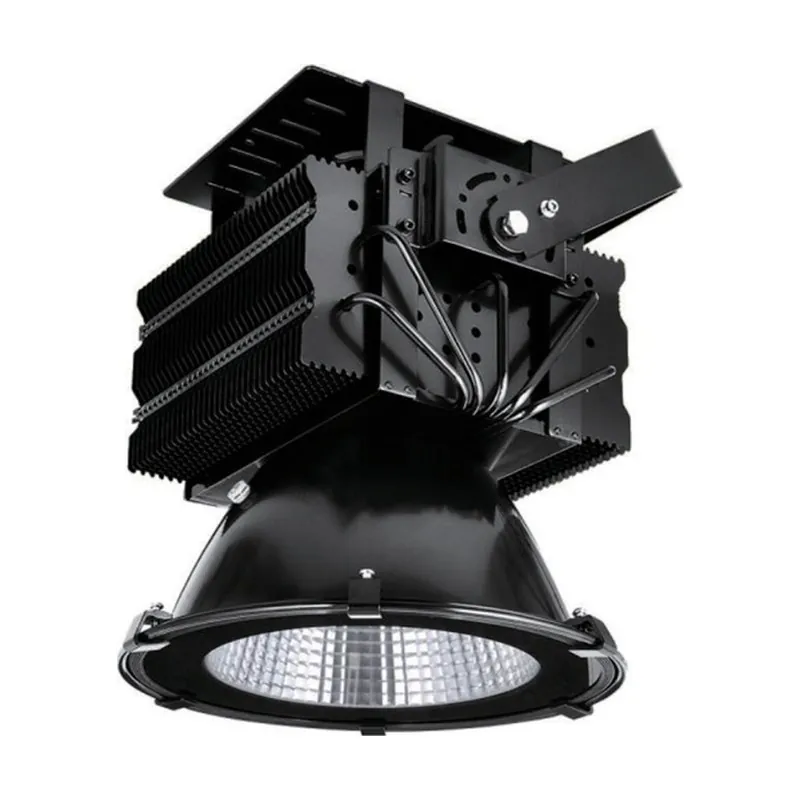
Our heat-pipe stadium and port floodlight at 500 W is rated above 110 lm/W in the stadium version (BG-TZ500H) and above 130 lm/W in the port and apron version (BG-TS500H). The difference between the two is about 10,000 lumens from the same power, a reminder that two “500 W” lights can be very different.
Watch out for wattage labels on low-cost floodlights. Some draw less than half the label power; others reach the label power at 70–80 lm/W. A measured input power and a lumen figure from a test report are the only reliable comparison.
What a 500 W LED floodlight replaces
The usual one-for-one replacement is a 1000 W metal halide or high-pressure sodium floodlight. LED wins back the difference in three ways: no lamp losses inside the reflector, no ballast losses (a 1000 W metal halide fitting draws around 1,080–1,100 W with its ballast), and much slower lumen depreciation. Whether 500 W is enough for a particular swap depends on the beam and aiming, so check it with a calculation, especially on masts.
Our retrofit savings calculator shows the energy side. For 20 floodlights, 1000 W metal halide with 10% ballast losses replaced by 500 W LED, 10 hours a night, $0.15/kWh, and $20 a year less maintenance per fitting:
| Item | Metal halide | LED |
|---|---|---|
| System power per fitting | 1,100 W | 500 W |
| Energy per year (20 fittings) | 80,300 kWh | 36,500 kWh |
| Saving | 43,800 kWh (55%) | |
| Energy cost saving | about $6,570 a year | |
| Maintenance saving | about $360 a year | |
| CO₂ saved (0.5 kg/kWh) | about 21.9 t a year |
(Open this example.) Add your own fitting and installation prices in the calculator to get the payback period.
Reflector or lens?
| Reflector floodlight | Lens floodlight | |
|---|---|---|
| Typical beams | 15°–60° symmetric, tight cut-off | 60°–140°, asymmetric options |
| Best for | Long throws from masts, stadium far side, port yards | Yards, car parks, facades, training pitches |
| Glare control | Good, deep reflector shields the source | Depends on the lens and tilt |
| Efficiency | High for narrow beams | High for wide beams |
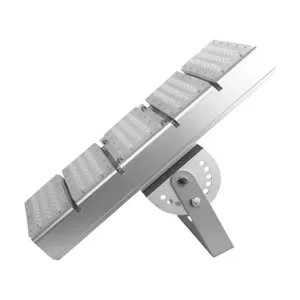
The “reflector flood light 500w” search usually means a mast or stadium fitting with a polished aluminium reflector. Our heat-pipe floodlight offers 25°, 40°, 60° and 90° beams on the same body, so one mast can use narrow beams for the far end and wider ones close in. For wide, low-level areas, a modular lens floodlight such as the TLM30C (50–300 W, 140° × 80°) on more poles is often the better choice than fewer 500 W units.
Size, weight and heat
| Item | 500 W heat-pipe floodlight |
|---|---|
| Size | 520 × 370 mm |
| Weight | 15.4 kg |
| Ingress protection | IP67 |
| Cooling | Copper heat pipes into an aluminium body |
| Wind resistance | Wind-tunnel tested to Beaufort force 17 |
| Operating temperature | −30 °C to +50 °C |
At 15.4 kg and with a face area of about 0.19 m², a 500 W floodlight matters to the structure. A cross-arm with four of them adds over 60 kg and a wind area roughly three times that of a large street light per fitting. Our guide to light pole EPA shows how to add up the wind load.
Worked example: an industrial yard
A 60 × 40 m loading yard (2,400 m²) at 50 lux, using the lumen method with a utilisation factor of 0.5 and a maintenance factor of 0.8:
Lumens = 50 × 2,400 ÷ (0.5 × 0.8) = 300,000 lm
At 55,000 lm per 500 W floodlight, that is 5.5, so six floodlights, for example three on each of two 15 m poles on the long sides. At 100 lux the count doubles to about 11–12, and a high mast in the middle may become simpler than four poles. An 80 × 60 m yard at 30 lux needs about seven.
Our high mast lighting coverage guide explains when one mast beats several poles. For comparison, the 32 m masts we installed at a steel pipe plant in Xiangtan in September 2025 carry 10 and 8 floodlights of 600 W each; see the 32 m high mast project.
Where 500 W fits, and where it does not
| Good fit | Better with another size |
|---|---|
| High masts of 20–30 m | Building facades (too bright, use 50–200 W) |
| Port and container yards | Small car parks (use street lights or 100–200 W floods) |
| Football and multi-sport pitches on 15–20 m poles | Tennis and padel courts (200–300 W per point) |
| Large industrial yards | Full-size stadiums on 35 m+ masts (800–1500 W) |
For the largest sizes, our 1000 W LED stadium light guide covers the step above. For choosing between sizes in general, see our LED flood light wattage guide.
Buying checklist
- Measured input power and lumens from a test report
- Beam angle options and photometric files (IES or LDT)
- Driver brand, surge protection and power factor
- IP rating, operating temperature and corrosion protection for the site
- Weight, size and bracket for the pole or mast head
- Warranty terms in writing
Send us the area, the target lux, the pole or mast positions and the existing fittings. We will return a floodlight schedule with beams and aiming, and the energy comparison.
Sources
Frequently asked questions
How many lumens is a 500W LED flood light?
About 50,000–65,000 lumens for current products, depending on efficacy (100–130 lm/W). Check the datasheet: some cheap fittings labelled 500 W draw much less power or have lower efficacy.
What does a 500W LED flood light replace?
Usually a 1000 W metal halide or high-pressure sodium floodlight. LED puts more of its light where it is aimed and holds its output better, so 500 W LED often matches or exceeds the old fitting in use.
How far does a 500W LED flood light reach?
It depends on the beam, the mounting height and the light level you need. Narrow beams (25°–40°) from tall masts are used for the far parts of a yard or pitch; 60°–90° beams for areas close to the pole. A photometric calculation with the real positions gives the answer for a site.
Is a reflector or lens flood light better?
Reflectors suit narrow beams and long throws with tight cut-off, such as masts and stadiums. Lenses suit wide, asymmetric and medium beams at shorter distances, such as yards, car parks and building fronts.