Typical Flood Light Height: Mounting Heights by Application, With a Spacing Example
Typical flood light mounting heights for homes, car parks, yards, sports fields and high masts, why height sets spacing and glare, and a worked yard example at 8, 10 and 12 m.
Key points
- Typical heights: 2.5–4 m for homes and building entrances, 6–10 m for car parks, 8–15 m for yards and depots, 12–20 m for community sports pitches, and 20–40 m for high masts and ports.
- Mounting height sets the maximum spacing: higher poles mean fewer poles but need more watts each to keep the same lux level.
- For a 20 m wide yard at 20 lux with 200 W floodlights, our calculator gives 28 m spacing at 8 m height, 35 m at 10 m and 41 m at 12 m.
- Aim floodlights so the main beam stays below about 70° from straight down; higher mounting lets you aim more steeply and cuts glare.
The first question in most floodlight enquiries is wattage, but the answer depends on the mounting height. A 200 W floodlight on a 6 m pole and the same fitting on a 12 m pole light the ground very differently. This guide gives typical heights for common applications, explains how height changes spacing and glare, and works through a yard example at three heights.
Typical heights by application
| Application | Typical mounting height | Typical floodlight power |
|---|---|---|
| House wall, driveway, back yard | 2.5–4 m | 20–50 W |
| Building entrance, signage, facade | 3–6 m | 30–100 W |
| Car park, small commercial lot | 6–10 m | 100–200 W |
| Yard, depot, loading area | 8–15 m | 150–300 W |
| Tennis, padel, five-a-side | 6–10 m | 200–400 W |
| Community football or cricket pitch | 12–20 m | 400–1,000 W |
| Professional stadium | 30–50 m (roof or towers) | 1,000–2,000 W |
| High mast for junctions, ports, rail yards | 20–40 m | 400–1,500 W per head |
These are typical ranges, not rules. The site layout, the target lux level and local obtrusive-light limits decide the final height. Our flood light mounting guide covers wall, pole and roof fixing methods.
Why height matters
Three things change as a floodlight goes higher:
- Spacing. A higher fitting spreads its light over a larger area, so poles can be further apart.
- Light level. Illuminance falls with the square of distance. Doubling the height spreads the same lumens over roughly four times the area at the same aiming.
- Glare. A higher fitting can be aimed more steeply downward, so less light goes towards people’s eyes and neighbouring property.
The trade-off is cost: fewer, taller poles with more powerful fittings, or more, shorter poles with smaller fittings. Foundations and wind load rise sharply with pole height. Our article on flood light dimensions gives the projected areas used in the wind-load estimate.
Worked example: a 20 m wide yard at three heights
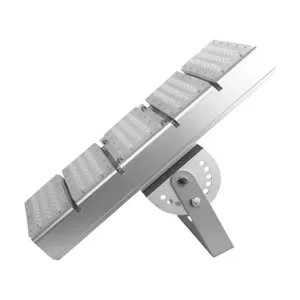
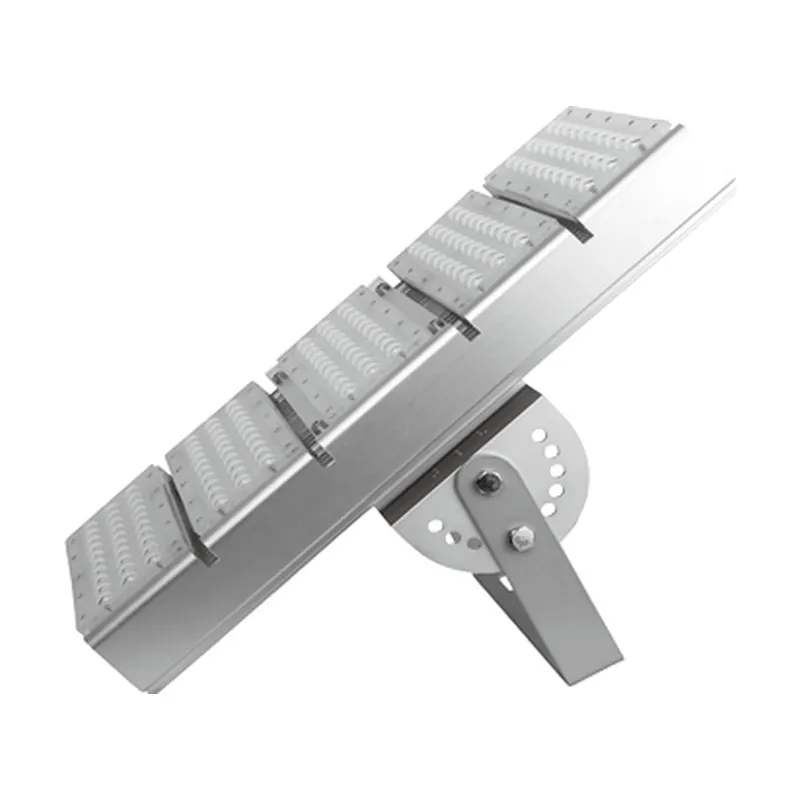
Take a depot road and yard 20 m wide, lit from both sides, with a target of 20 lux average. Using our TLM30C modular floodlight at 200 W and 110 lm/W, our pole height and spacing calculator gives:
| Mounting height | Utilisation factor | Spacing | Average lux at that spacing | Poles per km (both sides) | Power per km |
|---|---|---|---|---|---|
| 8 m | 0.55 | 28 m | about 34 lux | 72 | 14.4 kW |
| 10 m | 0.51 | 35 m | about 25 lux | 58 | 11.6 kW |
| 12 m | 0.47 | 41 m | about 20 lux | 50 | 10.0 kW |
At 8 m, spacing is capped by uniformity (about 3.5 times the height), so the yard is over-lit at 34 lux; the calculator shows about 117 W per fitting would be enough at that spacing. At 12 m the 200 W fitting just reaches 20 lux with 41 m spacing, and the yard needs 22 fewer poles per km than at 8 m.
In practice, 10 m is often the sweet spot for yards: spacing of 35 m, a margin over 20 lux with 200 W, and poles that standard cranes and lifts can reach for maintenance.
Aiming angle and glare
The aiming angle is measured from straight down (nadir). Practical limits:
- Up to about 60°: comfortable, little glare, good for yards and car parks.
- 60–70°: acceptable with good optics and shields.
- Above 70°: strong glare and light spill; usually a sign the pole is too short for the area it must cover.
Where light still reaches homes behind the pole, a shield or a backlight-control optic fixes it; our street light shield guide shows how little road light a shield costs.
A common rule for sports floodlights is that the angle from the centre of the pitch to the floodlight should be at least 25° above horizontal, which sets the minimum height for a given distance from the pitch. Our cricket stadium pole height article works through that rule for a cricket ground.
Homes and small buildings
On houses, the main limits are reach and neighbours:
- 2.5–3 m under eaves is the usual height for motion-sensor floods over doors and driveways.
- Aim down, with the front glass no more than about 30° from horizontal, so the light lands on your property.
- Higher is not always better: a floodlight at 5 m on a gable lights the whole garden but also the neighbour’s windows.
Our motion sensor flood lights guide covers detection range at different heights.
Car parks
Car parks are often lit with area lights or floodlights on 6–10 m poles. Lower poles keep light under tree canopies and reduce spill, but need more poles. Check the target level: 10 to 20 lux is common for open car parks, more at entrances and pay stations.
Sports facilities
Community pitches use 12–20 m poles. Taller poles reduce glare for players looking up at a high ball, which is why football, rugby and cricket grounds use taller poles than tennis courts. Our football floodlights guide gives pole counts and heights for common pitch sizes.
High masts
High masts of 20 to 40 m carry rings of 6 to 12 floodlights and light junctions, ports, container yards and rail sidings. Their advantage is fewer obstructions on the ground; their cost is a large foundation and a winch or lowering system for maintenance.
How to choose your height
- Start from the area width and any limits on pole positions.
- Choose the lowest height that keeps aiming angles below about 60–70°.
- Run the spacing calculation at two or three heights, as in the example.
- Compare total cost: poles, foundations, cable, fittings and energy.
- Check obstructions: trees, cranes, overhead lines and flight paths.
What to send us
- Site plan with the area to be lit
- Target lux level and uniformity
- Possible pole positions and any height limits
- Supply voltage
- Whether poles or only fittings are needed
With these we will run the spacing at several heights and recommend the combination with the lowest total cost.
Sources
Frequently asked questions
What is the typical height for a flood light?
It depends on the use: about 2.5–4 m on a house wall, 6–10 m in a car park, 8–15 m in a yard or depot, 12–20 m for a community sports pitch and 20–40 m on a high mast or at a port.
How high should a security flood light be mounted?
Around 2.5 to 3 m on a house wall is common: high enough to be out of easy reach and to light a driveway, low enough to aim without glare into neighbouring windows. Motion-sensor floods work best in this range.
Does a higher flood light cover more area?
Yes, a higher fitting can be spaced further apart and gives more even light, but the light level falls with the square of distance, so it needs more lumens for the same lux on the ground.
Which floodlight do you recommend for 8–12 m poles?
Our TLM30C modular floodlight (50–300 W, over 110 lm/W, 140° × 80° lens) suits yards and car parks on 8–12 m poles. For sports fields and taller masts, the heat-pipe floodlights go to higher powers.