Cricket Stadium Light Pole Height: The Geometry Behind 40–50 m Masts
Why cricket floodlight masts are so tall: the aiming-angle geometry for a 65–75 m boundary, mast heights for 20°, 25° and 30° angles, and a first estimate of floodlights for 300–750 lux.
Key points
- Mast height is set by the angle from the middle of the field up to the floodlights: the higher that angle, the less glare for batters and fielders looking up at a high ball.
- A mast 80 m from the pitch centre needs to be about 37 m tall for a 25° angle and 46 m for 30°; at 90 m, 42 m and 52 m.
- That is why international cricket grounds, with boundaries of 65–75 m and masts outside the stands, use masts of roughly 40–50 m or more.
- By the lumen method, a 70 m radius oval needs about 11.6 million lumens for 300 lux and 28.9 million for 750 lux, roughly 60 to 150 floodlights of 1,500 W at 130 lm/W.
- The head frame load grows fast: 25 floodlights of our 1,500 W model weigh about 1,050 kg before brackets and gear.
Floodlit cricket grounds are easy to recognise from a distance: four to eight huge masts towering over the stands. They are much taller than the poles around most football pitches, and the reason is geometry. Cricket is played on a large oval, the ball goes high, and players have to look up into the light. The mast height that keeps the floodlights out of their eyes depends on how far the mast stands from the middle of the field.
The aiming-angle idea
Sports lighting guidance uses a simple test: draw a line from the centre of the playing area up to the lowest floodlight on a mast, and measure its angle above the horizontal. The steeper that angle, the less likely a player looking across the field, or up at a high catch, is to stare into a floodlight.
For football, a minimum of about 25° is widely used in guidance, with steeper angles for televised venues. Cricket bodies set their own requirements for international grounds, but the same geometry applies, and the 20–30° range is a sensible starting point for estimating.
The height follows from trigonometry:
mast height ≈ horizontal distance from the centre × tan(angle)
Mast heights by distance and angle
| Distance from pitch centre | 20° | 25° | 30° |
|---|---|---|---|
| 70 m | 25.5 m | 32.6 m | 40.4 m |
| 80 m | 29.1 m | 37.3 m | 46.2 m |
| 90 m | 32.8 m | 42.0 m | 52.0 m |
| 100 m | 36.4 m | 46.6 m | 57.7 m |
(Height above the playing surface to the lowest floodlight row; add the base level if the mast stands on a stand roof or a raised bank.)
International boundaries are typically 65–75 m from the centre of the pitch. With a run-off, a sight-screen zone and stands, masts usually end up 80–100 m from the centre. The table shows why 40–50 m masts are common at large grounds.
Club grounds
A club ground with a 55–65 m boundary and poles just outside it, 60–70 m from the centre, can reach a 20–25° angle with poles of roughly 22–33 m. Many club installations use six or eight poles of 20–30 m around the boundary instead of four tall masts. That spreads the light from more directions, which reduces shadows, at the cost of more foundations and more structures near the fence.
How much light: a first estimate
The lumen method gives the order of magnitude:
lumens needed ≈ target lux × area ÷ (utilisation factor × maintenance factor)
For an oval of 70 m radius (about 15,400 m²), with an assumed utilisation factor of 0.5 for long-throw floodlights from tall masts and a maintenance factor of 0.8, and floodlights at 130 lm/W, which is the rating of the port and stadium version of our heat-pipe floodlight:
| Average horizontal target | Lumens needed | LED load | 1,500 W floodlights | Per mast, 4 masts | Per mast, 6 masts |
|---|---|---|---|---|---|
| 300 lux | 11.6 million | 89 kW | 60 | 15 | 10 |
| 500 lux | 19.2 million | 148 kW | 99 | 25 | 17 |
| 750 lux | 28.9 million | 222 kW | 149 | 38 | 25 |
These are first estimates for horizontal light. Televised cricket is designed for vertical illuminance towards each camera position and needs considerably more, plus a full computer design for uniformity and glare. The pitch square itself is often given extra light.
Why tall masts carry so much
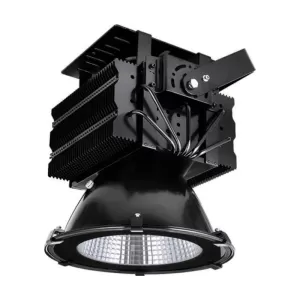
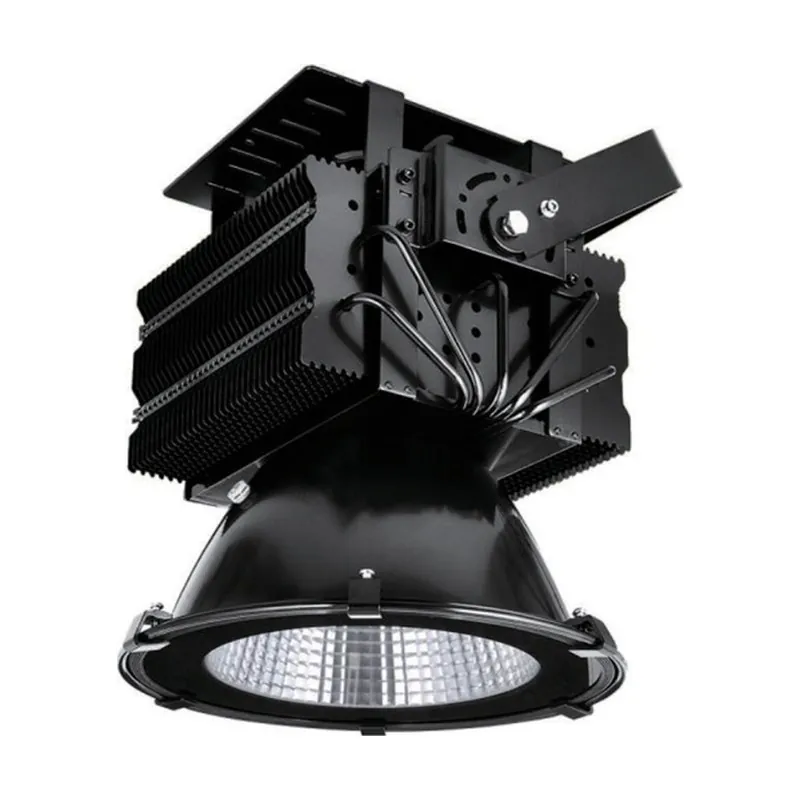
Fewer, taller masts mean more floodlights on each. Our 1,500 W heat-pipe floodlight measures 650 × 630 mm and weighs 41.8 kg:
| Floodlights per mast | Floodlight weight | Approximate frontal area |
|---|---|---|
| 15 | 627 kg | 6.1 m² |
| 25 | 1,045 kg | 10.2 m² |
| 38 | 1,588 kg | 15.6 m² |
Add the head frame, brackets, drivers or control gear and access platform. At 45 m, the wind load on that frontal area dominates the mast design. The structural engineer needs the floodlight count, weights and areas early; changing floodlight choice late can mean redesigning the mast.
Beam angles from tall masts
From 40–50 m, floodlights aimed at the far side of the field need narrow beams to throw the light 100 m or more without spilling into the sky. Floodlights aimed at the near boundary use wider beams. A typical cricket mast mixes:
- narrow beams (around 25°) for the far side and the square;
- medium beams (around 40°) for the middle distance;
- wider beams for the near outfield.
Our floodlight is available with 25°, 40°, 60° and 90° reflectors. Our article on LED flood light beam angles explains how the beam is defined.
Shadows and the high ball
Cricket has a particular problem: fielders track a ball that may climb 30–40 m. A floodlight in the line of sight at the wrong moment can cost a catch. Designers reduce this by:
- keeping masts out of the line between the pitch ends (behind the bowler’s arm), where batters look;
- using enough masts that each fielder sees light from several directions;
- using precise optics and visors to cut stray light near the floodlight face.
Spill and neighbours
Tall masts with narrow beams can control spill well, but a 45 m head is visible from far away. Shielded floodlights aimed below about 70° from vertical, careful aiming, and dimming for practice sessions keep light out of neighbouring homes. Our article on stadium lighting requirements covers spill limits and verification.
Masts versus poles: summary
| Option | Height | Advantages | Drawbacks |
|---|---|---|---|
| 4 tall masts outside the stands | 40–50 m+ | Clear views, few structures | Heavy heads, big foundations, more shadow risk |
| 6–8 poles near the boundary | 20–30 m | Lower poles, better modelling | More foundations, poles near the field |
| Roof-mounted lighting | On stands | No masts | Only where stands surround the field |
For the masts themselves, our high mast lighting guide explains lowering systems and foundations, and the LED stadium lights guide compares wattages.
For consultants and ground owners
Send us the boundary size, the possible mast positions and the level of play. We will work out the heights for your aiming angle, give a first lumen and floodlight estimate, and supply floodlight weights and areas for the structural design, followed by a full photometric design.
Sources
Frequently asked questions
How tall are cricket stadium light poles?
Club grounds often use 20–30 m poles around the boundary. Large stadiums with masts outside the stands are commonly 40–50 m or taller, because the masts are far from the pitch and must keep a steep angle to the playing area.
Why are cricket floodlights higher than football floodlights?
A cricket field is a large oval, so the masts stand much further from the centre than on a football pitch. To keep the same aiming angle, the mast has to be taller in proportion to the distance.
How many lux does a cricket ground need?
Recreational and training play uses a few hundred lux; club competition more; televised international matches need well over 1,000 lux vertical toward cameras. Check the governing body's requirements for the level of play.
Can cricket be lit with four masts?
Many grounds use four, others six or eight. Fewer masts means taller masts and more floodlights on each, and harder shadow control; more masts means lower poles but more structures around the boundary.