Stadium Lighting Requirements: Lux Levels, Uniformity, Glare and Broadcast Standards
Stadium lighting requirements: EN 12193 lux and uniformity for three classes of play, glare and colour limits, what TV adds, and a floodlight count for a pitch.
Key points
- EN 12193 sets three lighting classes for outdoor football: 75 lux for training, 200 lux for club matches and 500 lux for top-level competition.
- Uniformity matters as much as the average: the minimum must be at least 0.5, 0.6 or 0.7 of the average for the three classes.
- Television changes the target from horizontal to vertical light towards the cameras, and adds limits on flicker and colour rendering.
- On a 105 × 68 m pitch the lumen method gives about 12, 30 and 74 floodlights of 1,000 W for 75, 200 and 500 lux.
- The competition's own rule book always comes first; a standard only gives the minimum that designers start from.
A stadium is lit for three groups at once: the players, who must follow a fast ball without glare; the spectators, who must see the far side of the pitch; and, in larger venues, the cameras. The requirements below come from EN 12193, the European sports lighting standard, which is used as a reference in many countries. Leagues and federations publish their own rules on top of it, and those rules always take priority.
The three lighting classes
EN 12193 does not set one value per sport. It sets three classes by level of play.
| Class | Level of play | Typical venue |
|---|---|---|
| I | National and international competition | Large stadium, many spectators at long viewing distances |
| II | Regional and club competition | Club ground with a stand |
| III | Training, school sport, recreation | Training pitch, community ground |
Lux, uniformity, glare and colour for outdoor football
| Requirement | Class I | Class II | Class III |
|---|---|---|---|
| Average horizontal illuminance | 500 lux | 200 lux | 75 lux |
| Uniformity (minimum ÷ average) | 0.7 | 0.6 | 0.5 |
| Glare rating GR, maximum | 50 | 50 | 55 |
| Colour rendering index Ra, minimum | 60 | 60 | 20 |
These are maintained values: the light level at the end of the cleaning interval, not on the first night. Designs therefore start higher, using a maintenance factor of about 0.8.
Other sports have their own tables. Small, fast balls need more light than large, slow ones, so tennis and hockey sit above football at the same class. See our guides to tennis court lighting and basketball court lighting for those.
What the four requirements mean
Illuminance is the light arriving on the grass, in lux. It is measured on a grid of points across the pitch.
Uniformity is the lowest grid value divided by the average. A pitch that averages 200 lux with dark corners at 80 lux has a uniformity of 0.4 and fails Class II, even though the average passes.
Glare rating is calculated from the brightness of the floodlights as seen from set positions on the pitch, on a scale where lower is better. It depends on mounting height and aiming far more than on the fitting. Low poles with floodlights tilted up are the usual cause of failure.
Colour rendering is how naturally colours appear. The standard’s minimum is low, but most new LED installations use Ra 70 or 80, and Ra 90 where cameras are used.
What television adds
Once a match is filmed, the camera becomes the main “viewer” and several new requirements appear:
- Vertical illuminance. Cameras see players from the side, so the light is specified on vertical planes facing the main camera and the other fixed cameras. Top competitions specify well over 1,000 lux towards the main camera.
- Tighter uniformity. Both minimum to average and minimum to maximum, in each camera direction, so that the picture does not change brightness as the camera pans.
- Colour. A constant colour temperature across all floodlights, usually in the 5,000–6,000 K range, and a high colour rendering index.
- Flicker. Slow-motion cameras record hundreds of frames a second. The floodlight drivers must hold the light output steady.
- Backup. Rules for what stays lit if one supply fails.
The exact numbers differ by federation, competition level and season, and they change. Ask the league or the broadcaster for the current document and give it to the lighting designer. Do not design a televised stadium from a general article.
Mounting height and layout
| Layout | Used for | Notes |
|---|---|---|
| Four corner masts | Club grounds, Class II and III | Simple and economical; shadows from four directions |
| Six or eight side masts | Training pitches and small grounds | Lower masts; good uniformity along the touchlines |
| Roof-edge rows | Stadiums with stands | Needs a high roof; best control of glare and spill |
| Corner masts plus roof rows | Large stadiums | Used to balance vertical light for cameras |
The rule for glare is geometric: the angle from the centre of the pitch up to the lowest floodlights should be at least about 25 degrees. On a 68 m wide pitch with masts set back 5 m from the touchline, that means floodlights at roughly 18 m or higher. For masts and ring arrangements, see our high mast lighting guide.
How many floodlights: a first estimate
The lumen method gives the total light needed:
Total lumens = target lux × area ÷ (utilisation factor × maintenance factor)
For a full-size pitch of 105 × 68 m (7,140 m²), with a utilisation factor of 0.55 for well-aimed floodlights and a maintenance factor of 0.8:
| Target | Total lumens | 1,000 W floodlights at 110 lm/W | 1,500 W floodlights at 110 lm/W | Connected load |
|---|---|---|---|---|
| 75 lux (Class III) | 1.22 million | 12 | — | 12 kW |
| 200 lux (Class II) | 3.25 million | 30 | 20 | 30 kW |
| 500 lux (Class I) | 8.11 million | 74 | 50 | 74–75 kW |
These counts cover the horizontal requirement only. A design for vertical illuminance towards cameras needs considerably more, and it can only be found with photometric software and the real mast positions.
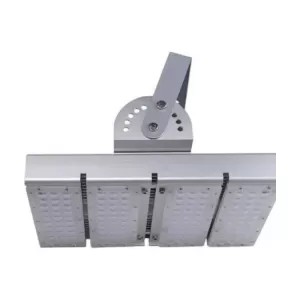
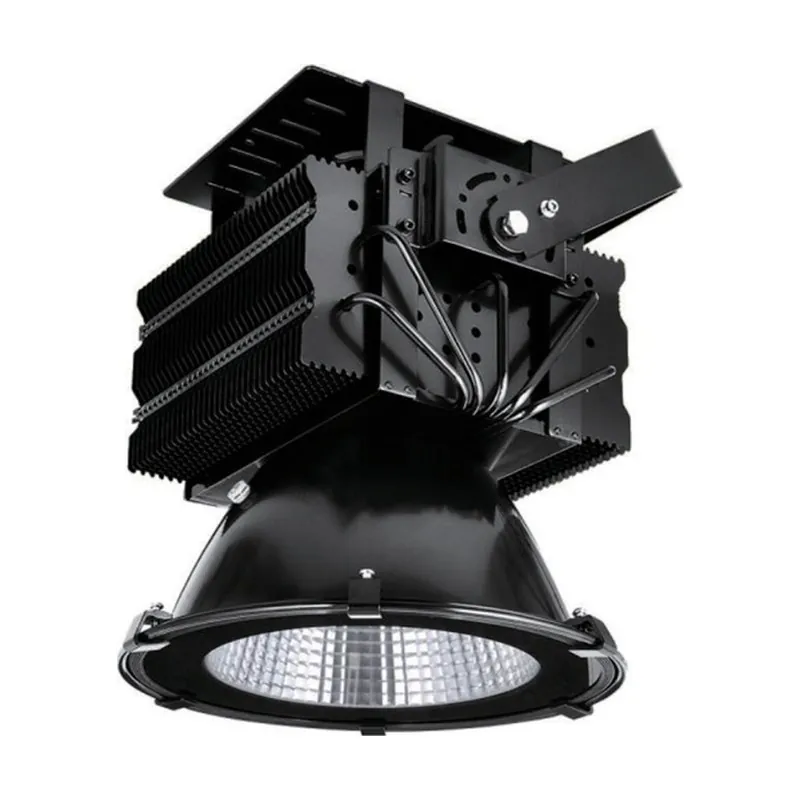
The figures use the data of our heat-pipe stadium floodlight: BG-TZ models from 200 W to 1,500 W, above 110 lm/W, beam angles of 25°, 40°, 60° and 90°, IP67, Ra 70, 80 or 90, and a housing wind-tunnel tested to Beaufort force 17. For small courts and school fields, the 50–300 W modular sports floodlight with asymmetric optics is the better fit.
Spill light and neighbours
Most planning authorities limit the light that leaves the site. The usual tools are:
- higher masts with floodlights aimed more steeply down;
- asymmetric optics and shields;
- narrow beams for the far side of the pitch;
- switching levels, so that training nights use Class III and only match nights use the full installation.
Verification
A stadium meets its requirement only when it has been measured. The normal procedure is a grid of measurement points across the pitch (EN 12193 describes the grid), readings with a calibrated lux meter after dark, and a report with the average, the uniformity ratios and, where required, the vertical values and glare calculation. Keep the report: leagues ask for it at licensing, and it is the baseline for later maintenance.
Common mistakes
| Mistake | Result |
|---|---|
| Buying by wattage without a design | Bright centre, dark corners, failed uniformity |
| Low masts with floodlights tilted up | Glare for players and complaints from neighbours |
| One beam angle for every floodlight | Poor uniformity; far side under-lit |
| Designing to the initial value | Below the standard after two seasons |
| Using a general standard for a televised venue | The broadcaster’s rules are not met |
What to send for a design
The pitch dimensions and a site plan, the class or the competition rule to meet, existing mast positions and heights if any, the supply voltage, and whether matches will be filmed. Our overview of LED stadium lights explains the product choices, and we return a layout with the calculated lux grid.
Sources
Frequently asked questions
How many lux does a stadium need?
It depends on the level of play. For outdoor football, EN 12193 gives 75 lux for training and recreation, 200 lux for club competition and 500 lux for national and international matches. Televised matches need much more, set by the broadcaster and the competition.
What is the uniformity requirement for stadium lighting?
The ratio of minimum to average illuminance on the pitch. EN 12193 asks for at least 0.5 at the training level, 0.6 for club matches and 0.7 at the top class. Broadcast lighting sets tighter ratios, including minimum to maximum.
Which stadium lights suit professional competitions?
High-power LED floodlights of 1,000 W and above with narrow, precise beams, low-flicker drivers, a colour rendering index of 80 or 90 and glare shields, aimed from a lighting design. The fitting alone does not make a stadium compliant; the aiming and the measured result do.
Do stadium lights need to be flicker-free?
For broadcasts with slow-motion replays, yes. Light that varies with the mains frequency shows as flicker in high-frame-rate cameras. Ask for the driver's flicker data if the venue will host televised matches.