Stadium Light Pole Design: Height, Headframe Load and Foundation, Worked from Real Floodlights
How stadium and sports field light poles are designed: height from the aiming angle, headframe wind area and weight from real floodlight sizes, pole types and foundations, with two worked examples.
Key points
- Pole height comes from geometry: a common rule keeps the line from the floodlight to the middle of the pitch at least 25° above horizontal, so H ≥ d × tan 25°. For side poles 5 m off a 64 m wide pitch, that is about 17–18 m.
- The headframe load comes from the floodlights themselves. Six of our 1000 W stadium lights (560 × 630 mm, 32.2 kg each) present about 2.1 m² to the wind and weigh about 193 kg.
- With a simplified wind check at 35 m/s, that headframe pushes with about 1.9 kN, a moment of about 35 kNm at the base of an 18 m pole before the pole's own wind load is added.
- Final pole and foundation sizes must come from a structural engineer working to the local wind code; the supplier's job is to give exact fitting areas, weights and aiming.
A stadium light pole has to do three jobs: hold the floodlights high enough to light the pitch without glare, carry their weight and wind load for decades, and let someone maintain them. The first is a lighting question, the second a structural one, and both depend on the exact floodlights chosen. This guide works through the design with the real sizes and weights of our fittings.
1. Height from the aiming angle
The height is set by geometry. A widely used guideline keeps the line from the floodlight to the middle of the pitch at least 25° above horizontal. Lower angles send light sideways into players’ eyes and spill it beyond the pitch. The minimum height is therefore:
H ≥ d × tan 25° ≈ 0.47 × d
where d is the horizontal distance from the pole to the pitch centre line.
| Pitch | Width | Pole set-back | d | Minimum height |
|---|---|---|---|---|
| Full-size football, side poles | 64 m | 5 m | 37 m | about 17.3 m → 18 m pole |
| Small-sided pitch, side poles | 40 m | 3 m | 23 m | about 10.7 m → 12 m pole |
| Tennis court, side poles | 18 m with run-off | 1 m | 10 m | about 4.7 m (8–10 m used for glare and uniformity) |
Corner-pole layouts put the poles farther from the centre, so they need more height. Our football field lighting guide compares four-, six- and eight-pole layouts, and the cricket stadium light pole height article applies the same geometry to a round ground.
2. The headframe: area and weight
The headframe carries the floodlights on crossarms. Its load depends on how many fittings, how big, and how heavy. Here are real numbers from our size tables.
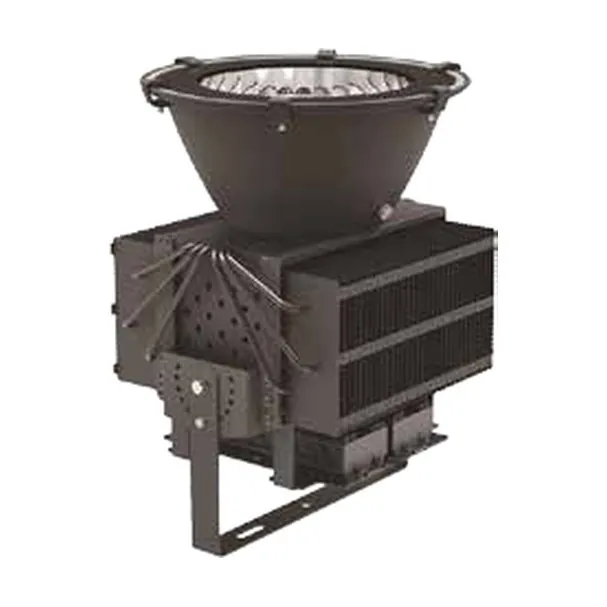
Full-size pitch, 18 m pole: six 1000 W stadium lights (BG-TZ1K0H), each 560 × 630 mm and 32.2 kg.
- Face area per fitting: 0.56 × 0.63 = 0.353 m²
- Six fittings: about 2.1 m²
- Weight: 6 × 32.2 = about 193 kg
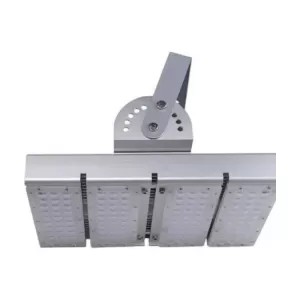
Small-sided pitch, 12 m pole: four 300 W modular sports floodlights (BG-TZ300M), each 290 × 532 mm and 5.0 kg.
- Face area per fitting: 0.29 × 0.532 = 0.154 m²
- Four fittings: about 0.62 m²
- Weight: 4 × 5.0 = 20 kg
Using the full face area is a worst case: tilted floodlights present a little less to a horizontal wind, but designers usually take the full figure.
3. A simplified wind check
To show the order of magnitude, take a basic wind speed of 35 m/s and a force coefficient of 1.2 for the flat floodlight faces. The dynamic pressure is q = ½ × 1.25 kg/m³ × 35² ≈ 766 Pa.
| Case | Area | Force on headframe | Moment at base |
|---|---|---|---|
| 6 × 1000 W at 18 m | 2.1 m² | about 1.9 kN | about 35 kNm |
| 4 × 300 W at 12 m | 0.62 m² | about 0.57 kN | about 6.8 kNm |
This is the headframe alone. The pole shaft has its own wind load, often as large as the headframe’s on a tall pole, plus gust factors, height and terrain factors, dynamic effects and fatigue checks. A structural engineer does that properly to EN 1991-1-4, ASCE 7 / AASHTO LTS or the local code. The point of the check here is that the floodlight choice changes the pole: three-and-a-half times the area means a heavier shaft and a bigger foundation. A high-efficacy fitting that needs fewer heads saves steel as well as electricity.
4. Pole types
| Type | Typical heights | Notes |
|---|---|---|
| Tapered polygonal steel, galvanised | 8–30 m | Most common for clubs and schools; slip-joint sections |
| Tubular steel | 6–15 m | Small courts and training areas |
| High mast with lowering ring | 20–40 m | Headframe winched to the ground for maintenance |
| Lattice tower | 30 m and above | Large stadiums, very heavy headframes |
Hot-dip galvanising to ISO 1461 is standard; our galvanised steel light pole guide covers coating thickness. Where maintenance access is hard, a lowering system avoids hiring a 20 m lift for every service. The high mast pole specification article lists what to put in a tender for those.
5. Headframe layout and aiming
- Crossarms are sized to keep fittings far enough apart that they can be aimed without shading one another and can be reached from a lift basket.
- Aiming angles for each fitting come from the photometric design and are marked on the drawing; the brackets must allow that tilt. Our stadium light has a 216° bracket; the modular floodlight uses asymmetric optics so that it can be mounted nearly flat.
- Drivers can sit in the fitting or in a box at the base of the pole. Base-mounted drivers make maintenance easier but need longer DC runs.
If you are new to the vocabulary of stadium fittings, our article on what stadium lights are called explains the names.
6. Foundations
Stadium poles stand on either:
- A reinforced concrete pad or pile with anchor bolts, the pole bolted to a base plate. This allows replacement and accurate levelling.
- A direct-embedded section, buried in concrete. Cheaper on small poles, harder to replace.
The foundation size depends on the base moment from step 3 (plus the shaft load) and the soil’s bearing capacity. A soil report is needed for anything above a small court pole. Cable ducts, earthing rods and a drainage path for the pole base are set in the foundation before it is poured.
7. Electrical and safety details
- Earth every pole and bond the headframe; tall poles in open fields are lightning targets.
- Provide a lockable access door and an isolator at the base.
- Fit surge protection at the base or in each fitting.
- Size cables for voltage drop over long runs to distant poles.
Our sports court lighting installation guide covers ducts, cable and commissioning step by step.
What to send us
The pitch size, standard or level of play, the proposed pole positions and heights, and the local wind speed if known. We will return a fitting count and aiming schedule, plus the area and weight per headframe for your structural engineer.
Sources
Frequently asked questions
How tall are football stadium light poles?
Community and club pitches commonly use 15–20 m poles; small-sided pitches 10–12 m; professional stadiums mount floodlights on roofs or masts of 30–50 m. The height follows from the pitch width, the pole position and the aiming angle.
What is the 25 degree rule for sports lighting?
A geometric guideline: the angle between the horizontal and the line from the floodlight to the middle of the playing area should be at least about 25°, so that players looking up are not dazzled and the light lands at a steep enough angle. Some standards and federations use different angles; check the one that applies.
How much do stadium floodlights weigh on a pole?
It depends on the fittings. Our 1000 W stadium light weighs 32.2 kg, so six on a headframe weigh about 193 kg; our 300 W modular sports floodlight weighs 5 kg, so four weigh 20 kg. Add the crossarms, brackets and cable.
Who designs the pole foundation?
A structural or civil engineer, using the site's soil report and the local wind code. The lighting supplier provides the fitting areas, weights, positions and aiming angles that go into that design.