Football Floodlighting: Lux Levels, Pole Heights and How Many Floodlights a Pitch Needs
Football floodlighting in numbers: 30 × 1,000 W LED floodlights light a full-size pitch to 200 lux on 6 poles. Lux by level, pole heights, wattages for small pitches, glare and running costs.
Key points
- EN 12193 sets about 75 lx for training and recreational football, 200 lx for club competition and 500 lx for national and international matches; broadcast adds vertical light for cameras.
- A full-size pitch at 200 lx needs about 3.2 million lumens: around 30 × 1000 W LED floodlights on 6 poles.
- Training pitches at 75 lx need roughly a third of that; a 5-a-side pitch at 200 lx about 8 × 400 W.
- Keep poles out of the goal-line zone and aim steeply enough that players looking up are not dazzled.
Floodlights turn a football pitch from a daytime facility into one that can be used every evening of the year, and LED has made them far cheaper to run and easier to control than the metal halide systems they replace. This guide covers the light levels, layouts and floodlight counts for full-size and small-sided pitches. For the general principles of sports lighting, see our LED stadium lights guide.
Football floodlights at a glance
If you only need the short answer, these are the floodlight sets we would start from for lighting football pitches with LED. They come from the lumen method below; a photometric design with your pole positions confirms the final count and aiming.
| Pitch | Level | Floodlights | Poles |
|---|---|---|---|
| Full size, 105 × 68 m | Training, 75 lx | 18 × 600 W | 6 × 3 |
| Full size, 105 × 68 m | Club, 200 lx | 30 × 1,000 W | 6 × 5 |
| Full size, 105 × 68 m | National, 500 lx | about 74 × 1,000 W | 8 poles or masts |
| 5-a-side, about 40 × 20 m | 200 lx | 8 × 400 W | 4 × 2 |
What to look for in a football floodlight
Pitch floodlights work at 15–25 m in wind, rain and frost, often for 20 years. The specifications that matter most:
- Beam choice. Narrow (25°) beams for the far side of the pitch, medium (40°) and wide (60°) for the near side; a range of reflectors lets each pole be aimed properly.
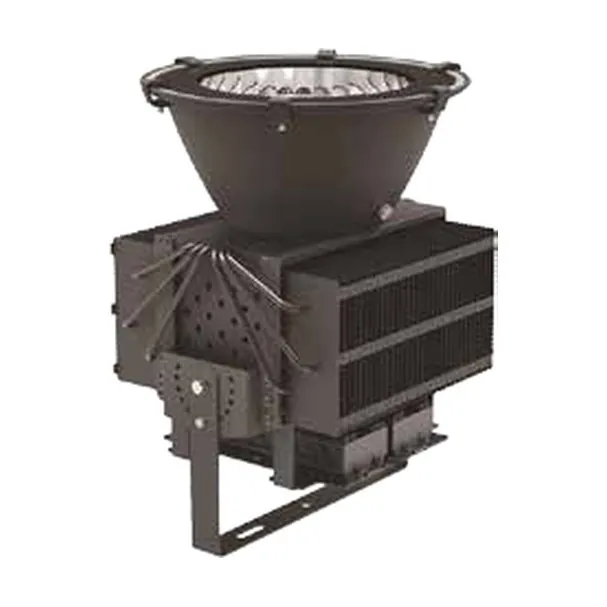
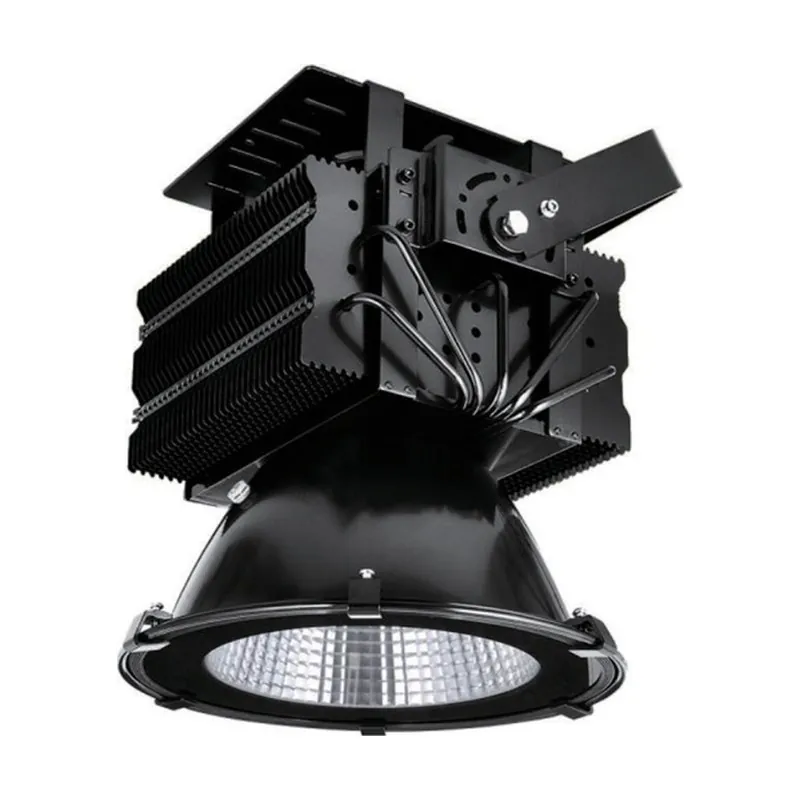
- Cooling. High-power LEDs last as long as they stay cool. Our LED stadium lights use copper heat pipes into a large fin array.
- Sealing. IP67 with a breather valve stops condensation inside the lens.
- Efficacy. Above 110 lm/W keeps the number of floodlights, and the load on the poles, down.
- Wind and hardware. Wind-tunnel testing and stainless fixings matter on tall poles; ours are tested to Beaufort force 17 and use hardware that passed a 500 h salt spray test.
- Flicker. For filmed or broadcast matches, specify flicker-free drivers.
Light levels by level of play
EN 12193 groups football lighting into three classes:
| Class | Typical use | Average horizontal illuminance | Uniformity (min/average), approx. |
|---|---|---|---|
| Class III | Training, schools, recreational play | 75 lx | 0.5 |
| Class II | Club and regional competition | 200 lx | 0.6 |
| Class I | National and international competition | 500 lx | 0.7 |
Uniformity matters as much as the average: a pitch with bright pools and dark patches is harder to play on than an evenly lit one at a lower average. Televised matches need vertical illuminance towards the main and secondary cameras, often well over 1,000 lx, plus flicker-free drivers for slow-motion replays; leagues and broadcasters publish their own requirements.
Layouts and pole heights
| Layout | Typical pole height | Best for |
|---|---|---|
| 4 poles at the corners | 18–25 m | Training and recreational pitches |
| 6 poles, 3 per side | 15–20 m | Club pitches, the most common layout |
| 8 poles, 4 per side | 15–18 m | Higher classes, or where poles must be shorter |
| Masts or roof | 30–50 m | Stadiums with stands |
Two placement rules avoid most glare problems:
- Keep poles out of the goal-line zone. Floodlights directly behind or in line with the goals dazzle goalkeepers looking up for high balls. Side poles are set back from the goal lines, and corner poles are positioned outside a zone either side of the goal line extension.
- Aim steeply enough. A common design rule is that the line from the centre of the pitch to the floodlights should be at least about 25° above the horizontal. That sets the minimum pole height for a given distance from the pitch.
How many floodlights: the lumen method
Total lumens = target lux × area ÷ (utilisation factor × maintenance factor)
For a full-size pitch of 105 × 68 m (7,140 m²), with a utilisation factor of about 0.55 for well-aimed floodlights and a maintenance factor of 0.8:
| Level | Target | Lumens needed | Example LED floodlights |
|---|---|---|---|
| Training (Class III) | 75 lx | about 1.2 million lm | 18 × 600 W (about 72,000 lm each), 6 poles × 3 |
| Club (Class II) | 200 lx | about 3.2 million lm | 30 × 1000 W (about 110,000 lm each), 6 poles × 5 |
| National (Class I) | 500 lx | about 8.1 million lm | about 74 × 1000 W, usually on 8 poles or masts |
Small-sided pitches
Five-a-side and seven-a-side pitches are often commercial facilities lit to 200 lx or more, with lower poles and side-mounted floodlights. A utilisation factor of about 0.5 is typical, because more light falls outside a small area:
| Pitch | Area | Target | Lumens needed | Example |
|---|---|---|---|---|
| 5-a-side, 40 × 20 m | 800 m² | 200 lx | about 400,000 lm | 8 × 400 W on 4–6 poles of 8–10 m |
| 7-a-side, 60 × 40 m | 2,400 m² | 200 lx | about 1.2 million lm | 12 × 800 W on 6 poles of 12–15 m |
These are planning estimates. A photometric design with the floodlights’ IES files sets the beam angle and aiming point of each floodlight and checks uniformity and glare.
Choosing the beam angles
- Far side of the pitch from high poles: narrow beams (15°–25°) to reach across without spilling.
- Near half and corners: medium beams (40°–60°).
- Low poles on small pitches: asymmetric floodlights with flat glass, which throw the light forward while the fixture stays horizontal, keeping glare and spill down.
Mixing beam angles on the same pole is normal; that is how a good design reaches high uniformity.
Neighbours and planning permission
Floodlit pitches near houses often need a spill-light assessment for planning approval. Flat-glass asymmetric floodlights, steep aiming and visors keep light on the pitch. LED makes it easy to switch sections independently and to dim for training, so the full output is used only when needed.
Running costs and switching modes
A club pitch at 200 lx with 30 × 1000 W floodlights draws about 30 kW. Used 3 hours a night on 250 nights, with matches at full output (150 hours) and training dimmed to about 100 lx (600 hours at about 15 kW), it uses about 13,500 kWh a year. Running every session at full output would use about 22,500 kWh.
Replacing an old metal halide installation adds the savings of higher efficacy, instant restrike (no 10–15 minute wait after a power dip) and no relamping at height. Try your own numbers in the LED retrofit savings calculator.
What to send for a design
- Pitch dimensions and run-off areas
- Level of play and the standard or league requirements
- Existing or possible pole positions and heights
- Neighbouring houses or roads to protect from spill
- Power supply available, and whether dimming or zones are wanted
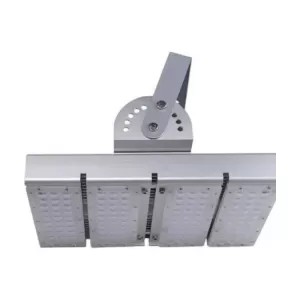
Our LED stadium floodlights run from 200 W to 1500 W, and our modular sports floodlights with asymmetric optics from 50 W to 300 W for small pitches and courts. Send us the pitch details and we will return a photometric layout with the floodlight count and aiming.
Sources
Frequently asked questions
How many lux does a football field need?
Under EN 12193, about 75 lx for training and recreational play (Class III), 200 lx for club and regional competition (Class II) and 500 lx for national and international matches (Class I). Televised matches need much higher vertical illuminance towards the cameras, set by the league or broadcaster.
How many floodlights does a football field need?
For a full-size pitch of about 105 × 68 m at 200 lx, roughly 30 LED floodlights of 1000 W on 6 poles. A training pitch at 75 lx needs roughly 18 × 600 W; a 5-a-side pitch at 200 lx about 8 × 400 W. A photometric design with the actual floodlights sets the exact number and aiming.
What wattage are football floodlights?
On full-size pitches, LED floodlights of 800–1,500 W on poles of 15–25 m; on 5- and 7-a-side pitches, 200–400 W on 8–12 m poles. Choose by the lumens and beam needed at each pole, not by wattage alone; efficacy above 110 lm/W keeps the count down.
How tall are football stadium light poles?
About 15–18 m for training pitches, 18–25 m for club grounds and 30–50 m masts or roof mounting for stadiums. Taller poles reduce glare and allow narrower beams.