Bocce Ball Court Lighting: Light Levels, Pole Positions and Fixture Counts for a Narrow Court
How to light a bocce ball court: 100 lux for casual play or 200 for leagues, side poles not end poles, fixture counts by the lumen method with our floodlights, running cost and glare.
Key points
- Bocce courts are long and narrow, commonly 60–91 ft by 10–13 ft; a 76 × 12 ft court with a small margin is about 24 × 4.6 m to light.
- About 100 lux suits casual play and 200 lux suits league play; there is no dedicated standard, so these follow recreational and club values for other outdoor sports.
- By the lumen method, six of our 50 W court floodlights give about 98 lux on that court and six of 100 W about 196 lux.
- Put the lights along the sides, never at the ends: players throw along the court and would look straight into end-mounted lights.
Bocce is played in backyards, parks, restaurants and clubs, and much of it happens in the evening. A court lit only by string lights looks pleasant until two balls finish a few centimetres apart and nobody can tell which is closer. Bocce ball court lighting has to light a long, narrow strip evenly without putting a light in the thrower’s eyes. This guide shows how, with fixture counts from our own floodlight data.
Court size and the area to light
Bocce courts vary. Common sizes run from about 60 to 91 ft long and 10 to 13 ft wide (about 18–28 × 3–4 m), with side and end boards. For the worked example we take a 76 × 12 ft court, about 23.2 × 3.7 m, and light a small margin around it: 24 × 4.6 m, about 110 m².
How much light
No lighting standard is written specifically for bocce. We use the values that EN 12193 and similar guides give other outdoor recreational and club sports, adjusted for the fact that bocce is slow but needs fine judgement of distance:
| Use | Target average | Notes |
|---|---|---|
| Backyard and casual play | about 100 lux | Enough to see the pallino and judge most throws |
| League and club play | about 200 lux | Clear view of close finishes, measuring at the end |
| Restaurant or bar court | 100–150 lux | Balanced with the surrounding seating lighting |
Uniformity matters more than the average. A court that is bright in the middle and dim at the ends makes the end of each frame, where points are decided, the hardest part to see.
Where to put the lights
The rule is simple: lights along the long sides, none at the ends. Players throw along the court, so a light behind either end is directly in the thrower’s line of sight.
A typical layout:
- three poles on each long side, or three on one side if the other is a wall or seating area;
- pole height about 4–5 m, high enough to keep the light out of players’ eyes when they look down the court, low enough to stay discreet;
- poles set back from the side boards so balls and players do not hit them.
On a narrow court, a lot of light falls outside the boards. That is why the utilisation factor is low and why fittings with an asymmetric beam, which push light forward across the court, help.
How many fixtures: our calculation
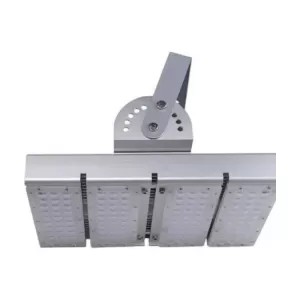
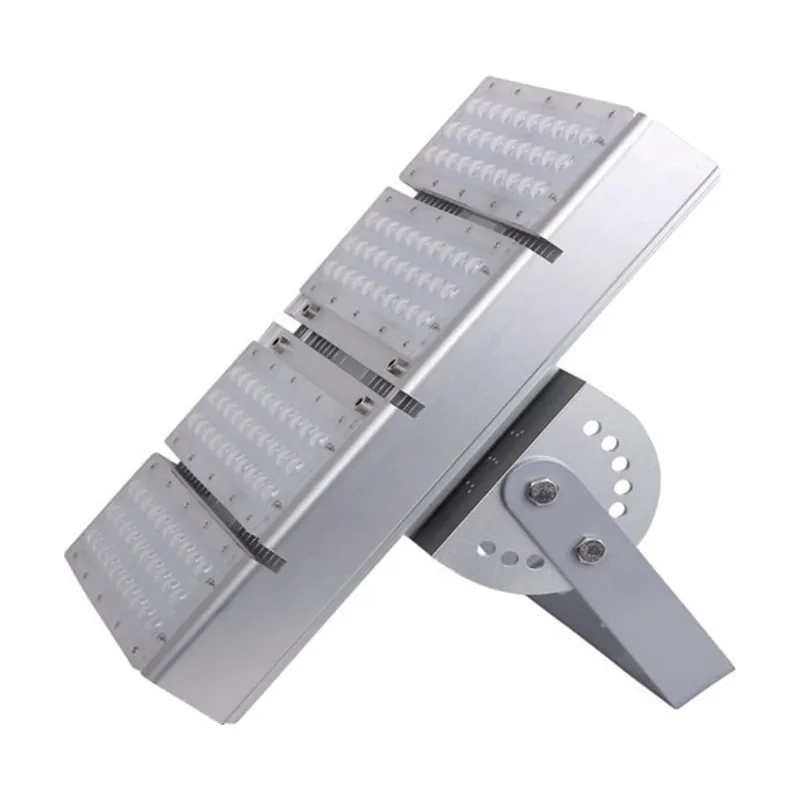
We used the lumen method: fixtures = target lux × area ÷ (lumens per fixture × utilisation factor × maintenance factor). For a long, narrow court lit from the sides we use a utilisation factor of 0.45 and a maintenance factor of 0.8. Our modular LED sports floodlight gives more than 100 lm/W in sizes from 50 W, with a 140° × 80° asymmetric beam.
| Layout | Fixture power | Total | Estimated average |
|---|---|---|---|
| 6 fixtures (3 per side) | 50 W | 300 W | about 98 lux |
| 4 fixtures (2 per side) | 100 W | 400 W | about 130 lux, less even |
| 6 fixtures (3 per side) | 100 W | 600 W | about 196 lux |
Six smaller fixtures give a more even court than four larger ones, so we prefer the first and third rows. For two courts side by side, poles between the courts can carry fixtures for both, saving one row of poles.
Running cost
Six 50 W fixtures draw 0.3 kW. Used 3 hours an evening, 150 evenings a year:
0.3 kW × 3 h × 150 = 135 kWh a year, about US$20 at US$0.15/kWh.
The league layout (0.6 kW) uses about 270 kWh, about US$40. A timer or a switch with a run-down timer stops the lights being left on after the last game.
Why not solar floodlights?
The court at 100 lux uses 300 W × 3 h = 900 Wh per evening. The largest solar flood light in our range, whose real panel and battery we publish, collects about 80 Wh on a sunny day. Solar flood lights are made for paths, gates and signs, not for sports surfaces. Use a mains circuit.
Glare, colour and atmosphere
- 4000 K gives a natural look to the court surface and the balls; 3000 K suits restaurant courts where the light must blend with warm seating lights.
- Mount fixtures flat with asymmetric optics, and keep tilt low, so neighbours and diners see less bright surface.
- Ambience lighting such as string lights, low bollards or uplights on trees can surround the court, but should not be relied on for the playing surface. Our landscape lighting installation guide covers garden circuits.
For more on how glare is assessed, see our sports lighting glare rating guide.
Wiring and installation
Use a dedicated outdoor circuit with residual current protection, buried cable in conduit to each pole and a weatherproof isolator near the court. Earth each metal pole. Our sports court lighting installation guide shows foundations and cable routes for small courts, and our backyard pickleball court lighting guide covers a similar small-court project with four poles.
What to send us
Send the court length and width, the number of courts, where poles can stand, the distance to houses or seating, your supply voltage and whether the court is for casual or league play. We will return a fixture schedule and a layout with average lux and uniformity.
Sources
Frequently asked questions
How much light does a bocce court need?
About 100 lux for casual and backyard play, and about 200 lux for league play where players need to judge close distances between balls. Even light along the whole court matters more than a high average.
Where should lights go on a bocce court?
Along the long sides, on poles of about 4–5 m, aimed across and along the court. Avoid lights at either end, because players throw towards them.
How many lights does a bocce court need?
For a 76 × 12 ft court, about six floodlights of 50 W for around 100 lux, or six of 100 W for around 200 lux, by our lumen-method estimate. A layout with your pole positions confirms uniformity.
Can I light a bocce court with garden or string lights?
String and garden lights create atmosphere but rarely give enough even light to judge distances. Use them around the court for ambience and light the playing surface with floodlights.