How Many Lumens for an Outdoor Half Basketball Court? A Worked Answer with Fixture Options
How many lumens an outdoor half basketball court needs: the lit area, light levels for play, the lumen calculation, fixture and pole options, and running cost for a typical home court.
Key points
- A half court of about 15 × 14 m, lit with a margin to 17 × 16 m, needs about 57,000 fixture lumens for 75 lux, a comfortable recreational level, by the lumen method.
- That is two floodlights of 300 W or three of 200 W at 100 lm/W; for 200 lux (club training) it rises to about 150,000 lumens, five to six fittings of 250–300 W.
- Mount the floodlights at 6–8 m on one or two poles at the side, not behind the basket, and use asymmetric optics so players are not looking into the glass.
- Two 200 W floodlights used 3 hours a night all year consume about 440 kWh, roughly $66 at $0.15/kWh.
A half court in a back garden, a school yard or a residential compound is one of the most common small sports lighting jobs, and one of the most often over- or under-lit. The question usually arrives as “how many lumens do I need?”. This guide answers it with a calculation, then turns the lumens into fixtures, poles and running cost.
Step 1: the area to light
A full FIBA court is 28 × 15 m. A half court is commonly about 15 m wide × 14 m deep (the full width, from the baseline to the centre line). Home courts are often smaller, around 9–12 m square.
Players run beyond the lines, so it is good practice to light a margin of about 1 m around the playing area. For the standard half court, that gives a lit area of about 17 × 16 m = 272 m². If the court is fenced tight to the lines, use the court area alone (210 m²).
Step 2: the light level
| Use | Average illuminance | Notes |
|---|---|---|
| Casual shooting, family use | 50–75 lux | Enough to follow the ball and read the hoop |
| Recreational games, school yards | 75–100 lux | Typical target for community courts |
| Club training | 200 lux | Matches EN 12193 training levels |
| Competition | 500 lux and more | Rare on half courts |
For most half courts, 75 lux is the sensible design target. Our sports field lighting lux levels guide lists levels for other sports.
Step 3: the lumen calculation
The lumen method gives the fixture lumens needed:
Lumens = E × A ÷ (UF × MF)
with E the target illuminance, A the area, UF the utilisation factor (how much of the light lands on the area; about 0.45 for floodlights on side poles) and MF the maintenance factor (0.8 for LED, allowing for dirt and ageing).
| Area | Target | Fixture lumens needed |
|---|---|---|
| Court only, 15 × 14 m | 75 lux | about 43,800 lm |
| Court + margin, 17 × 16 m | 75 lux | about 56,700 lm |
| Court only, 15 × 14 m | 200 lux | about 116,700 lm |
| Court + margin, 17 × 16 m | 200 lux | about 151,100 lm |
So the short answer: about 45,000–60,000 lumens for recreational play, 120,000–150,000 lumens for club training.
Step 4: from lumens to fixtures
At a rated efficacy of 100 lm/W, a fixture’s lumens are roughly its watts × 100. For the court + margin case:
| Target | Lumens | Option A | Option B | Option C |
|---|---|---|---|---|
| 75 lux | about 57,000 | 2 × 300 W | 3 × 200 W | 4 × 150 W |
| 200 lux | about 151,000 | 5 × 300 W | 6 × 250 W | 8 × 200 W |
More, smaller fixtures give better uniformity and less glare; fewer, larger fixtures mean fewer poles and less wiring. For a home court, option B at 75 lux (three 200 W fixtures on two poles) is a good balance.
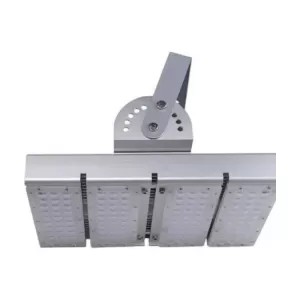
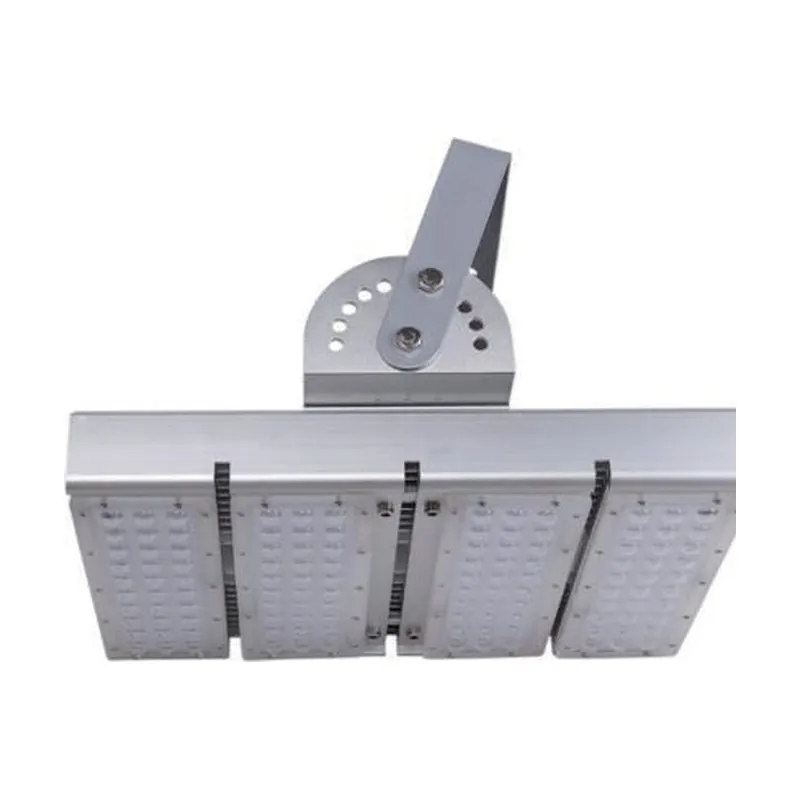
Our BG-TZ…M sports floodlight comes in 50–300 W, more than 100 lm/W, IP65, with an asymmetric 140° × 80° lens with a 30° offset. The offset lets the floodlight throw light across the court while its glass stays close to horizontal, which keeps glare down for players looking up at the ball. The 200 W size measures 290 × 232 × 370 mm and weighs 3.5 kg, light enough for a standard steel pole.
Step 5: poles and positions
- Height: 6–8 m. At 6 m, aim the fixtures steeply and consider an extra fixture; at 8 m, two fixtures can cover a half court evenly.
- Position: along the sidelines, roughly level with the free-throw line, or at the corners of the lit area on the side away from the basket. Never directly behind the backboard: shooters look straight at it.
- Neighbours: on a residential plot, put the poles on the side facing away from houses and aim inward. Asymmetric optics help keep light inside the fence.
Our full basketball court lighting guide covers full-court layouts and pickleball courts.
Step 6: running cost
Three 200 W fixtures used for three hours every evening all year:
3 × 200 W × 3 h × 365 = 657 kWh, about $99 at $0.15 per kWh.
Two 200 W fixtures on the same schedule use about 440 kWh, roughly $66. A timer or a push-button with auto-off stops the lights burning after the game. For the cost of replacing old halogen or metal halide floodlights with LED, our retrofit savings calculator works out the saving.
Solar for a half court?
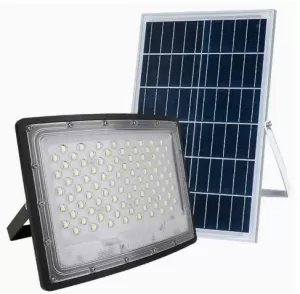
It is possible, but the numbers are large. 600 W for 3 hours is 1,800 Wh per night, which needs roughly 700–900 Wp of solar panels and a battery of 2–4 kWh, depending on the sun hours. That is a small solar system, not a light with a built-in panel. For occasional use, a grid supply is almost always cheaper. Beware of “solar floodlights” with large wattage labels: our solar flood light page shows the real panel and battery behind each label.
Common mistakes
- Buying by wattage label alone. Check the lumens and efficacy; 300 W at 80 lm/W is not 300 W at 120 lm/W.
- One big floodlight on the house wall. It glares into players’ eyes and leaves the far baseline dark.
- Symmetric floodlights tilted up. They spill light into the neighbours’ windows and the sky.
- Forgetting the margin. Players chasing a loose ball run beyond the lines.
What to send us
Court size, fence position, where poles can go, the level of play and the supply voltage. We will return a fixture and pole proposal with the calculation, and a photometric check for uniformity if needed.
Sources
Frequently asked questions
How many lumens do I need for an outdoor half basketball court?
About 45,000–60,000 fixture lumens for recreational play at 75 lux, depending on how much margin around the court you light. For club training at 200 lux, about 120,000–150,000 lumens.
How many watts of LED for a half court?
At 100 lm/W, about 450–600 W in total for recreational play, for example two 300 W or three 200 W floodlights. For 200 lux, about 1,200–1,500 W.
How high should half court lights be?
6–8 m is typical. Lower poles need more floodlights to avoid glare and dark patches; higher poles cost more but give better uniformity.
Where should the poles go on a half court?
Along one or both sidelines, roughly level with the free-throw line, or at the corners of the lit area away from the basket. Avoid placing a floodlight directly behind the backboard, where players look when shooting.