Backyard Pickleball Court Lighting: How Many Lights, Pole Height and Keeping Neighbours Happy
How to light a backyard pickleball court: 200 or 300 lux, four poles with two floodlights each, pole height, glare and spill control, running cost, and why solar floodlights fall short.
Key points
- A backyard pickleball court with run-off is about 30 × 60 ft (9.1 × 18.3 m); light it to about 200 lux for social play or 300 lux for serious practice.
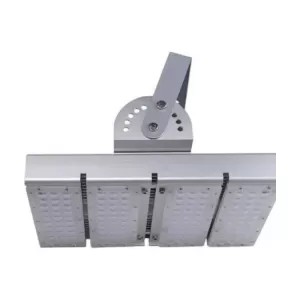
- By the lumen method, four poles with two of our 100 W court floodlights each give about 210 lux; with 150 W heads, about 317 lux.
- Eight 100 W floodlights used 2 hours a night, 250 nights a year, use about 400 kWh, roughly US$60 at US$0.15/kWh.
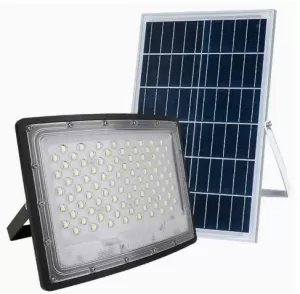
- Solar floodlights cannot light a court: our largest solar flood light collects about 80 Wh on a sunny day, while the court needs about 1,600 Wh for a 2-hour session.
A lit backyard court turns pickleball into an evening game after work. It is also the project most likely to annoy the neighbours if it is done with a couple of cheap floodlights on the house wall. This guide sizes backyard pickleball court lighting properly: how much light, how many fittings, which pole height, and how to keep the light on your court and out of the next garden.
If your court is indoors, see indoor pickleball court lighting instead.
Court size and the area to light
The playing area of a pickleball court is 20 × 44 ft (6.1 × 13.4 m). Players need room around it, so the lit area is usually the full pad, commonly about 30 × 60 ft (9.1 × 18.3 m), or 166.5 m². Light the whole pad: players chase lobs and wide shots into the run-off.
How much light
There is no European class written for pickleball, so tennis and small-court values are the usual reference:
| Use | Target average | Notes |
|---|---|---|
| Social and family play | about 200 lux | Comfortable for the ball speed of casual games |
| Serious practice, club-level players | about 300 lux | Sharper ball tracking, better on fast exchanges |
| Tournaments | 500 lux or more | Rare on a backyard court |
Even light matters as much as the average. A court with 300 lux in the middle and dark corners plays worse than an even 200 lux.
How many lights: our calculation
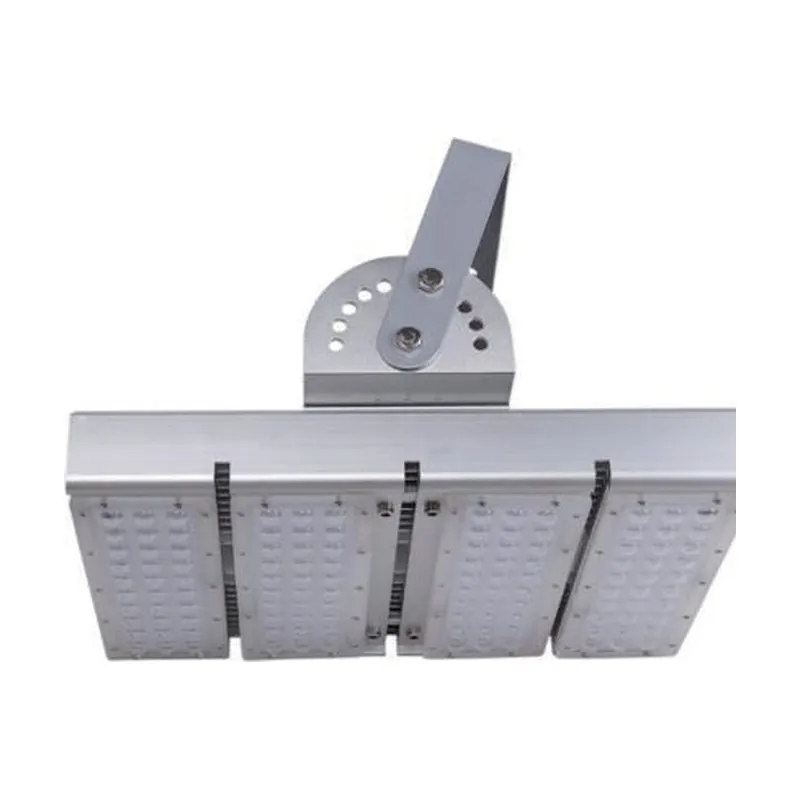
We used the lumen method: number of fittings = target lux × area ÷ (lumens per fitting × utilisation factor × maintenance factor). With poles at the edge of the court, a utilisation factor of 0.55 is realistic for a small area; the maintenance factor is 0.8. Our modular LED sports floodlight gives more than 100 lm/W.
| Layout | Fitting power | Total | Estimated average |
|---|---|---|---|
| 4 poles × 2 heads | 100 W | 800 W | about 210 lux |
| 4 poles × 2 heads | 150 W | 1,200 W | about 317 lux |
| 4 poles × 1 head | 200 W | 800 W | about 210 lux, but less even |
Two heads per pole aimed at different points give better uniformity than one large head, which is why we prefer the first two rows. A photometric layout with your real pole positions confirms uniformity; we provide one with a quotation.
Pole positions and height
Place the four poles along the two long sides, outside the run-off, roughly at the quarter points of the court’s length. Avoid poles at the ends behind the baselines: players look straight at them when they serve and lob.
Height: about 5–6 m (16–20 ft) suits a single court. Lower poles put the fittings closer to the players’ line of sight and need more tilt, which means more glare. Higher poles light more evenly but are more visible over fences and may need planning approval. Check local rules on pole height and lighting hours before ordering.
For pole types and foundations, see our sports court lighting installation guide.
Glare and spill: the neighbour question
Most complaints about backyard courts are about light in bedroom windows, not about the hours of play. The fixes:
- Asymmetric optics. Our court floodlight has a 140° × 80° beam with a 30° offset, so the fitting can be mounted almost flat while throwing light forward onto the court. A flat fitting shows much less bright surface to people outside.
- Low tilt. Keep the tilt as small as the layout allows; a fitting tilted up to reach the far side sends light over the fence.
- Visors on the side facing the nearest houses.
- Warm or neutral colour. 4000 K is a good balance; 5000–6000 K looks harsher from a distance.
- A timer with a fixed switch-off, for example 10 pm.
Our sports lighting glare rating guide explains how glare is measured if a planning officer asks.
Running cost
Eight 100 W floodlights draw 0.8 kW. Used 2 hours a night, 250 nights a year:
0.8 kW × 2 h × 250 = 400 kWh a year, about US$60 at US$0.15/kWh.
At 300 lux (1.2 kW), the same use is 600 kWh, about US$90. A timer and a switch near the court door make sure the lights do not stay on when play stops.
Why solar floodlights are not the answer
Solar is the first idea for many backyard projects, because it avoids trenching a cable. For a court, the numbers do not work. In our solar flood light range, we publish the real panel and battery for every size. The largest has a 30 W panel and an 80 Wh battery and collects about 80 Wh on a sunny day.
A court lit at 200 lux uses 800 W × 2 h = 1,600 Wh per session, twenty times what that solar light can store. Solar flood lights are made for gates, paths and sheds, not for play. If trenching is hard, a properly sized off-grid system with a large battery bank is possible, but it costs more than the cable.
Wiring and safety
Run a dedicated outdoor circuit with residual current protection, buried cable or conduit to each pole, and a weatherproof isolator near the court. Have it installed by a licensed electrician; many places require it for outdoor circuits. Earth every metal pole.
Sharing the court with other games
If the same pad is used for basketball or a half tennis court, light for the most demanding use. Our basketball and pickleball court lighting guide and residential tennis court lighting guide cover the larger layouts.
What to send us
Send the pad size, the positions available for poles, the distance to the nearest house, your supply voltage and the level of play. We will return a fitting schedule and a photometric layout with average lux and uniformity.
Sources
Frequently asked questions
How many lights do I need for a backyard pickleball court?
For a single court of about 30 × 60 ft including run-off, eight floodlights of 100 W on four poles give about 210 lux by our lumen-method estimate; eight of 150 W give about 317 lux.
How tall should pickleball light poles be?
About 5–6 m (16–20 ft) is common for a single backyard court. Lower poles need more fittings and give more glare; taller poles may need planning permission and are more visible to neighbours.
Can I use solar lights for a backyard pickleball court?
Not for play-quality light. Solar floodlights sold for yards collect only tens of watt-hours a day, while a lit court needs well over a kilowatt-hour per session. Use mains-powered LED floodlights with a timer.
How do I stop pickleball lights bothering the neighbours?
Use asymmetric optics mounted flat, aim the light into the court, add visors on the side facing houses, and put the lights on a timer with a fixed switch-off time.