Glare Rating (GR) in Sports Lighting: What It Measures, the Limits, and How Arenas Control It
Glare rating (GR) for sports and competition lighting: the CIE formula in plain terms, the usual GR 50 limit, why brighter pitches tolerate more luminaire glare, and how arenas control it.
Key points
- GR (glare rating, from CIE 112) runs from about 10 (unnoticeable) to 90 (unbearable); most sports standards and federation guides ask for GR 50 or lower at defined observer positions.
- GR compares the veiling luminance from the floodlights with the veiling luminance from the lit surroundings, so the same floodlights glare less over a brighter pitch.
- By our calculation from the CIE formula, halving the floodlight veiling luminance lowers GR by about 7 points; and keeping GR at 50 allows roughly twice the floodlight veiling luminance at 500 lux as at 200 lux.
- Glare is controlled mainly by geometry: higher poles, lower aiming angles, asymmetric optics that keep the glass close to horizontal, and visors.
Spectators notice light levels. Players notice glare. A high ball against a bright floodlight, a goalkeeper looking towards a corner mast, a tennis player serving into a lit sky: these are the moments that decide whether a sports installation is good. Standards capture this with the glare rating, GR. This guide explains what GR measures, the limits used for competition lighting, a calculation that shows why the same floodlights glare less over a brighter pitch, and the practical ways arenas keep GR down.
What GR measures
GR was defined by the CIE in publication 112 for outdoor sports and area lighting:
GR = 27 + 24 × log10(Lvl / Lve^0.9)
- Lvl is the veiling luminance in the observer’s eye caused by the floodlights. It grows with the light reaching the eye from each floodlight and falls with the angle between the floodlight and the line of sight.
- Lve is the veiling luminance caused by the lit environment: the pitch and its surroundings. CIE 112 estimates it from the average horizontal illuminance and the reflectance of the surface.
The scale runs roughly from 10 (unnoticeable) through 30 (noticeable), 50 (just admissible) and 70 (disturbing) to 90 (unbearable). Lighting software calculates GR at a grid of observer positions, each looking in several directions, and the design must meet the limit everywhere.
The usual limits
| Application | Typical maximum GR |
|---|---|
| Outdoor sports, most classes (EN 12193) | 50 |
| Some training and recreational classes | 55 |
| Football competition (federation stadium guides) | 50 |
| Outdoor work areas (EN 12464-2), depending on task | 45–55 |
Indoor sports halls are not assessed with GR. There, glare is controlled by mounting height, fitting position relative to the main playing directions and the optics, and some federations add their own requirements for television.
A calculation: why brighter pitches tolerate more floodlight glare
Because GR divides by the environment term, the same floodlight veiling luminance gives a lower GR over a brighter field. We used the CIE formula with a grass reflectance of 0.2 and the CIE estimate Lve = 0.035 × E × ρ / π to find the floodlight veiling luminance that just reaches GR 50:
| Average illuminance on pitch | Lve (environment) | Max Lvl for GR 50 | Max Lvl for GR 55 |
|---|---|---|---|
| 75 lux (recreational) | 0.17 cd/m² | about 1.8 cd/m² | about 2.9 cd/m² |
| 200 lux (club training) | 0.45 cd/m² | about 4.4 cd/m² | about 7.1 cd/m² |
| 500 lux (club competition) | 1.11 cd/m² | about 10.0 cd/m² | about 16.2 cd/m² |
| 750 lux (national) | 1.67 cd/m² | about 14.4 cd/m² | about 23.3 cd/m² |
Two lessons follow. First, a recreational pitch at 75 lux is actually the hardest place to avoid glare: the dark surroundings make every floodlight stand out, so aiming and shielding matter most on small community grounds. Second, the logarithm means that halving Lvl only lowers GR by about 7 points (24 × log10 2 ≈ 7.2). Small aiming changes rarely fix a bad GR; geometry has to be right from the start.
How arenas keep GR down
1. Mounting height. Higher floodlights sit farther from the line of sight. Federation guides often tie minimum mast heights to the pitch geometry for this reason. Our stadium light pole design guide covers height choice.
2. Aiming angle. The steeper the aim (closer to straight down), the less light reaches the eye of a player looking across the field. Keeping the main beam well below the horizontal is the single most effective measure. Our anti-glare training pitch guide works through aiming by pole height.
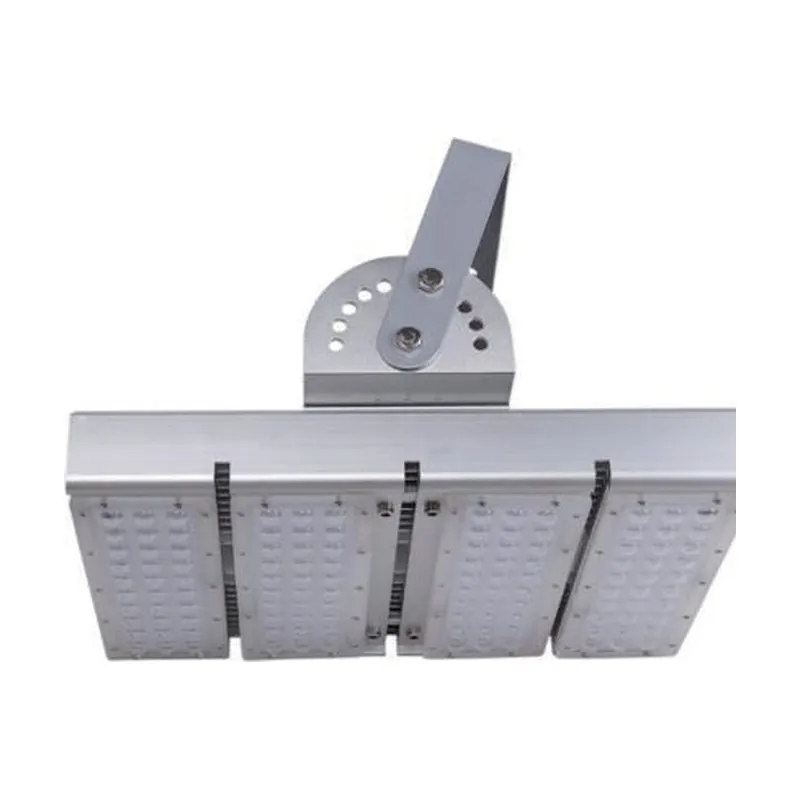
3. Asymmetric optics. A symmetric floodlight must be tilted up to throw light across the pitch, exposing its glass. An asymmetric floodlight throws its peak forward while the glass stays nearly flat. Our BG-TZ…M sports floodlight uses a 140° × 80° lens with a 30° offset (or 155° × 80°) for exactly this; it comes in 50–300 W for training pitches and courts.
4. Visors and louvres. External visors cut off light above the beam; internal louvres reduce the luminance seen at high angles. They cost a little light but often save GR points where the geometry is tight.
5. Positions outside the main view. On football pitches, floodlights are kept out of a zone around the goal line extension so goalkeepers are not looking into them. On tennis courts, poles stand behind the side fences rather than the baselines.
6. More, smaller sources. For the same illuminance, several medium floodlights spread across the mast head give lower peak luminance than a few very large ones.
For larger stadiums and high masts, our heat-pipe stadium floodlight offers 25° to 90° beams at 200–1500 W, so narrow beams can be used for the far side with steep aiming.
Indoor competition halls
Indoor halls swap GR for geometry and luminance control. In the basketball arenas and training hall we lit in Hunan, fittings were mounted high above the courts and positioned so players looking up at the ball are not looking straight into them; the general design notes are on the sports hall project page. Typical EN 12193 levels for basketball and volleyball are about 200 lux for training, 500 lux for club competition and 750 lux for national and international matches. Our indoor pickleball court lighting guide applies the same principles to smaller courts.
Television and international events
Broadcast adds vertical illuminance targets towards the main cameras, and cameras looking towards floodlights suffer flare in the same way eyes suffer glare. International designs therefore combine GR checks with camera-position checks. Our stadium lighting requirements guide summarises the levels.
Common mistakes
- Treating GR as a fitting property. It depends on the whole installation and the observer position.
- Checking only the average lux. A design can meet every illuminance target and fail GR.
- Tilting symmetric floodlights to reach. It exposes the glass and raises GR sharply.
- Ignoring small community pitches. Dark surroundings make glare worse at low light levels.
If you send us the pitch or court dimensions, pole positions and the class of play, we will propose floodlights and aiming, and supply photometric files so GR can be calculated at the observer positions your standard requires.
Sources
Frequently asked questions
What is a good glare rating for sports lighting?
GR 50 or lower is the usual requirement for competition and most training classes; lower values feel more comfortable. Some lower-class or training installations accept up to GR 55. The value is checked at observer positions set by the standard or the federation.
How is glare rating calculated?
CIE 112 defines GR = 27 + 24 × log10(Lvl / Lve^0.9), where Lvl is the veiling luminance in the observer's eye caused by the floodlights and Lve the veiling luminance caused by the lit environment. Lighting software calculates it at each observer position and viewing direction.
Is GR the same as UGR?
No. UGR is for indoor work places and compares luminaire luminance with background luminance for a seated observer. GR is for outdoor sports and area lighting, where the background is the lit field and the floodlights are far away and high.
How do international arenas control glare?
With high mounting, aiming angles kept well below the horizontal, asymmetric floodlights whose glass stays nearly flat, visors and louvres, and floodlights placed outside the main lines of sight of players and cameras.