Indoor Sports Hall Lighting: Levels by Class, Fitting Counts and Glare Control
Indoor sports hall lighting by EN 12193 class: 200, 500 and 750 lux worked for a 44 × 24 m hall in our calculator, plus glare, impact protection, flicker and lessons from basketball arenas.
Key points
- EN 12193 sets typical levels for indoor basketball, volleyball and handball of about 200 lux for training and recreation, 500 lux for club competition and 750 lux for national and international matches.
- For a 44 × 24 m hall with fittings at 10 m, our calculator gives 24 fittings of 150 W for about 220 lux, 45 of 200 W for about 550 lux, and 54 of 250 W for about 830 lux, at 130 lm/W.
- More, smaller fittings give better uniformity and less glare than a few large ones; place them beside the main playing lines rather than directly above, and protect them against ball impact.
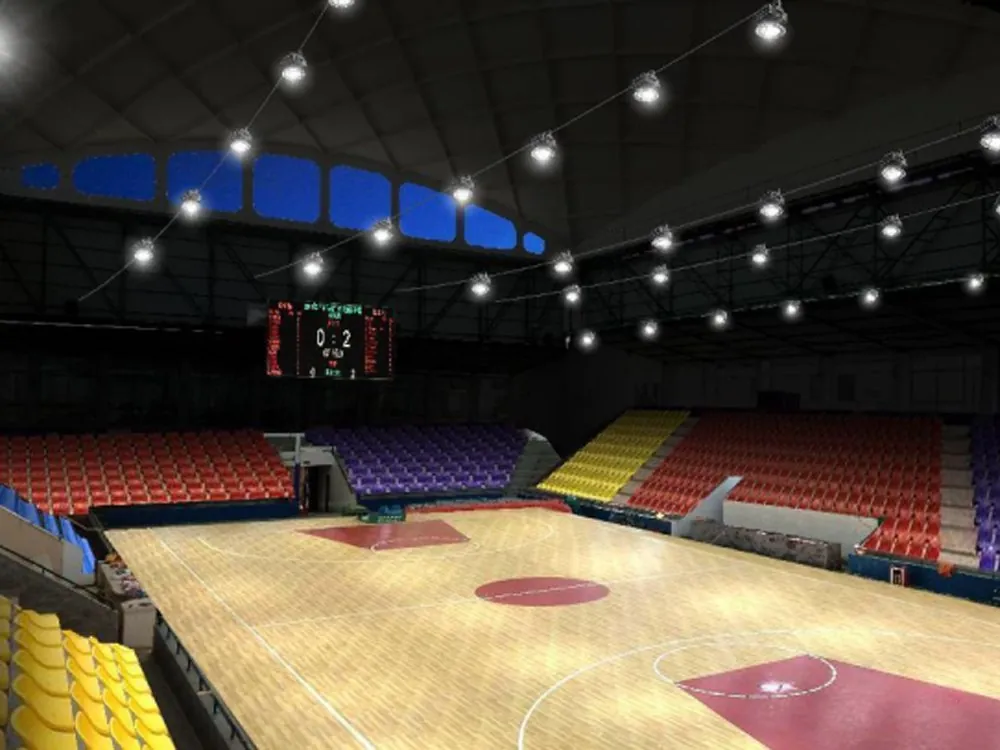
- We have lit two indoor basketball arenas and a sports training hall with LED fittings mounted high above the courts.
A sports hall is a hard space to light well. Players look up at the ball, so glare matters more than in a warehouse. The ball travels fast, so uniformity and flicker matter. The same hall may host a school PE lesson in the morning and a league match at night, so the system needs more than one level. And balls hit the fittings. This guide sets out the levels by class, works through fitting counts for a typical hall, and covers the details that separate a good installation from a merely bright one.
Light levels by class
EN 12193 groups play into three classes. For indoor basketball, volleyball, handball and similar sports, typical values are:
| Class | Level of play | Average illuminance | Uniformity (min ÷ avg) |
|---|---|---|---|
| III | Training, school sport, recreational play | about 200 lux | about 0.5 |
| II | Club and league competition | about 500 lux | about 0.7 |
| I | National and international competition | about 750 lux | about 0.7 |
Badminton, table tennis and some other sports have their own values and add requirements for background contrast. Our guides to badminton court lighting design and indoor pickleball court lighting cover those.
Televised events need higher vertical illuminance towards the cameras, set by the broadcaster, and are a separate design.
Fitting counts for a 44 × 24 m hall
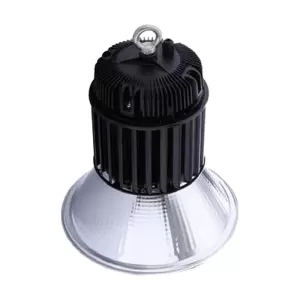
A multi-sport hall of 44 × 24 m, large enough for a 40 × 20 m handball court with run-off, with fittings at 10 m, medium surface reflectances and a maintenance factor of 0.8. We used 130 lm/W IP65 heat-pipe high bays (GKP40G) with a medium beam in our high bay and warehouse lighting calculator:
| Class | Target | Fitting power | Fittings (grid) | Average illuminance | W/m² |
|---|---|---|---|---|---|
| III | 200 lux | 150 W | 24 (6 × 4) | about 220 lux | 3.4 |
| II | 500 lux | 200 W | 45 (9 × 5) | about 550 lux | 8.5 |
| I | 750 lux | 250 W | 54 (9 × 6) | about 830 lux | 12.8 |
The lumen method gives the average. For classes I and II the uniformity requirement of about 0.7 is tight, so a point-by-point photometric layout should confirm the minimum, especially near the walls and at the corners of the court where players chase the ball.
Designing for more than one level
Most halls do not run at competition level all the time. Two common approaches:
- Switching groups: wire the class II layout so that a subset of fittings, spread evenly, gives class III. For example, switch on roughly half the fittings for training. Check that the subset still meets the class III uniformity.
- Dimming: use dimmable drivers and a simple scene controller with presets for cleaning, training, club matches and events. This keeps the full grid lit for uniformity and saves energy at lower levels.
Either way, the energy difference between training and match mode is large: in the table, class III uses 3.4 W/m² and class I about 12.8 W/m².
Glare: where the fittings go
- Not directly above the main playing lines. In basketball, avoid fittings right above the baskets; in volleyball, above the net zone. Players look straight up there.
- Mount high. At 10 m and above, the fitting sits well outside a player’s normal line of sight. In lower halls, use wider-spaced fittings with deeper reflectors or diffusers.
- Use anti-glare optics. Deep reflectors, prismatic diffusers or louvres reduce luminance when seen at steep angles.
- Think about the walls. Light walls raise the utilisation factor and soften contrast; dark walls make the fittings look brighter by comparison.
If you are comparing fitting types for large spaces, our article on what stadium lights are called explains the main families, from high bays to floodlights.
Impact, flicker and maintenance
- Impact protection. Use wire guards or fittings rated IK08 or higher. A broken diffuser falling onto a court is a safety incident.
- Flicker. Slow-motion replays, phone videos and some players are sensitive to flicker. Ask for low-flicker drivers; IEEE 1789 gives a recommended practice for modulation.
- Colour. Ra 80 is usual; 4000–5000 K suits most halls.
- Access. At 10 m, plan for a scissor lift or tower. Long-life LED fittings reduce how often that is needed, which matters in a hall booked every evening.
- Emergency lighting. Spectator areas and exits need emergency lighting to the local code.
What we learned lighting basketball arenas
We have lit two indoor basketball arenas and a sports training hall in Hunan with LED fittings mounted high above the courts; photos are on the sports hall project page. The design notes for that type of space match the points above: high mounting, fittings beside rather than directly above the main playing lines, more and smaller fittings for an even field, and guards or impact-resistant covers on every fitting.
Choosing between high bays and floodlights
| Option | Best for |
|---|---|
| Round high bays in a grid | Halls with flat roofs at 7–12 m; simple, even layout |
| Linear high bays | Lower halls, where a longer, softer light source reduces glare |
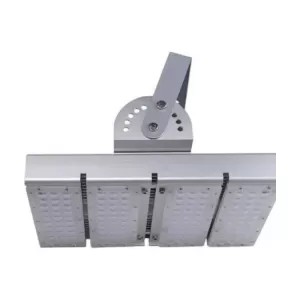
| Side-mounted compact floodlights | Halls with low roof trusses or where fittings must avoid the play zone; our modular sports floodlight with asymmetric optics suits this |
Common mistakes
- Designing to the average only. Class II and I need uniformity of about 0.7; check the minimum.
- Mounting fittings over the baskets. The single most common glare complaint.
- No guards. Cheap at installation, expensive after the first season.
- One switch for everything. A training session at full competition level wastes energy for years.
What to send us
The hall dimensions and mounting height, the sports and levels of play, the roof structure, and whether any events are televised. We will return fitting counts for each class and a suggested switching or dimming scheme. For the general counting method, see how many LED high bay lights do I need.
Sources
Frequently asked questions
How many lux does a sports hall need?
For basketball, volleyball and handball, EN 12193 gives about 200 lux for training and recreational play (class III), 500 lux for club competition (class II) and 750 lux for national and international matches (class I). Televised events need more, set by the broadcaster.
How many lights does a sports hall need?
For a 44 × 24 m hall with fittings at 10 m, about 24 LED high bays of 150 W for 200 lux, 45 of 200 W for 500 lux, or 54 of 250 W for 750 lux, by our lumen-method calculator at 130 lm/W. A photometric layout confirms uniformity and glare.
What kind of light fixtures are used in sports halls?
Usually LED high bays with anti-glare reflectors, linear high bays, or compact floodlights aimed from the sides. They should be impact-protected, low-flicker, and dimmable or switchable in groups for different levels of play.
Do sports hall lights need ball guards?
Yes, in any hall used for ball games. Fittings are hit regularly; guards or impact-resistant fittings (IK08 or higher) prevent broken diffusers and falling parts.