What Are Stadium Lights Called? Floodlights, Sports Lights, Masts and the Words Buyers Use
Stadium lights are called floodlights; the structures are masts, towers or pylons. Every name buyers use, typical wattages, how many football floodlights a pitch needs, and pole heights.
Key points
- The fixtures are usually called floodlights or sports floodlights; the structures that carry them are masts, light towers or, in British football, pylons.
- "Stadium lights" in a supplier catalogue normally means high-power LED floodlights of about 400–1,500 W with narrow, aimable beams.
- Smaller courts and training fields use the same idea at lower power: 50–300 W floodlights, often with asymmetric optics, on 8–15 m poles.
- By our lumen-method estimate, a 105 × 68 m football pitch needs about 30 floodlights of 1,000 W for 200 lux training and about 74 for 500 lux competition, usually on 4 corner masts or 6–8 side poles of 18–35 m.
- Whatever you call them, ask for wattage, lumens, beam angles, IP rating, glare control and a lighting calculation for your field.
Short answer: stadium lights are called floodlights (or sports floodlights). The tall structures that hold them are called masts, light towers or, at British football grounds, pylons. On modern stadiums the floodlights sit along the roof edge instead.
Buyers search for the same product under many names. A football club asks for “stadium lights”, a contractor writes “sports floodlights 1000 W”, an engineer specifies “high mast floodlighting”, and a British fan talks about “the pylons”. Behind all of them is the same basic idea: powerful, aimable lights on tall structures. This short guide sorts out the words so that what you ask for is what you get.
The fixture: floodlight
The light itself is almost always a floodlight: a fitting with a reflector or lens that throws light in a controlled beam, which can be aimed at a point on the field. Common names for it include:
| Name | Where you hear it | What it usually means |
|---|---|---|
| Floodlight / sports floodlight | Worldwide, standards, tenders | The aimable fitting itself |
| Stadium light / stadium flood light | Catalogues, online searches | A high-power floodlight, 400–1,500 W LED |
| Sports light / sports lighting | US and Australia | Any lighting for a sports area |
| Court light | Tennis, padel, basketball | Smaller floodlights, often asymmetric |
| Projector | Some European and Asian markets | A narrow-beam floodlight |
Before LED, stadium floodlights were metal halide lamps of 1,000–2,000 W. Today they are LED floodlights, usually with several beam options so the designer can mix narrow beams for the far side of the pitch with wider ones for the near side. Our 1000 W LED stadium light guide explains what that wattage class delivers.
The structure: mast, tower, pylon or roof
The structure carrying the floodlights has its own set of names:
- Mast or pole. Steel poles of about 12–40 m. Small fields use four to eight poles of 12–20 m along the sides.
- Light tower. A lattice steel tower, often at the four corners of older stadiums.
- Pylon. British football slang for those corner towers.
- High mast. A tall pole with a ring of floodlights, often with a winch to lower the ring for maintenance. The same structure is used for motorway junctions, ports and yards.
- Roof or catwalk mounting. Modern stadiums mount floodlights along the edge of the roof, close to the field and out of players’ eye line.
Football floodlighting: how many lights, how high
“Football floodlights” is the most common name in Britain, Africa and much of Asia. For budgeting, the lumen method gives the order of magnitude. With our heat-pipe stadium floodlight at its minimum rated 110 lm/W, a utilisation factor of 0.55 and a maintenance factor of 0.8, a full-size pitch of 105 × 68 m needs:
| Level | Target | Floodlight | Lights (estimate) |
|---|---|---|---|
| Training | 200 lux | 1,000 W | about 30 |
| Regional competition | 500 lux | 1,000 W | about 74 |
| National competition | 750 lux | 1,500 W | about 74 |
The floodlights are usually grouped on 4 corner masts or 6–8 side poles, at 18–35 m depending on the level of play. Taller structures let the beams land at a steeper angle, which cuts glare for players and spill for neighbours. A photometric calculation with the real pole positions then confirms uniformity and glare. For pole heights at a round ground, see cricket stadium light pole height; for budgets, football pitch floodlighting cost.
Indoor arenas: different fittings, same job
Indoor sports halls are lit from the ceiling, so the fittings look more like high bays or compact floodlights with wide beams. In the sports hall lighting project we supplied for a basketball arena and a training hall in Hunan, the lighting combined floodlights and high bay lights. The goal is the same as outdoors: even light, controlled glare for players looking up, and enough vertical light to see the ball in the air.
How much light each level needs
The name does not tell you how much light you need; the level of play does. EN 12193 sets horizontal illuminance for football, for example:
| Class | Typical use | Average horizontal illuminance |
|---|---|---|
| III | Training, recreational play | 75 lux |
| II | League and club matches | 200 lux |
| I | Top-level national and international matches | 500 lux |
Televised matches add requirements for vertical light towards the cameras, often 1,000 lux or more, which is why broadcast stadiums need far more floodlights. Our LED stadium lights guide covers lux levels, pole heights and a quick way to estimate the number of fittings.
Our two stadium light families
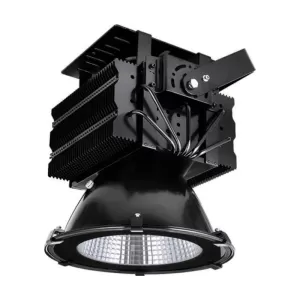
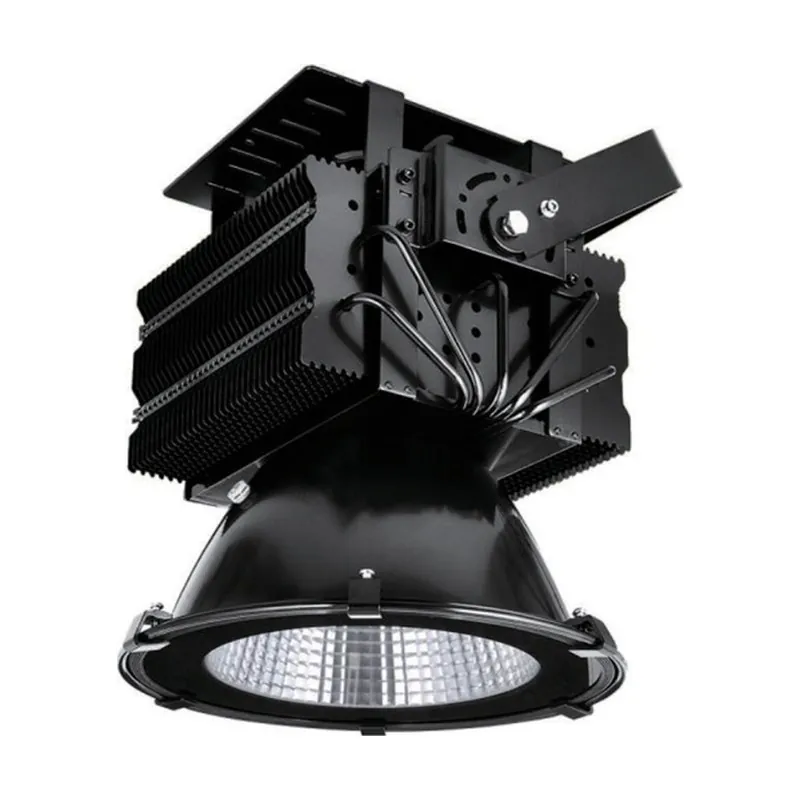
- The heat-pipe LED stadium floodlight, 200–1,500 W, IP67, copper heat pipes, 25°/40°/60°/90° reflectors and a 216° bracket. This is what most buyers mean by “stadium lights”: large fields, stadiums, and the same fitting is used on ports and airport aprons.
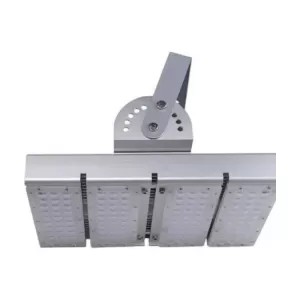
- The modular LED sports floodlight BG-TZ-M, 50–300 W, IP65, with asymmetric 140° × 80° optics. This is the “court light” end: tennis, basketball, five-a-side and school fields.
For sites without a grid connection, see solar stadium lights for what solar can and cannot do at this scale.
Common mix-ups when ordering
Because the names overlap, a few misunderstandings come up again and again:
- “Flood lights” from a general catalogue. A 200 W security floodlight with a 120° beam is not a sports floodlight. On a pitch it spills light everywhere and leaves the far side dark. Sports work needs narrow or asymmetric beams that can be aimed.
- “High mast” meaning the pole only. Some buyers ask for high mast lights and expect the mast; others expect only the floodlights. Say which you need.
- Equivalent wattage. “1000 W LED to replace 2000 W metal halide” is a rough guide. What matters is lumens on the field after aiming, which only a lighting calculation shows.
What to put in your enquiry
Whatever name you use, these details get you an accurate offer:
- Sport and field size, for example an 11-a-side football pitch of 105 × 68 m.
- Level of play, training, club or broadcast, or a lux target.
- Poles or structure: existing or new, number, height and position.
- Wattage and beam angles, if you already have a design, or a request for a lighting calculation.
- Colour temperature and CRI, typically 5000–5700 K and Ra 70–80 for sports, Ra 90 for broadcast.
- IP rating and environment: coastal sites need corrosion-resistant hardware.
- Controls: separate circuits or dimming for training and match modes.
Summary
Stadium lights are floodlights. Depending on where you are and what you build, the lights may be called sports lights, court lights or projectors, and the structures masts, towers, pylons or high masts. The name matters less than the specification: power, beams, glare control and a lighting calculation for your field.
Sources
Frequently asked questions
What are the big lights at a stadium called?
Floodlights. In stadiums they are high-power floodlights, today mostly LED, mounted in groups on masts, towers or the stadium roof. In Britain the tall towers at older football grounds are often called floodlight pylons.
Are stadium lights the same as high mast lights?
Not exactly. High mast lighting means a tall pole, usually 18–40 m, with several floodlights on a ring at the top, used for motorway junctions, ports and large yards. Some sports fields use similar masts, but stadium lighting is aimed and designed specifically for the playing area.
How many watts are stadium lights?
Individual LED stadium floodlights are usually 400–1,500 W. A small training pitch may use a few dozen of them; a large stadium uses hundreds. Courts and small fields use 50–300 W floodlights.
What replaced metal halide stadium lights?
LED floodlights. They use roughly half the energy for the same light on the pitch, switch on instantly without a warm-up, and can be dimmed for training or used for light shows.
What is the name of the poles that hold stadium lights?
Floodlight masts or poles; lattice structures are light towers, called pylons at older British football grounds. Side poles for club pitches are typically 15–20 m, corner masts and broadcast stadium structures 25–35 m or more.