Solar Stadium Lights: Can Sports Fields and Courts Really Run on Solar?
Can solar power stadium and court lighting? Worked sizing for an off-grid tennis court, basketball court and football pitch, what it takes in panels and batteries, and the options that work.
Key points
- Sports lighting needs far more energy than street lighting: a recreational tennis court at 200 lux uses about 50 times the energy of a solar street light.
- In our worked example, an off-grid tennis court lit 4 hours a night needs about 3.5 kWp of panels and 25 kWh of battery; a full-size football pitch needs over ten times that.
- Off-grid solar can work for single courts, training areas and lower light levels, especially where the grid is unavailable or unreliable.
- For full pitches, the practical answer is usually LED floodlights on the grid, with rooftop or ground-mounted solar offsetting the energy over the year.
Clubs, schools and municipalities often ask whether they can light a sports field or court with solar, especially where the grid is far away or unreliable. The answer depends on the size of the field, the light level and how many hours of play are needed. This guide works through the numbers for a tennis court, a basketball court and a football pitch, and explains which solutions work in practice.
Why sports lighting is different from street lighting
A solar street light lights a strip of road to 10–20 lux, often dimming after midnight. A sports court needs 100–500 lux across the whole playing area, evenly, with players able to follow a fast ball. EN 12193 sets typical values for outdoor courts:
- Training and recreational (Class III): about 200 lux for tennis, 75–200 lux for many team sports
- Club competition (Class II): about 300 lux for tennis, 200 lux for football
- High-level competition (Class I): 500 lux or more
Light level times area gives the lumens needed. Sports fields are large and the light level is high, so the energy is in a different league.
Estimating the lighting load
The lumen method gives a first estimate:
Lumens = lux × area ÷ (utilisation × maintenance)
For sports floodlighting with good asymmetric optics, a utilisation factor of about 0.5 and a maintenance factor of 0.8 are reasonable. With LED floodlights at about 130 lm/W:
| Venue | Area | Target | Lumens | LED load |
|---|---|---|---|---|
| Tennis court (with run-off) | 36.6 × 18.3 m, 670 m² | 200 lux | about 335,000 lm | about 2.6 kW |
| Basketball court (with run-off) | 32 × 19 m, 608 m² | 200 lux | about 304,000 lm | about 2.3 kW |
| Football pitch | 105 × 68 m, 7,140 m² | 200 lux | about 3.6 million lm | about 27 kW |
A real design adds uniformity and glare checks and may change the numbers, but this is the right order of magnitude.
Off-grid solar sizing
Now size an off-grid system using the same formulas as our solar street light calculator: 4 hours of full-power play a night, 4.5 peak sun hours, MPPT charging, LiFePO4 batteries at 90% depth of discharge and 2 nights of autonomy.
| Venue | Energy per night | Battery | Solar panels |
|---|---|---|---|
| Tennis court, 200 lux | about 11.4 kWh | about 25 kWh | about 3.5 kWp |
| Basketball court, 200 lux | about 10.4 kWh | about 23 kWh | about 3.2 kWp |
| Basketball court, 100 lux (training) | about 5.2 kWh | about 11.5 kWh | about 1.6 kWp |
| Football pitch, 200 lux | about 122 kWh | about 271 kWh | about 38 kWp |
For comparison, a typical 30 W solar street light uses about 0.23 kWh a night with a battery under 1 kWh. A single tennis court needs roughly the energy of 50 solar street lights.
Open the calculator with the tennis court’s load and change the hours or sun to see how quickly the system grows.
What the numbers mean
- A single court is feasible off grid. About 3.5 kWp of panels fits on a shelter roof or a small ground mount next to the court, and 25 kWh of LiFePO4 batteries fits in a cabinet. The cost is real but comparable to a long grid connection in remote areas.
- Training lighting is much easier. Halving the light level or the hours halves the system. Many community courts are used for an hour or two after dark.
- A full football pitch off grid is a major power project. 38 kWp and 271 kWh of storage is a mini power station. It is rarely economical unless the site already needs off-grid power for other uses.
- Cloudy seasons matter. Size for the worst month of the playing season, not the annual average. A location with 6 peak sun hours in summer may have 3 in winter; check the site’s monthly data in PVGIS or similar.
Why small solar flood lights do not work for sports
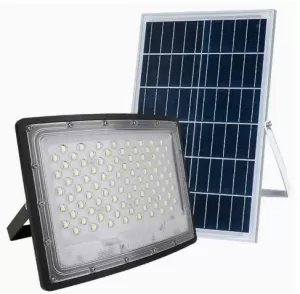
All-in-one solar flood lights advertised at “500 W” or “1000 W” typically have panels of 20–60 Wp and batteries of a few hundred Wh. That is enough for a few hours of a 20–40 W LED, not for sports lighting. A court lit with such lights would be dim, uneven and dark after a cloudy day. See our solar flood light page for what an honestly rated solar floodlight can do: with a 3–30 W panel and a 9.6–80 Wh battery, it lights yards, gates, signs and sheds, not sports.
Options that work
1. Off-grid central solar system (single courts, remote sites)
A solar array, a battery bank and an inverter or DC distribution feed proper LED sports floodlights on poles. Design points:
- Use asymmetric sports optics to put light on the court, not around it
- Add controls: a timer or push-button so lights only run when the court is booked
- Allow a training level (for example 50% output) and a match level
- Protect batteries from heat in a ventilated, shaded enclosure
2. Grid-tied LED floodlights with solar offset (most venues)
Where a grid exists, use LED floodlights on the grid and install solar panels on clubhouse roofs, stands or car park canopies. Over the year the panels generate as much energy as the lights use, without the battery cost. This is how most “solar powered” sports venues actually work.
3. Hybrid systems (unreliable grid)
Where the grid exists but fails often, a smaller battery and solar array keep lights running through outages, with the grid or a generator charging the battery when solar is insufficient.
Choosing the floodlights
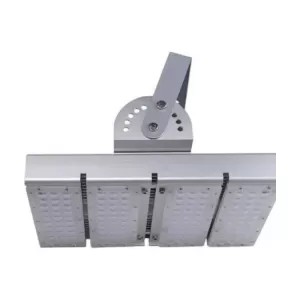
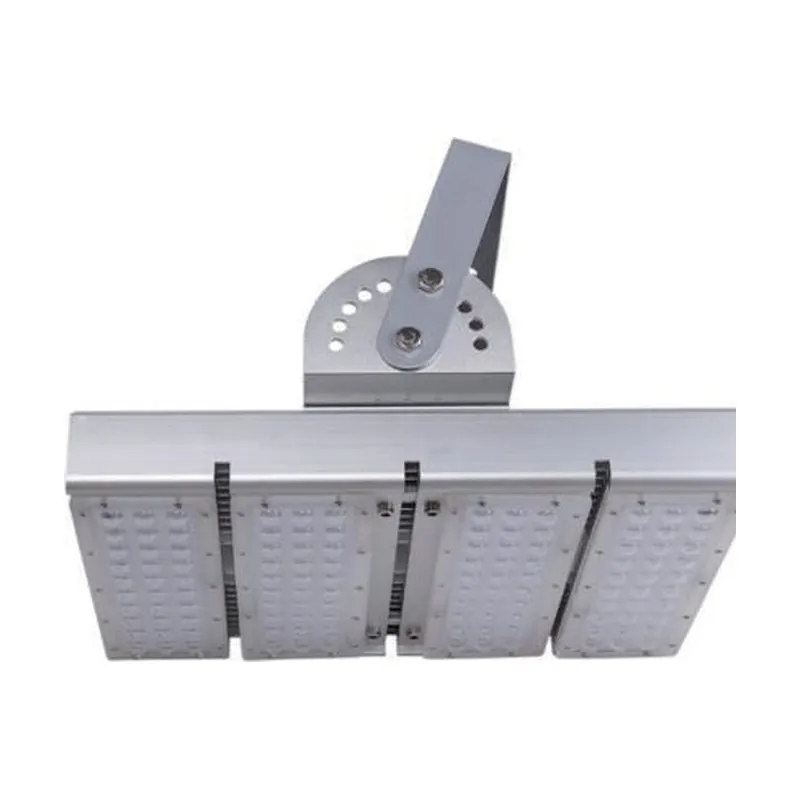
Whatever the power source, efficient floodlights with good optics reduce the system size. For courts, our modular LED sports floodlight BG-TZ-M offers 50–300 W with asymmetric 140° × 80° optics (30° offset), which push light onto the court and reduce glare for players and neighbours. Higher efficacy translates directly into fewer panels and batteries.
See tennis court lighting, basketball court lighting and soccer field lighting for layouts and pole heights.
Questions to answer before choosing solar
- Is there a grid connection, and how far away is it?
- What light level does the sport and level of play need?
- How many hours a night, and how many nights a week?
- What is the worst month’s solar resource during the playing season?
- Where can the panels go: roof, ground, shelter canopy?
- Who will maintain the batteries and system?
Send us the court or field size, the sport, the hours of use and the site location, and we will calculate the floodlights and, where it makes sense, the solar system to power them.
Sources
Frequently asked questions
Are there solar powered stadium lights?
Yes, but true off-grid solar is practical only for small venues: single courts, training grids and community fields at modest light levels. Large stadiums use grid-powered LED floodlights, sometimes offset by a solar array that feeds the grid during the day.
How much solar power does a tennis court need?
For a recreational court lit to about 200 lux for 4 hours a night, about 2.6 kW of LED floodlights, roughly 11.5 kWh a night. Off grid, that needs around 3.5 kWp of panels and 25 kWh of battery in a location with 4.5 peak sun hours.
Can I use solar flood lights for a basketball court?
Small all-in-one solar flood lights do not have enough panel or battery for a court. A court needs a central solar system with a large battery bank driving proper LED sports floodlights, or a grid supply.
What is the cheapest way to light a sports field with solar?
If a grid connection exists, use efficient LED floodlights on the grid and install solar panels on nearby roofs to offset the energy over the year. That avoids the large battery, which is the most expensive part of an off-grid system.