Residential Tennis Court Lighting: Lighting a Backyard Court Without Annoying the Neighbours
How to light a private backyard tennis court: light level, 4 or 6 poles, keeping light off neighbours, and what it costs to run, with floodlight counts and energy figures from our own calculations.
Key points
- For social and family tennis, about 200 lux is the usual target; 300 lux suits keen club-level players.
- By the lumen method, one court with run-off needs about 18 of our 150 W BG-TZ-M floodlights for 200 lux, or 21 of 200 W for 300 lux, usually on 6 poles of 8–10 m.
- Running 18 × 150 W for 2 hours a night on 300 nights uses about 1,620 kWh a year: about $243 at an example $0.15 per kWh.
- Replacing six old 1,000 W metal halide floodlights with that layout saves about 2,340 kWh a year in our retrofit calculator.
- Asymmetric optics with flat glass, house-side shields, a curfew timer and a warm 4000 K colour do most to keep neighbours happy.
A floodlit court turns a summer-only tennis court into one you can use after work for most of the year. On a private property the brief is different from a club: the court is used by a few people for a couple of hours, the budget is personal, and the neighbours are close. This guide covers what a homeowner, or the contractor building the court, needs to decide.
How much light a home court needs
EN 12193 sets light levels for tennis by class. For private and social play, around 200 lux is the usual target. Keen players who want club conditions, or a court used for coaching, are better at 300 lux. Television-level lighting at 500 lux and above is not needed at home.
Uniformity matters as much as the average. A court with bright patches near the poles and a dim middle makes the ball disappear in flight.
How many floodlights
Our published figures for a standard court (36 × 18 m including run-off) use the lumen method with our BG-TZ-M modular sports floodlight:
| Level | Floodlights | Poles | Total load |
|---|---|---|---|
| 200 lux (social play) | 18 × 150 W | 6, three per side | 2.7 kW |
| 300 lux (club standard) | 21 × 200 W | 6 | 4.2 kW |
These are first estimates; a photometric layout confirms uniformity and spill for your court.
Four poles or six?
Four corner poles are cheaper and keep the sides open. Each pole carries more floodlights, aimed across the court. The light reaches the middle at a shallow angle, so uniformity is lower and glare higher when players look towards the corners.
Six poles, three on each long side, give more even light and allow lower aiming angles. Most club courts use six; for a private court used for serious play, six is worth the extra two foundations.
Whatever the layout, keep poles outside the run-off and away from the baseline view, so players serving do not look straight into a floodlight.
Keeping light off the neighbours
On a home court, the neighbours’ view of the floodlights is often the deciding factor, for them and for the planning officer.
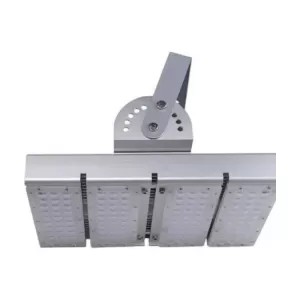
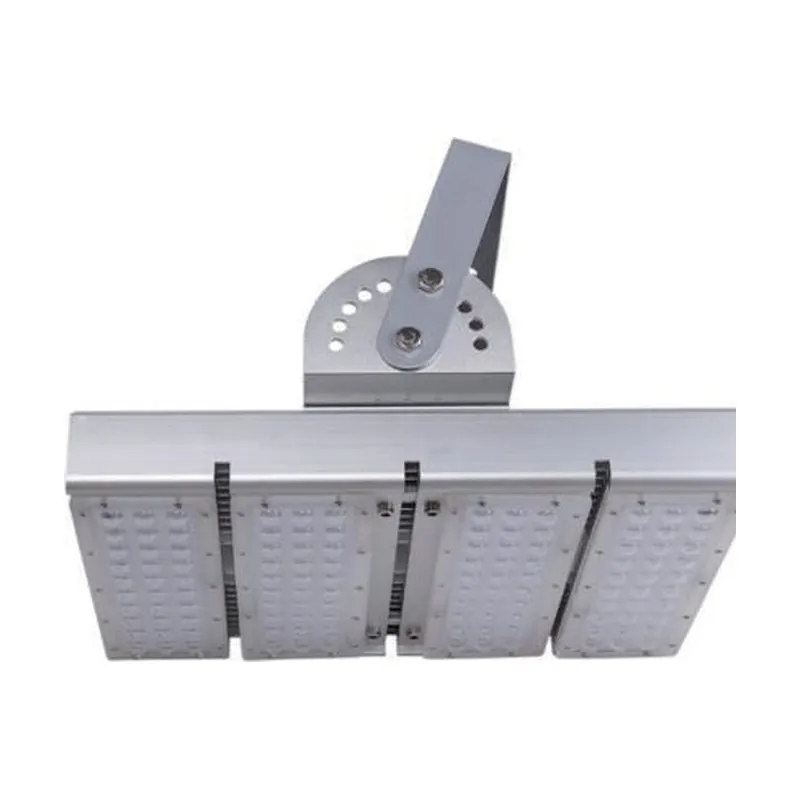
- Asymmetric optics. The BG-TZ-M’s 30° offset beam lets the glass stay nearly flat, so less light leaves the court and the bright LEDs are hidden from neighbouring windows.
- House-side shields and visors on floodlights facing homes cut light towards them. Our guide to street light shields explains how backlight control works; the same principle applies to floodlights.
- Pole height. A taller pole lets floodlights point more steeply down, which actually reduces spill. Very low poles push light sideways.
- Curfew timer. An automatic off time, for example 10 pm, avoids lights left on and is often a planning condition.
- Colour temperature. 4000 K looks less harsh than 5700 K and suits residential areas.
- Fencing and planting. Windbreak netting on the court fence and hedges outside it soften the view of the lit court.
Running costs
LED court lighting costs less to run than many homeowners expect. At 2 hours a night for 300 nights a year:
| Layout | Load | Energy per year | Cost at $0.15/kWh |
|---|---|---|---|
| 18 × 150 W (200 lux) | 2.7 kW | 1,620 kWh | about $243 |
| 21 × 200 W (300 lux) | 4.2 kW | 2,520 kWh | about $378 |
Use your own tariff and hours; a court used only at weekends costs a fraction of that.
Upgrading an old court
Older private courts often have four to six metal halide floodlights of 1,000 W. With ballast losses of about 10%, each draws about 1,100 W. We entered six of them, replaced by six poles of 3 × 150 W LED, into our LED retrofit savings calculator:
| Item | Metal halide | LED |
|---|---|---|
| Energy per year | 3,960 kWh | 1,620 kWh |
| Saving | 2,340 kWh (59%) | |
| Energy cost saving at $0.15 | about $351 a year |
LED also comes on instantly. Metal halide needs several minutes to warm up and longer to restrike after a power blip, which is frustrating mid-set. Old poles can often be reused if they are sound and the new heads’ weight and wind area are within the pole’s rating; see sports court lighting repair and replacement.
Approvals and practical points
- Planning: check whether poles and floodlights need permission, and what hours or spill limits apply.
- Supply: a 2.7–4.2 kW load usually needs its own circuit from the house board, sized for the cable run to the court.
- Switching: a simple switch at the court gate, plus a timer, is enough for most homes; a smart switch can be controlled from a phone.
- Multi-use courts: if the court is also for basketball or pickleball, plan the light level for the most demanding sport; see basketball and pickleball court lighting.
For standards and club layouts, our main tennis court lighting guide covers the detail.
Getting a layout
Send us the court size, a site plan showing the house and neighbouring buildings, and any pole positions you prefer. We will return a floodlight layout with the expected light level, a spill estimate towards the neighbours and the flood lights to match.
Sources
Frequently asked questions
How many lights do I need for a backyard tennis court?
For about 200 lux on a full court with run-off, about 18 LED floodlights of 150 W on 6 poles, by our calculation. A 4-pole corner layout uses fewer poles but gives less even light.
How high should residential tennis court light poles be?
Usually 6–10 m. Lower poles reduce visual impact but increase glare and need more fittings; 8 m is a common compromise for private courts.
How much does it cost to run tennis court lights?
For 18 × 150 W LED floodlights, about 2.7 kW. At 2 hours a night for 300 nights, that is about 1,620 kWh a year, or about $243 at $0.15 per kWh.
Do I need permission to light a tennis court at home?
Often, yes. Many councils treat floodlights and tall poles as development that needs approval, and may set hours and spill limits. Check before ordering.