Sports Court Lighting Repair and Replacement: Fix the Old Lamps or Change to LED?
How to diagnose failing court lights, when repair still makes sense, and what replacing twelve 400 W metal halide fittings with LED saves, from our calculators.
Key points
- Flickering, slow starts, pink or green light and dark patches on a court usually point to ageing metal halide lamps, ballasts or igniters, not to wiring faults.
- Replacing twelve 400 W metal halide fittings (456 W with ballast) with 200 W LED, used 6 hours a day, 300 days a year, saves about 5,530 kWh a year, 56%, in our retrofit calculator.
- For a 32 × 19 m indoor court area at 8 m, our high bay calculator gives 24 × 200 W LED fittings for 300 lux and 35 for 500 lux.
- Repair is worth it when the fittings are recent and only lamps fail; once ballasts, sockets and reflectors are going, replacement costs little more and ends the cycle.
Court lights rarely fail all at once. One fitting flickers, another takes ten minutes to come on, a third has turned pinkish, and the corners of the court are darker than they were. Clubs, schools and facility managers then face a choice: keep repairing the old fittings, or replace them with LED. This guide covers how to read the symptoms, when repair is still the right call, and what replacement saves, using our own calculators.
Common faults and what they mean
Most older court lighting uses metal halide lamps, typically 250–1,000 W, with a magnetic ballast and an igniter. Their faults are recognisable:
| Symptom | Likely cause | Fix |
|---|---|---|
| Lamp cycles on and off | End-of-life lamp or overheating | Replace lamp; check ventilation |
| Very slow start, dim for minutes | Ageing lamp, weak igniter | Replace lamp and igniter |
| Pink, green or blue tint | Lamp near end of life | Replace lamp (often all at once) |
| Fitting dead, lamp new | Ballast, igniter, capacitor or socket | Test components; replace failed part |
| Uneven court, dark patches | Lamp depreciation, misaimed or dirty fittings | Re-lamp, clean, re-aim |
| Breaker trips | Insulation fault, water ingress | Electrician to test wiring and fitting |
Metal halide lamps lose a good part of their output well before they stop working, so a court that “still works” may already be well below its design level. A light meter reading at a few points on the court tells you more than counting dead lamps.
When repair still makes sense
Repair is reasonable when:
- the fittings are fairly recent and only lamps are failing;
- the court meets its light level after re-lamping and cleaning;
- the club plans a full refurbishment in a year or two anyway;
- spare parts are easy to get.
Re-lamp a whole court at once rather than one lamp at a time; mixing old and new lamps gives uneven brightness and colour. Clean reflectors and glass while you are up there, and check the aiming.
When replacement is the better choice
Once ballasts, igniters and sockets start failing, every visit costs a lift hire and a technician’s time, and the next fitting fails a month later. That is usually the moment to replace. Other signs:
- reflectors are dull or corroded, so new lamps do not restore the level;
- the court needs a higher level for competition or for broadcasting;
- the restart delay after a power cut is a safety problem;
- energy prices make the running cost hard to justify.
What replacement saves: twelve 400 W fittings
A typical older indoor court or small outdoor court might have twelve 400 W metal halide fittings. With a magnetic ballast, each draws about 456 W. We ran that through our LED retrofit savings calculator, replacing each with a 200 W LED fitting, at 6 hours a day, 300 days a year and an electricity price of $0.15/kWh:
| Metal halide | LED | |
|---|---|---|
| System power per fitting | 456 W | 200 W |
| Annual use | 9,850 kWh | 4,320 kWh |
| Annual saving | — | 5,530 kWh (56%) |
| Energy cost saving | — | about $830 a year |
| Maintenance saving (calculator default, $20 vs $2 per fitting) | — | about $216 a year |
Use your own electricity price and hours. A club court lit 3 hours a night saves half as much; a school hall used 12 hours a day saves twice as much. Our guide to metal halide to LED covers the wattage equivalents in more detail.
How many fittings for the new layout
A like-for-like swap is not always right: if the court was under-lit, the new layout should fix that. For an indoor court area of 32 × 19 m (a basketball court with run-off) and an 8 m mounting height, our high bay lighting calculator gives, with 200 W fittings at 100 lm/W and a maintenance factor of 0.8:
| Target | Typical level of play | Fittings | Average |
|---|---|---|---|
| 300 lux | Training, schools, recreation | 24 (6 × 4) | 391 lux |
| 500 lux | Club competition | 35 (7 × 5) | 570 lux |
EN 12193 gives about 200 lux for recreational and training basketball, 500 lux for club competition and 750 lux for national matches; the sports hall project we supplied in Hunan shows a typical arrangement of floodlights and high bays. For outdoor courts, see our guides to tennis court lighting and basketball court lighting.
Glare and ball impact
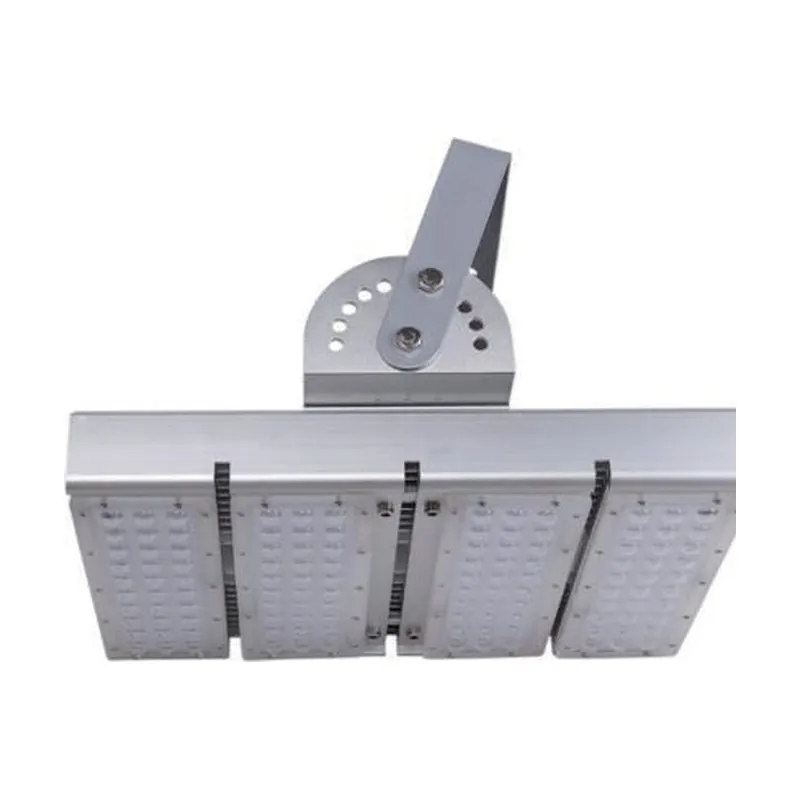
Players look up. A court retrofit should keep fittings away from the main lines of play, use optics or louvres that hide the LEDs from normal viewing angles, and use guards or impact-resistant bodies where balls can hit them. Mounting fittings beside rather than directly above the main playing area is the simplest fix for glare. Our modular LED sports floodlight is designed for aiming from the sides of a court or field.
Practical points for the change-over
- Wiring. LED fittings do not need the old ballast or igniter. Remove them or bypass them, and check the cable insulation; old cables near hot lamps are often brittle.
- Controls. LED allows instant on/off and dimming. A simple two-level switch (training and match) saves energy on most courts.
- Brackets. Check that the new fitting fits the old bracket or plan new brackets. Outdoor poles need a wind-load check if the new fitting’s area is larger.
- Aiming. Do not copy the old aiming blindly. Use the new photometric layout.
- Disposal. Metal halide lamps contain mercury and must be recycled, not thrown away.
A simple decision rule
If only lamps fail and the level is fine after re-lamping, repair. If two or more components are failing, the level is short, or the court is used most evenings, replace with LED. The saving pays for the change over time, and the call-outs stop.
Send us the court size, mounting height, the current fittings and how many hours the court is used, and we will return a layout, a fitting list and the savings worked through our calculators.
Sources
Frequently asked questions
Why do my court lights take so long to come on?
Metal halide lamps need several minutes to reach full output, and after a power cut they must cool down before they can restart. As the lamp ages, the warm-up gets longer and the colour shifts. LED fittings reach full output instantly and restart at once.
Should I replace the bulbs or the whole fixture?
If the fittings are less than about ten years old and only lamps fail, replacing lamps is cheap. If ballasts, igniters, sockets or reflectors are also failing, or parts are hard to get, replacing the whole fitting with LED usually costs little more and removes the repeated call-outs.
How much electricity does an LED court retrofit save?
In our example of twelve 400 W metal halide fittings replaced with 200 W LED, used 1,800 hours a year, consumption falls from about 9,850 kWh to 4,320 kWh a year, a 56% saving.
Can I keep the old poles or brackets?
Often yes. LED fittings are usually lighter than metal halide ones. Check the bracket fixing, the cable condition and the aiming angle; outdoor poles also need a wind-load check if the new fitting has a larger area.