
How Explosion-Proof Lights Are Tested Before They Get a Certificate
The tests behind an explosion-proof light certificate: explosion pressure, overpressure, flame transmission, impact, thermal shock, IP and surface temperature, and how to check them.
Key points
- A certificate rests on type tests made on samples by the certification body, plus routine tests and a quality system at the factory.
- Flameproof enclosures are tested by igniting gas inside them: first to measure the explosion pressure, then at 1.5 times that pressure, then to prove the flame does not escape through the joints.
- Mechanical and climatic tests follow: impact on the housing and glass, thermal shock on the glass, thermal endurance of seals, ingress protection and maximum surface temperature.
- Our BED series was tested under GB/T 3836 parts 1, 2, 3, 9 and 31 (the Chinese adoptions of IEC 60079-0, -1, -7, -18 and -31), certificate ZJEx23.0914.
An explosion-proof certificate is a short document: a number, a marking such as Ex db eb mb IIC T4 Gb, a model list and a validity date. Behind it sit weeks of testing in which samples are deliberately filled with explosive gas, set off, struck, frozen, heated and sprayed. Knowing what those tests are helps a buyer tell a real certificate from a nice-looking test report, and helps an engineer understand what the marking really guarantees. For a guide to reading the marking itself, see explosion-proof light ratings explained.
Two kinds of testing
Type tests are made once, on samples of a design, by the certification body’s laboratory. They prove the design meets the standard. A certificate is issued only after the type tests pass and the drawings are reviewed.
Routine tests are made on production units at the factory. They prove each unit matches the tested design. The factory’s quality system is audited so that the routine tests actually happen.
The standards that set the tests are the IEC 60079 series, adopted as EN 60079 in Europe and as GB/T 3836 in China. Our explosion-proof standards guide shows how the families fit together.
Tests on a flameproof enclosure (Ex d)
Flameproof protection accepts that gas may enter the housing and ignite. The housing must survive the explosion and stop the flame from reaching the outside. IEC 60079-1 tests exactly that.
1. Reference pressure
The empty enclosure (with its internal parts in place) is filled with the test gas mixture for its group and ignited. Pressure sensors record the peak. This is the reference pressure. For IIC equipment the tests use hydrogen and acetylene mixtures, which give the most severe results.
2. Overpressure test
The enclosure is then pressurised to 1.5 times the reference pressure, either statically with water or dynamically with gas. It must not break or deform permanently in a way that widens the flame paths.
3. Flame transmission test
The enclosure is placed in a chamber filled with an explosive mixture, with the same mixture inside. The inside is ignited, repeatedly. The test passes only if the outside mixture never ignites. For this test the joint gaps are usually set at or above the maximum allowed by the drawings, so the result covers worst-case production.
4. Routine overpressure
In production, each enclosure is pressure-tested again, unless the type test was carried out at four times the reference pressure. That is why some manufacturers choose a heavier housing: it removes a routine test on every unit.
Tests from the general standard (IEC 60079-0)
Every Ex light, whatever its protection type, goes through the general tests:
| Test | What is done | Why |
|---|---|---|
| Impact | A 1 kg mass is dropped on the housing and on the glass from a set height | Proves the light survives knocks from tools and ladders |
| Thermal shock | Cold water is sprayed on the hot glass | Proves the glass does not crack in rain or wash-down |
| Thermal endurance | Seals and plastic parts are aged hot and cold | Proves gaskets keep the IP rating over time |
| Ingress protection | Dust and water tests to IEC 60529 | Keeps dust and water out of electrical parts |
| Torque and cable entry | Bushings and glands are twisted and pulled | Proves the entries stay tight |
| Surface temperature | Measured at maximum ambient and supply voltage | Sets the temperature class (T1–T6) |
Impact energies depend on the part and the risk of mechanical damage: housings in a high-risk position must take 7 J, unguarded light-transmitting parts 4 J. Most industrial lights are tested to the high-risk values.
Tests for the other protection types on the same light
Modern LED explosion-proof lights often combine several protection types, and each one has its own tests:
- Increased safety (Ex e), usually the terminal box: clearances and creepage distances are measured, terminals are tested for temperature rise and secure clamping. Our Ex eb increased safety article explains why this is used for terminals.
- Encapsulation (Ex m), usually the driver: the potting compound is tested for temperature and adhesion, and the driver is tested under fault conditions so that it cannot overheat inside the compound.
- Dust protection (Ex t): dust-tight IP6X testing and surface-temperature measurement, sometimes with a dust layer on the light.
A real example: our BED certificate
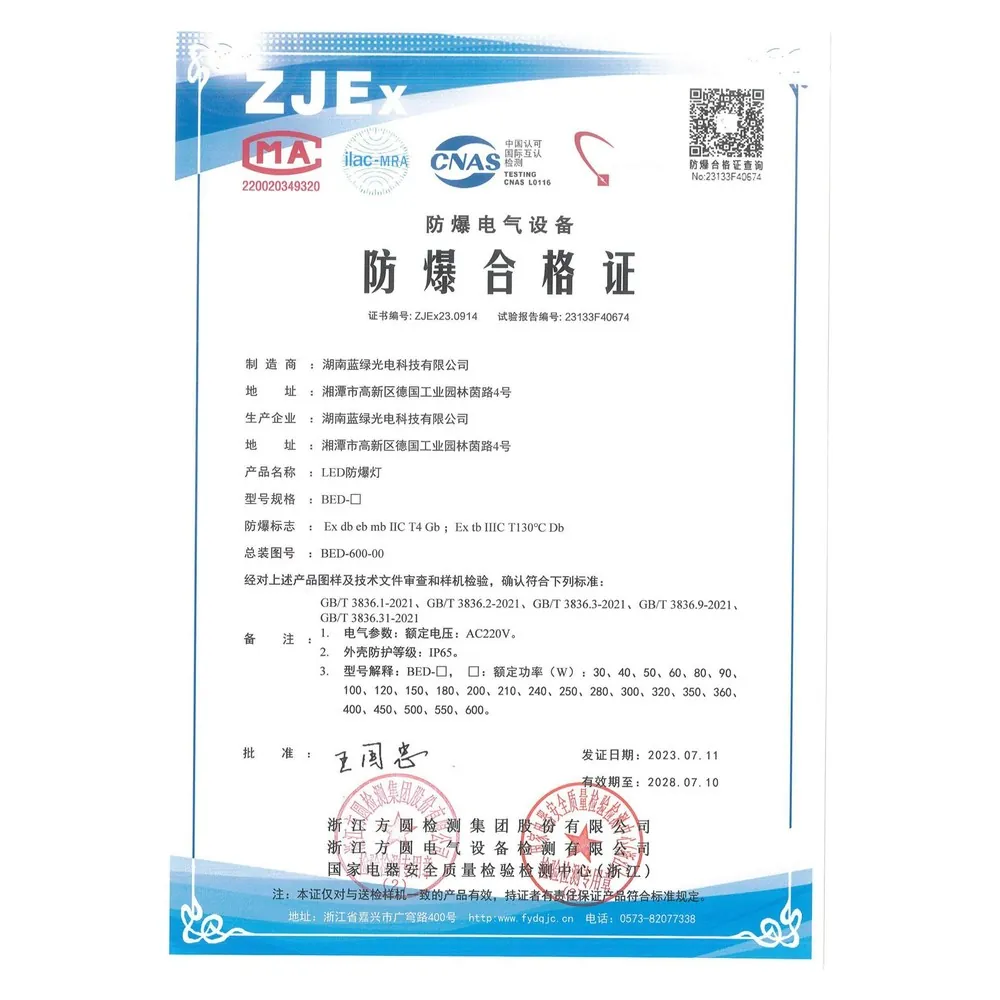
Our BED series is a good illustration because it uses four protection types in one light. Its certificate ZJEx23.0914 was issued by Zhejiang Fangyuan Electrical Equipment Testing, valid from July 2023 to July 2028, and covers 30–600 W. The standards on the certificate tell you which test sets were applied:
| GB/T 3836 part (2021) | IEC equivalent | Applies to |
|---|---|---|
| 3836.1 | IEC 60079-0 | General tests above |
| 3836.2 | IEC 60079-1 | Flameproof LED and driver chamber (db) |
| 3836.3 | IEC 60079-7 | Increased-safety terminal box (eb) |
| 3836.9 | IEC 60079-18 | Encapsulated parts (mb) |
| 3836.31 | IEC 60079-31 | Dust protection (tb) |
The resulting markings are Ex db eb mb IIC T4 Gb for gas and Ex tb IIIC T130 °C Db for dust, IP65.
The temperature figures are worth a quick calculation. T4 allows a surface temperature up to 135 °C, and the dust marking says 130 °C. A dust with a cloud ignition temperature of 300 °C must be kept below two-thirds of that (200 °C), and a 5 mm layer with an ignition temperature of 250 °C must be kept below 250 − 75 = 175 °C. Both are above 130 °C, so the light is acceptable for those dusts. For dust areas in general, see combustible dust lighting for Zone 21 and 22.
How to check test claims from a supplier
- Ask for the certificate, not a test report. A test report from a general lab (for example an IP test alone) is not an Ex certificate.
- Check the number with the issuer. IECEx certificates are in a public online database; other schemes can be checked with the issuing body.
- Match the model and power. A certificate for 50–150 W does not cover a 200 W version.
- Match the marking to your area. Gas group, temperature class and equipment protection level must suit your zone drawing.
- Ask about the factory audit. ATEX and IECEx require a quality assessment of production; Chinese certificates also involve factory inspection.
After installation
Testing does not end at the factory. Inspections on site follow IEC 60079-17, and any repair that touches a flame path must follow IEC 60079-19. Our explosion-proof light maintenance guide covers what a site team may and may not do.
What to send us
The zone drawing, gas group, temperature class and the certification scheme your project requires. We will tell you which of our series fit, send the certificate, and say clearly where we cannot meet a scheme.
Sources
- IEC 60079-0 — Explosive atmospheres, Part 0: Equipment, general requirements
- IEC 60079-1 — Equipment protection by flameproof enclosures 'd'
- IEC 60529 — Degrees of protection provided by enclosures (IP code)
- IECEx — Certified Equipment Scheme and online certificate database
- BlueGreen OE — BED explosion-proof LED light
Frequently asked questions
Who tests explosion-proof lights?
An accredited certification body and its laboratory, not the manufacturer alone. Examples are notified bodies under ATEX, IECEx certification bodies, and Chinese bodies such as the one that issued our BED certificate.
What is a flame transmission test?
The enclosure is filled with and surrounded by an explosive gas mixture, the inside mixture is ignited, and the test passes only if the outside mixture does not ignite. It proves the flame paths cool the escaping gases enough.
Are explosion-proof lights tested again after production?
Each flameproof enclosure gets a routine overpressure test unless the type test was done at four times the reference pressure. Other routine checks and an audited factory quality system keep production the same as the tested sample.
Does an IP66 test mean the light is explosion-proof?
No. IP is about dust and water entry. It is one test among many on an Ex light, and an IP66 light without an Ex certificate is not allowed in a hazardous area.
How can I check a supplier's certificate?
Ask for the certificate number and look it up with the issuing body or in the IECEx online database. Check that the model, power range and marking on the certificate match the light you are buying.
