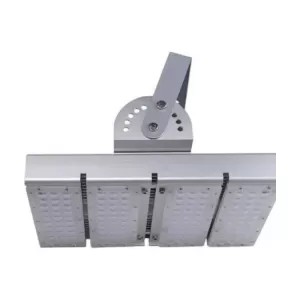
Sports Complex Lighting: Planning a Pitch, Courts and a Hall as One Project
How to plan lighting for a sports complex: light levels per facility, a worked load of 45.9 kW for a pitch, four tennis and two basketball courts, shared controls, standard fittings and phasing.
Key points
- Plan a sports complex as one lighting project: one set of light levels, one control system, a small range of fittings and spares, and one supply design.
- Our worked complex, with a football pitch at 200 lux, four tennis courts at 200 lux and two basketball courts at 200 lux, needs about 45.9 kW of LED floodlights by the lumen method.
- At 1,000 hours a year at full output that is 45,900 kWh, about US$6,885 at US$0.15/kWh, before scenes and timers cut it further.
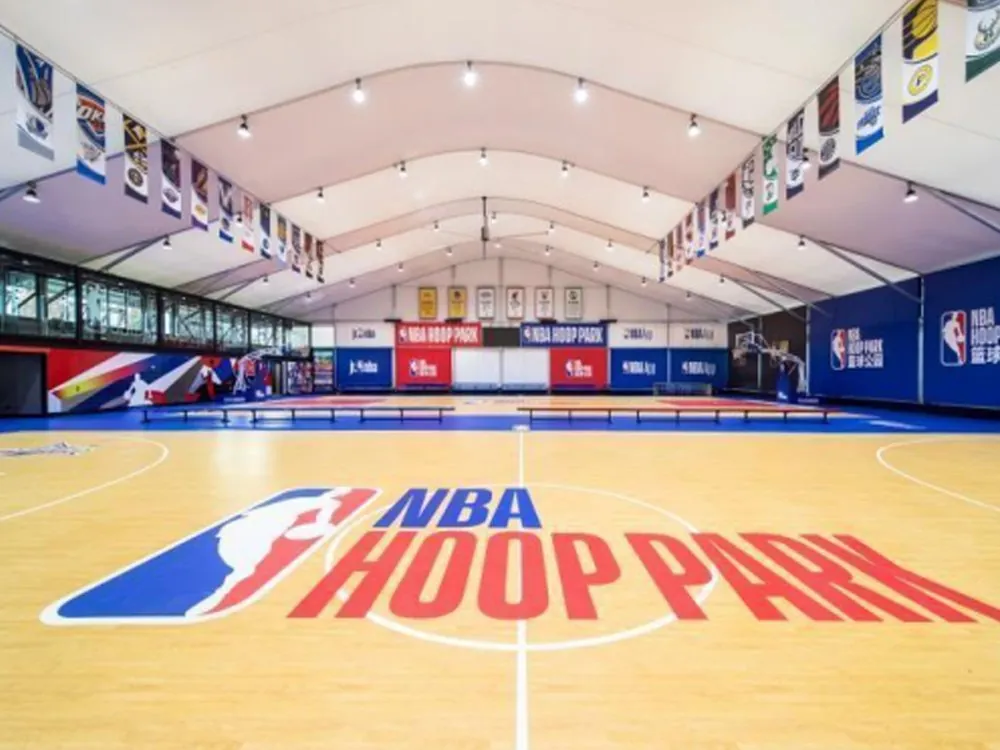
- Standardising on two or three fitting families across the site keeps spares simple: we lit two basketball arenas and a training hall in Hunan with LED fittings mounted high above the courts.
A sports complex is rarely lit all at once. A football pitch gets floodlights, a few years later the tennis club adds courts, then a hall is built, each with a different contractor and different fittings. The result is three control panels, five types of spare parts and a supply that was never designed for the total. Sports complex lighting works better planned as one project from the start, even if it is built in phases. This guide shows how, with a worked load for a typical site.
Step 1: list the facilities and their levels
Start with a table of every space, its size and the highest level of play you expect in the next ten years. Light levels come from EN 12193 or the sport’s federation:
| Facility | Size lit | Level | Target |
|---|---|---|---|
| Football pitch | 105 × 68 m | Training and club play | 200 lux |
| Four tennis courts | 36 × 18 m each | Recreational | 200 lux |
| Two outdoor basketball courts | 32 × 19 m each, with run-off | Club play | 200 lux |
| Indoor hall | per design | Club competition | 500 lux |
| Car park and paths | per area | Safe access | 10–20 lux |
Our sports field lighting lux levels guide lists targets for other sports.
Step 2: size each facility
Using our product data and the lumen method:
- Football pitch: about 30 of our 1,000 W LED stadium lights for 200 lux, on 6 poles. Load: 30 kW.
- Tennis courts: 18 of our 150 W court floodlights per court for 200 lux. Four courts: 72 fittings, 10.8 kW. Shared poles between courts reduce the pole count.
- Basketball courts: 32 × 19 m at 200 lux with 150 W fittings at 100 lm/W, a utilisation factor of 0.6 and a maintenance factor of 0.8 gives 17 fittings per court. Two courts: 34 fittings, 5.1 kW.
| Facility | Fittings | Load |
|---|---|---|
| Football pitch | 30 × 1,000 W | 30.0 kW |
| Tennis, 4 courts | 72 × 150 W | 10.8 kW |
| Basketball, 2 courts | 34 × 150 W | 5.1 kW |
| Outdoor total | 136 | 45.9 kW |
The indoor hall is sized separately with the high bay lighting calculator; our indoor sports hall lighting guide works through one.
Layouts for each area are covered in our sports field lighting layout guide, tennis court lighting guide and basketball court lighting guide.
Step 3: the supply
45.9 kW of outdoor floodlights plus a hall and car park is a significant three-phase load. Plan:
- one main lighting distribution board, or one per area fed from it;
- circuits balanced across the three phases;
- cable sizes for voltage drop over the longest runs, often to the far side of the pitch;
- surge protection at the board and on tall poles;
- capacity for the final phase, not only the first.
Step 4: running cost
At 1,000 hours a year with everything at full output:
45.9 kW × 1,000 h = 45,900 kWh a year, about US$6,885 at US$0.15/kWh.
In practice not every facility is used every evening, and training levels are lower than match levels. Scenes and schedules typically cut this a great deal; our sports lighting control systems guide shows a 58 % saving on a stadium with a training-heavy schedule.
Step 5: one control system
A single system for the whole complex lets the manager:
- link lighting to bookings, so only booked courts light up;
- set scenes per facility (match, training, cleaning);
- switch paths and car park lights on a dusk sensor and step them down after closing;
- see faults from one screen.
Separate panels for each facility, each with its own timer and keys, are the most common reason lights stay on after hours.
Step 6: keep the fitting range small
Standardise on as few families as possible:
| Family | Used for |
|---|---|
| Large floodlight, 800–1,500 W | Pitch, athletics |
| Court floodlight, 50–300 W, asymmetric | Tennis, basketball, padel, small-sided football |
| High bay | Indoor halls |
| Area and path lights | Car parks, walkways |
Fewer families mean fewer spare types, one maintenance procedure per family and easier replacement years later. We supplied LED lighting for two basketball arenas and a sports training hall in Hunan, with fittings mounted high above the courts to keep glare out of players’ eyes; see the project page.
Step 7: phase the build, not the design
If the budget comes in stages:
- Phase 1: trenches, ducts and foundations for the whole site; the pitch lights and main board.
- Phase 2: court poles and fittings, connected to the existing control system.
- Phase 3: hall, paths and car park.
Ducts across a finished pitch or a new car park cost far more than ducts laid in phase 1.
Maintenance across the site
One maintenance plan with one yearly lux survey route covers every facility. Our sports lighting maintenance plan lists the checks and spares.
What to send us
Send a site plan with each facility, the level of play, pole positions available, the supply point and how you plan to phase the work. We will return fitting schedules, layouts and loads for each facility, and a combined total for the supply design.
Sources
Frequently asked questions
How do you plan lighting for a sports complex?
List every facility with its size and highest level of play, set the light level for each, choose a small range of fittings, size the loads and supply, and put everything on one control system with scenes and schedules. Phase the work if the budget requires it, but design the poles and cabling for the final layout.
How much power does sports complex lighting need?
It depends on the facilities and levels. Our example with one full-size football pitch, four tennis courts and two basketball courts at club-training levels needs about 45.9 kW of LED floodlights.
Should every facility use the same light fittings?
Not the same model everywhere, but as few families as possible: one large floodlight for the pitch, one court floodlight for tennis and basketball, and one high bay for halls. That keeps spares and maintenance simple.
Can a sports complex be lit in phases?
Yes. Install the trenches, ducts and pole foundations for the whole site in the first phase, even if some poles and fittings come later. Retro-fitting ducts across finished pitches and paths costs far more.