230 W LED Floodlights for a Sports Pitch: How Many, How High and Where They Fit
Where 200–250 W LED floodlights make sense on sports pitches, how many a 5-a-side or 7-a-side pitch needs at 100 and 200 lux by the lumen method, and when to move up to bigger floods.
Key points
- A 230 W LED floodlight at about 100 lm/W gives some 23,000 lm: the right size for small-sided pitches, training areas and courts on 6–10 m poles.
- By the lumen method, a 40 × 20 m 5-a-side pitch needs about 8 floods of this size for 100 lux and 16 for 200 lux, typically on four poles.
- A 60 × 40 m 7-a-side pitch at 100 lux needs about 24; a full-size pitch at 75 lux would need over 50, so larger floodlights on taller poles are the better choice there.
- Our modular sports floodlight comes in 200 W and 250 W steps with an asymmetric 140° × 80° optic that keeps light on the pitch and out of players' eyes.
“230 W LED floodlight” is a common search from clubs, schools and contractors planning lights for a small pitch. LED floodlights in the 200–250 W class are a good match for small-sided football, training areas and multi-use games areas, but not for full-size pitches. This guide shows how many you need for different pitch sizes, how high to mount them, and where the size stops making sense.
What 230 W gives you
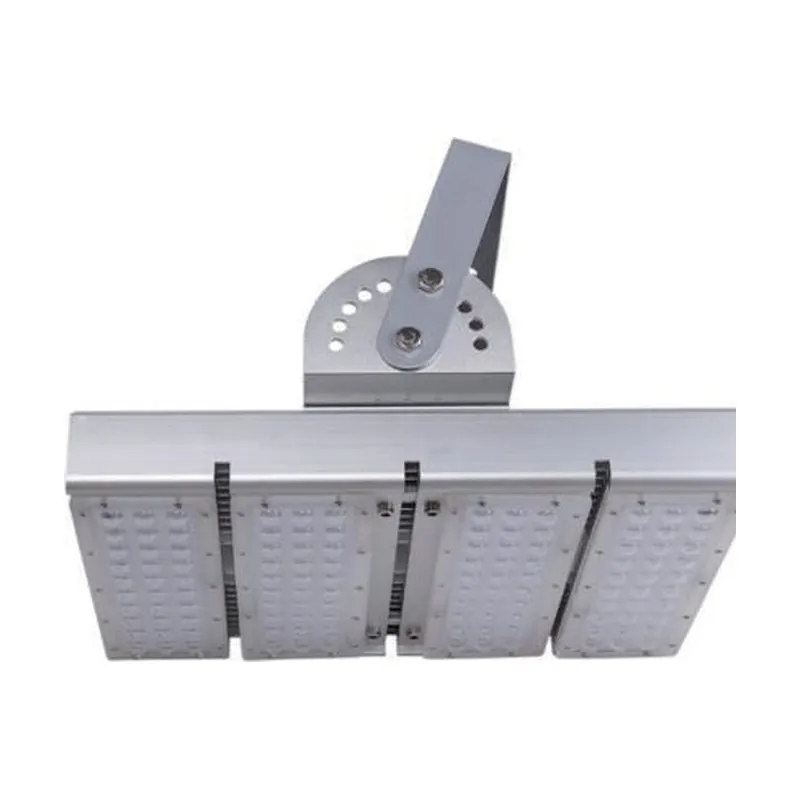
Light output is power times efficacy. At about 100 lm/W, a 230 W floodlight gives about 23,000 lm. Our modular LED sports floodlight BG-TZ-M comes in 50 W steps from 50 to 300 W, so the nearest sizes are 200 W (about 20,000 lm) and 250 W (about 25,000 lm) at more than 100 lm/W. Its 140° × 80° optic with a 30° offset is asymmetric: it throws light forward onto the pitch from a pole at the edge, rather than up into the sky or into players’ eyes.
How much light a pitch needs
EN 12193 sets three classes for outdoor football:
| Class | Average horizontal | Use |
|---|---|---|
| I | 500 lux | High-level competition |
| II | 200 lux | Mid-level competition, serious training |
| III | 75 lux | Training, recreational play |
Many small-sided and recreational pitches are lit to 100–200 lux. Our article on sports field lighting lux levels compares sports.
The lumen method
lumens needed = target lux × pitch area ÷ (utilisation factor × maintenance factor)
On small pitches with poles close to the playing area, a utilisation factor of about 0.55–0.6 is realistic for asymmetric optics; we use a maintenance factor of 0.8.
Example 1: a 5-a-side pitch, 40 × 20 m
Area 800 m², utilisation factor 0.6:
| Target | Lumens needed | 230 W floods | Layout |
|---|---|---|---|
| 100 lux | about 167,000 lm | about 8 | 4 poles × 2 |
| 200 lux | about 333,000 lm | about 16 | 4 poles × 4 |
Four poles, one near each corner or two on each long side, at 6–8 m, give good coverage on a pitch this size. Two-pole layouts on one side are cheaper but leave the far side darker and send more glare across the pitch.
Example 2: a 7-a-side pitch, 60 × 40 m
Area 2,400 m², utilisation factor 0.55:
| Target | Lumens needed | 230 W floods | Layout |
|---|---|---|---|
| 100 lux | about 545,000 lm | about 24 | 6 poles × 4 |
| 200 lux | about 1.09 million lm | about 48 | 6–8 poles, larger floods advisable |
At 200 lux, eight floods per pole on six poles is a heavy load at 8–10 m. Moving to 300 W floods, or to larger heat-pipe floodlights on taller poles, cuts the count. See our soccer field lighting guide for the larger formats.
Example 3: why not a full-size pitch?
A 100 × 64 m pitch (6,400 m²) at class III, 75 lux, with a utilisation factor of 0.5:
75 × 6,400 ÷ 0.4 = 1.2 million lm, or more than 50 floods of 230 W.
That many fittings need many poles, much cabling and many aiming points. Full-size pitches are lit with 400–1,000 W floodlights on 15–20 m masts, which put the same lumens on the pitch from four to eight positions. Our heat-pipe stadium floodlight covers that range, and the football field lighting guide explains the layouts.
Pole height and aiming
- Height: 6–8 m for 5-a-side and courts, 8–10 m for 7-a-side and training grids.
- Aiming: the beam centre should not point higher than about 70° from the vertical; above that, glare rises quickly for players looking up at the ball.
- Asymmetric optics let the floodlight face nearly flat (front glass close to horizontal) while still throwing light onto the pitch, which reduces glare and spill. Our anti-glare training pitch lighting article covers this in detail.
- Back spill: if houses are close, add shields or choose positions on the side away from them.
Running costs
Sixteen floods of 230 W draw about 3.7 kW. At 3 hours a night on 300 nights a year:
3.7 kW × 900 h ≈ 3,300 kWh a year, about 500 at 0.15 per kWh.
Two switching modes, for example 100 lux for casual play and 200 lux for training, cut that further. See our football pitch floodlighting cost guide for installation and running costs together.
What to check on the data sheet
- Efficacy of the complete fitting, to convert watts into lumens.
- Optic: asymmetric for edge poles, with a stated tilt range.
- IP rating: IP65 or better outdoors.
- Wind area and weight, for the pole design.
- Driver: surge protection and, if needed, dimming for multiple modes.
Ordering
Send the pitch size, the level of play or target lux, and the pole positions and heights you have in mind. We will check the count with a photometric layout, propose wattages and optics, and send the IES files with the quotation.
Sources
Frequently asked questions
How many 230 W floodlights does a 5-a-side pitch need?
About 8 for recreational play at 100 lux and about 16 for training at 200 lux on a 40 × 20 m pitch, by the lumen method with lights at about 100 lm/W. A photometric design confirms uniformity.
Is 230 W enough for a full-size football pitch?
Not practically. A 100 × 64 m pitch at 75 lux needs about 1.2 million lumens, more than 50 floods of this size. Full-size pitches use 400–1,000 W floodlights on 15–20 m masts.
What pole height suits 230 W floodlights?
Typically 6–10 m on small pitches and courts. Higher poles allow steeper aiming and less glare, but need more powerful or narrower floods to keep the light level.
How much does it cost to run 16 floodlights of 230 W?
They draw about 3.7 kW. At 3 hours a night, 300 nights a year and 0.15 per kWh, that is about 3,300 kWh and 500 in local currency per year.