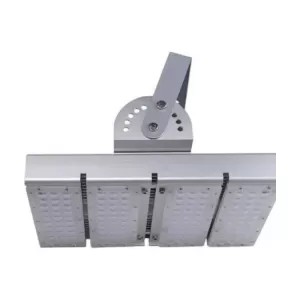
Anti-Glare Floodlights for Football Night Training: Pole Height, Aiming Angles and Asymmetric Optics Compared
How to keep glare down on a floodlit football training pitch: the aiming angle and pole height geometry worked out for a 60 × 40 m pitch, and symmetric versus asymmetric floodlights compared.
Key points
- Glare on a training pitch comes mostly from geometry: floodlights mounted too low and tilted too far up, so players looking across the pitch see the bright LEDs.
- On a 60 × 40 m pitch with poles 3 m behind the touchline, aiming at the far third gives an aiming angle of about 75° from vertical on 8 m poles, 68° on 12 m and 63° on 15 m; most guides keep it below about 70°.
- With a symmetric 60° beam aimed at 68°, the top of the beam points about 8° above the horizon; that light is wasted and glaring.
- An asymmetric floodlight like our BG-TZ-M, whose peak is 30° off the glass, needs its glass tilted only about 38° from flat-down for the same aim, so the LEDs stay out of players' sight lines.
- By the lumen method, 18 BG-TZ-M at 300 W on 6 poles give about 108 lux for training, and 36 give about 216 lux for club matches.
Night training is where most of a club’s floodlight hours go, and it is where poor lighting hurts most. A goalkeeper loses a cross in the glare; a winger cannot pick out a pass against bright heads on the far side. The cause is rarely a lack of light. It is the angle at which the light reaches the eye. This guide works through the geometry for a typical training pitch and compares two types of floodlight for glare.
Where glare comes from
A player sees glare when a floodlight’s bright surface sits in their normal field of view. On a football pitch players look across and up, following long balls. Three things put floodlights in their eye line:
- Low poles, so floodlights must be tilted up to reach the far side
- Large aiming angles, measured from straight down, so the beam’s upper edge rises above the horizon
- Optics that need steep tilt, so the glass faces the players rather than the grass
EN 12193 uses a glare rating (GR) to measure the result. It does not tell you how to achieve it; geometry and optics do.
The pitch we used
A 60 × 40 m pitch, the size of many seven-a-side and training areas, with three poles on each long side set 3 m back from the touchline. Each floodlight is aimed at a point on the pitch; the hardest ones reach the far third, about 26.7 m into the pitch, or 29.7 m horizontally from the pole.
Aiming angle by pole height
The aiming angle from vertical is the arctangent of the horizontal distance divided by the mounting height. We also worked out the angle at which a player standing on the centre line looks up to the floodlights; a common rule is that this should be at least about 25°.
| Pole height | Aiming angle to far third | View angle from centre line | Verdict |
|---|---|---|---|
| 8 m | 74.9° | 19.2° | Glaring; heads close to players’ sight line |
| 10 m | 71.4° | 23.5° | Borderline |
| 12 m | 68.0° | 27.6° | Acceptable for training |
| 15 m | 63.2° | 33.1° | Good; least glare and spill |
Most sports lighting guides keep the main aiming angles below about 70°. On this pitch, that means poles of at least 12 m. The extra cost of four more metres of steel is usually smaller than the cost of complaints and poor training conditions.
Symmetric versus asymmetric floodlights
A symmetric floodlight sends its beam straight out of the glass. To aim the beam centre at 68° from vertical, the glass itself faces 68° from straight down: almost at the players. With a 60° beam, the upper edge points at 68° + 30° = 98°, about 8° above the horizon. That top slice of the beam lights the sky and the eyes of anyone on the far side.
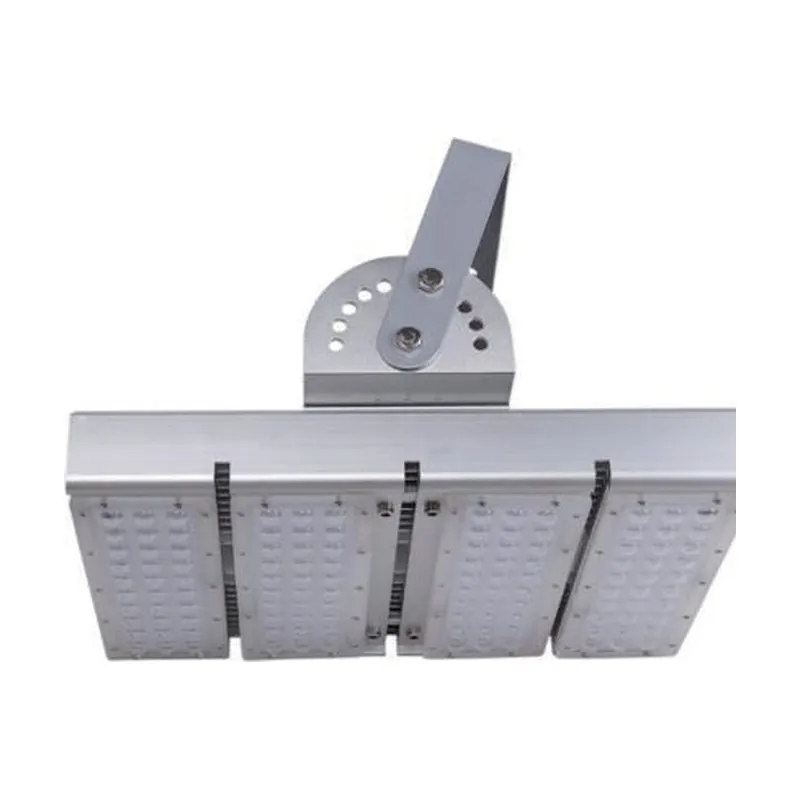
An asymmetric floodlight sends its peak intensity at an angle to the glass. Our modular LED sports floodlight BG-TZ-M is available with a 140° × 80° beam with a 30° offset. To aim its peak at 68°, the glass is tilted only 68° − 30° = 38° from straight down.
| Item | Symmetric 60° floodlight | BG-TZ-M, 30° offset |
|---|---|---|
| Aim of peak intensity | 68° | 68° |
| Glass tilt from straight down | 68° | 38° |
| Upper beam edge vs horizon | about 8° above | sharp cut-off above the peak |
| What a player on the far side sees | The bright LED face | Mostly the side of the housing |
| Light above the horizon | Significant | Little |
On 15 m poles, the same comparison gives a glass tilt of 63° for the symmetric light and 33° for the asymmetric one. The flatter the glass, the less of its brightness reaches the eye.
How many floodlights for training and club play
We used the lumen method with the utilisation and maintenance factors behind our own published court figures (a combined factor of about 0.48) and the BG-TZ-M at 300 W and its rated minimum of 100 lm/W, so 30,000 lumens per light:
| Target | Floodlights needed | On 6 poles | Average | Load |
|---|---|---|---|---|
| 100 lux training | 16.7 → 18 | 3 per pole | about 108 lux | 5.4 kW |
| 200 lux (class II, club matches) | 33.3 → 36 | 6 per pole | about 216 lux | 10.8 kW |
Two heads per pole would give only about 72 lux, just short of the 75 lux of EN 12193 class III, so the three-per-pole layout is the practical minimum here and leaves margin as the LEDs age. Using more, smaller floodlights also helps glare. Each head is less bright, the light comes from more directions, and shadows are softer. A lighting simulation confirms uniformity and GR before the poles are ordered.
Other ways to cut glare
- Visors and louvres on the floodlights facing houses or a road. They cut spill and the view of the LEDs from outside the pitch, at a small cost in efficiency.
- Aim symmetric heads lower and let neighbouring heads overlap, rather than reaching for the far touchline.
- Keep poles off the goal lines. Floodlights directly behind the goals sit in the goalkeeper’s line of sight during crosses.
- Dim for training. A dimmable driver lets the same installation run at 100 lux on weeknights and 200 lux on match days.
- Warmer colour temperature at 4000 K rather than 5700 K is often perceived as less harsh.
Neighbours and the night sky
Glare at the pitch and spill outside it have the same cure. Asymmetric optics with flat glass put less light above the horizon, which is what planning conditions on obtrusive light usually ask for. Our football field lighting guide gives full-size pitch layouts, and stadium lighting requirements sets out uniformity and broadcast levels.
What to send us
Pitch dimensions, pole positions if they are fixed, the light level you want for training and matches, and any planning limits on spill. We will return the pole height, the number and aiming of BG-TZ-M or other flood lights, and the expected average and uniformity.
Sources
Frequently asked questions
How do you reduce glare from football floodlights?
Use taller poles so floodlights are aimed more steeply down, keep aiming angles below about 70° from vertical, choose asymmetric optics that keep the glass close to horizontal, and add visors or louvres where neighbours or roads are close.
What height should training pitch floodlight poles be?
For a small-sided or training pitch around 60 × 40 m with poles on the long sides, 12–15 m keeps aiming angles below about 70°. Lower poles are cheaper but glare more and spill more light.
How many lux does a football training pitch need?
EN 12193 gives 75 lux for class III (training and recreational), 200 lux for class II (club matches) and 500 lux for class I (top level). Many clubs light training areas to 100–200 lux.
What is the glare rating GR?
GR is the glare rating used in outdoor sports lighting, calculated from the luminaires' brightness in the observer's view against the lit background. Lower is better; football specifications commonly set a maximum of around 50.