Sports Field Lighting Layout: 4, 6 and 8-Pole Arrangements and How Many Lights per Pole
Choosing a sports field lighting layout: corner, 6-pole and 8-pole football arrangements, tennis and multi-court layouts, keep-out zones for glare, and fittings per pole from our floodlight data.
Key points
- The layout, meaning where the poles stand and how many there are, decides uniformity and glare more than the choice of floodlight; fix it before counting fittings.
- Community football pitches usually use 6 or 8 side poles; 4 corner masts suit stadiums with stands and need tall masts and narrow beams.
- Our product data gives about 30 of our 1,000 W stadium lights for 200 lux training on a 105 × 68 m pitch: about 8 per pole on 4 poles, 5 per pole on 6, or 4 per pole on 8.
- Keep poles out of the zones behind the goals and baselines where players look up; federations set the exact angles.
Before anyone chooses a floodlight, someone has to decide where the poles go. The sports field lighting layout sets how even the light can be, how much glare players see and how much light spills outside. It also fixes the most expensive items in the budget: poles, foundations and trenches. This guide compares the common layouts for football and courts, explains the keep-out zones, and shows how many fittings go on each pole using our floodlight data.
For pole height and structure, see our stadium light pole design guide. For the light levels, see sports field lighting lux levels.
Football: the four standard layouts
| Layout | Pole positions | Typical height | Suits | Main trade-off |
|---|---|---|---|---|
| 4 corner masts | Beyond each corner flag, set back | 30–45 m | Stadiums with stands | Tall masts, narrow beams, long throws |
| 4 side poles | Two per side, near the 18 m lines | 18–25 m | Training pitches, low budgets | Weak corners and centre on wide pitches |
| 6 side poles | Three per side: near each 18 m line and at halfway | 15–20 m | Club pitches, the usual choice | Halfway poles sit in spectators’ view on one side |
| 8 side poles | Four per side, evenly spaced | 15–18 m | Wide pitches, higher uniformity, lower poles | More foundations and cabling |
Side poles stand outside the touchline with enough clearance for players, linesmen and maintenance vehicles. Corner masts are set back diagonally so their beams reach the far half without aiming too close to horizontal.
Keep-out zones
Players look up to follow the ball, and goalkeepers look up most. Two rules appear in every federation guide, with exact angles that vary by federation and level:
- Behind the goals: no poles in a zone either side of the goal-line extension, so goalkeepers do not face lights when a cross or corner comes in.
- Minimum aiming angle: the fittings must be high enough that the angle from the far aiming point up to the fitting is not too shallow; low angles mean glare. Our pole design guide works this out for a typical pitch.
On tennis, padel and pickleball courts the same logic applies: no poles behind the baselines, where players look up to serve and lob.
How many fittings per pole: worked example
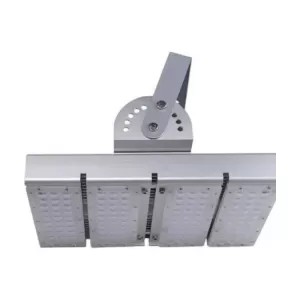
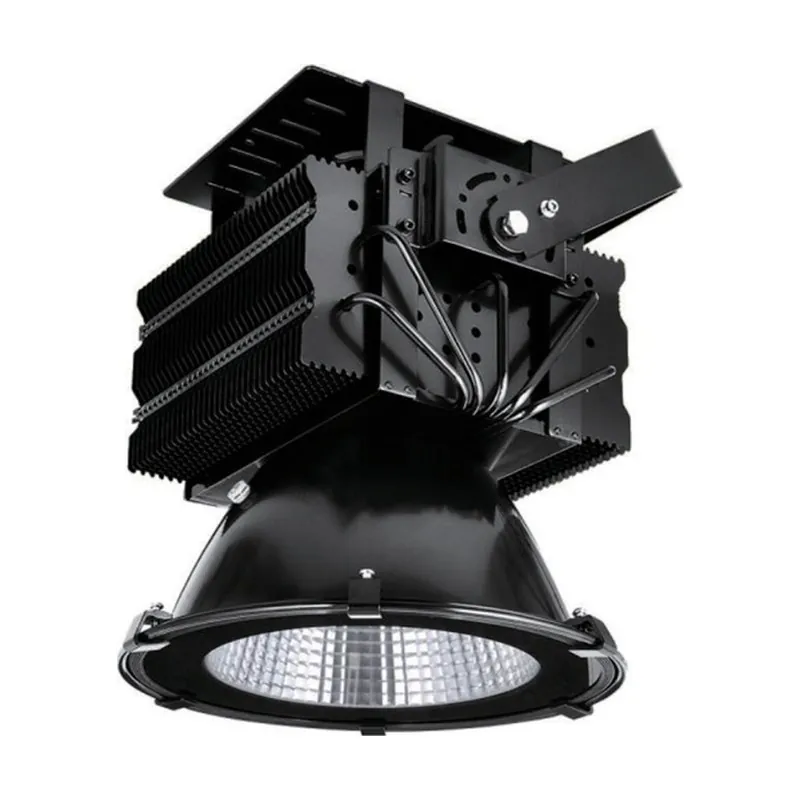
Our product data for the 1,000 W LED stadium light (BG-TZ range, more than 110 lm/W) gives, by the lumen method on a 105 × 68 m pitch:
- about 30 fittings for 200 lux training;
- about 74 fittings for 500 lux competition.
Shared across the common layouts:
| Layout | 200 lux (30 fittings) | 500 lux (74 fittings) |
|---|---|---|
| 4 poles | 7–8 per pole | 18–19 per pole, a heavy headframe |
| 6 poles | 5 per pole | 12–13 per pole |
| 8 poles | 4 per pole | 9–10 per pole |
Two practical points come out of the table:
- Plan the poles for the highest level you expect. A 6-pole layout carrying 5 fittings for training can take 12–13 later if the headframes and foundations were designed for it. Adding poles later costs far more.
- The final count per pole is not equal. Halfway poles light a larger share of the pitch, and corner positions need narrower beams. The photometric design balances fittings and beam angles per pole; we provide it with the quotation.
Our football field lighting guide covers the levels and costs for football in more detail.
Tennis and other courts
| Area | Lit size | Typical layout | Fittings (our data) |
|---|---|---|---|
| Single tennis court, recreational | 36 × 18 m | 6 poles of 8–10 m, 3 per pole | 18 × 150 W, about 200 lux |
| Single tennis court, club | 36 × 18 m | 6 poles, 3–4 per pole | 21 × 200 W, about 300 lux |
| Pickleball pad | 9.1 × 18.3 m | 4 poles of 5–6 m, 2 per pole | 8 × 100 W, about 210 lux |
Figures come from our modular LED sports floodlight data, with asymmetric optics that let the fitting stay almost flat. On rows of courts, poles between courts serve two courts each, which cuts the pole count: three courts in a row can be lit from 8 poles instead of 18. See tennis court lighting and padel court lighting for single-court details.
Baseball and softball
Diamond fields are asymmetric: the infield needs about twice the light of the outfield. Layouts usually place poles along both foul lines behind the dugouts, plus outfield poles beyond the fence. Infield poles carry more fittings and narrower beams. See our baseball field lighting guide.
Multi-use fields
Where one field hosts football, rugby and athletics, lay out the poles for the largest pitch and the most demanding sport, then set scenes for each use. Athletics adds the track, so poles move outside it, which raises heights. For control scenes, see our sports lighting control systems guide.
Checklist before fixing the layout
- Pitch or court dimensions and run-off, plus any future change (larger pitch, extra courts).
- Highest level of play expected, and whether filming is planned.
- Positions where poles cannot go: drainage, spectator areas, access roads, keep-out zones.
- Distance to houses and roads, for spill and glare limits.
- Ground conditions for foundations.
- Supply point and cable route.
Send these with a site plan and we will return two or three layout options with fitting counts, average lux and uniformity for each.
Sources
Frequently asked questions
How many poles does a football field need for lighting?
Community and club pitches usually use 6 or 8 poles along the sides; stadiums with stands often use 4 corner masts or lights on the stand roofs. More poles give more even light with lower poles; fewer poles need taller masts and narrower beams.
How many lights per pole on a sports field?
Divide the total number of fittings from the lighting calculation by the number of poles, then adjust for the aiming design. For 30 fittings of 1,000 W on a full-size pitch, that is about 5 per pole on 6 poles.
Where should light poles be placed on a tennis court?
Along the two long sides outside the run-off, commonly 4 or 6 poles for a single court, never behind the baselines where players look up to serve.
Can I change the layout later?
Poles and foundations are the expensive part, so plan them for the highest level of play you expect, then add or dim fittings. Moving poles later means new foundations and cabling.