Portable Sports Field Lights: Light Towers for Training, Baseball and Events
How portable sports field lights work, how many light towers a pitch or baseball field needs, how to size the generator, and when temporary lighting makes sense, with our LED floodlights.
Key points
- Portable sports lights are mobile towers, usually 6–9 m masts on a trailer or skid, carrying four to six LED floodlights and powered by a generator or a site supply.
- By our lumen-method estimate, a 90 × 55 m training pitch at 75 lux needs about 1.03 million lumens: 35 floodlights of 300 W, or six towers of six heads, about 10.8 kW in total.
- Each six-head tower draws about 1.8 kW, so a small generator per tower or one central set of about 15 kVA is enough; a three-hour session uses about 32 kWh.
- Portable towers suit training, seasonal play, events and fields waiting for permanent poles; for regular competition, fixed poles give better uniformity and lower running cost.
Not every field can wait for permanent floodlights. Clubs want evening training before the funding for poles arrives, schools need a few weeks of light for a tournament, and event organisers light a field for one night and move on. Portable sports field lights fill that gap. This guide explains how they work, how many you need and how to size the power, using our LED sports floodlights for the numbers.
What a portable sports light is
A portable sports light is a mast on a trailer, skid or weighted base, carrying a frame of floodlights. Common features:
- Mast height of about 6–9 m, raised by a hand winch or hydraulic pump.
- Four to six floodlights on a rotating head frame, each aimed separately.
- Power from an on-board generator, a separate generator, or a site supply through a cable.
- Outriggers or ballast for stability in wind.
The older generation used 1,000 W metal halide lamps. LED floodlights have taken over because they start instantly, survive vibration better and draw much less power, which shrinks the generator and the fuel bill.
How much light the field needs
The European sports lighting standard EN 12193 sets three classes. For football, Class III (training and recreational play) asks for 75 lux average with a uniformity of 0.5; club competition needs 200 lux. Our guide to sports field lighting lux levels lists the values for other sports.
Portable towers are best matched to Class III. Reaching 200 lux or more across a full pitch takes so many towers that fixed poles usually make more sense.
Worked example: a training pitch
Take a 90 × 55 m pitch (4,950 m²) lit to 75 lux for training. With the lumen method:
lumens needed = lux × area ÷ (utilisation factor × maintenance factor)
Low towers at the sides waste more light off the pitch than tall poles, so we use a utilisation factor of 0.45 and a maintenance factor of 0.8:
75 × 4,950 ÷ (0.45 × 0.8) ≈ 1.03 million lumens
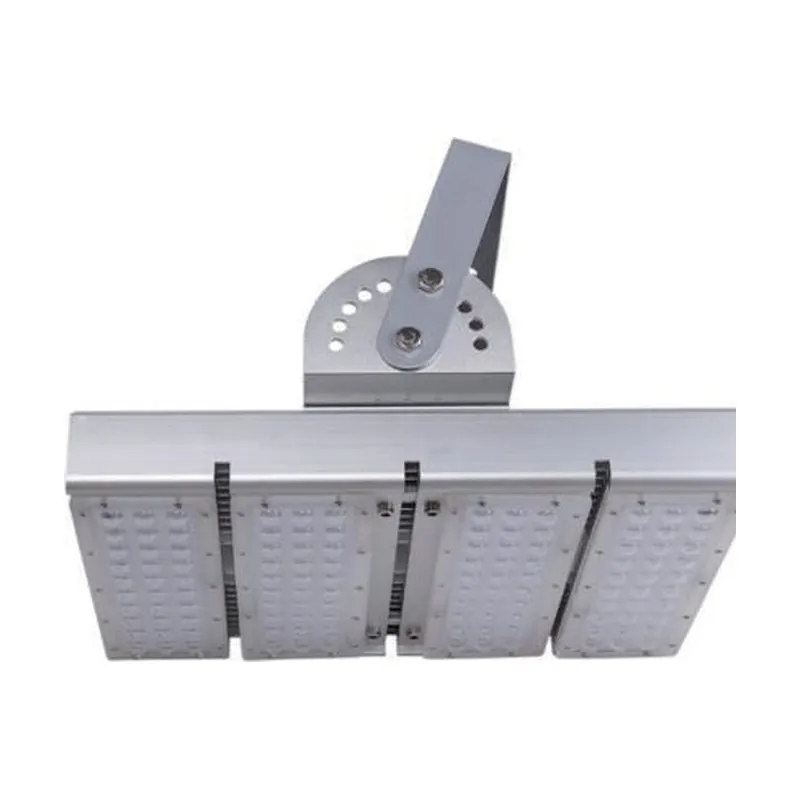
Our BG-TZ-M modular sports floodlight gives more than 100 lm/W, so a 300 W head delivers about 30,000 lm. That makes about 35 heads, or six towers of six heads (36 heads, 10.8 kW), placed three along each touchline.
Uniformity depends on spacing and aiming. With towers 30 m apart along each side and the heads aimed across the pitch towards the far half, a training level with reasonable evenness is realistic. A photometric layout with the actual optics confirms the aiming before the event.
Powering the towers
Each six-head tower draws 6 × 300 W = 1.8 kW. The BG-TZ-M driver accepts AC 85–264 V at 47/63 Hz, which tolerates the voltage swings of small generators.
| Set-up | Load | Typical generator |
|---|---|---|
| One tower | 1.8 kW | about 3 kVA (with start-up margin) |
| Six towers, central set | 10.8 kW | about 15 kVA |
| Site supply | 10.8 kW | 3-phase connection, one circuit per tower |
Energy per session. A three-hour training session uses 10.8 kW × 3 h ≈ 32 kWh. Ask your generator supplier for the fuel use of their set at that load; it is far less than a metal halide tower of the same light output.
Cables. Running cables across a field is a trip hazard. Route them around the perimeter, cover them at crossings and keep connections off wet ground.
Baseball and softball
Baseball is harder to light with portable towers than football. The infield needs more light than the outfield, and players must follow high fly balls against the sky. Practical approach:
- concentrate towers around the infield, behind the baselines and home plate;
- give the outfield a lower, even level from towers along the foul lines;
- keep floodlights aimed below the horizon so they do not blind fielders looking up.
For casual games and practice this works well. For league play, tall fixed poles carry the light above the players’ line of sight, which towers cannot match.
Where portable lights make sense
- Training before permanent floodlights are funded.
- Seasonal sports such as winter training on summer fields.
- Tournaments and events on fields without lights.
- Construction phases, where the permanent poles are not yet installed.
- Emergency use when a fixed system fails before a fixture.
If the field is used several nights a week for years, compare the hire or purchase cost of towers plus fuel against fixed poles on a mains supply. Our article on sports lighting cost shows how fixed systems are budgeted, and used stadium lights for sale covers another low-cost route.
Safety on site
- Wind. Lower the masts when wind exceeds the maker’s limit; a 9 m mast with six floodlights carries a large sail area.
- Ground. Set outriggers on firm ground and level the base before raising.
- Glare. Aim heads down onto the field, away from roads and houses.
- Fuel and exhaust. Keep generators away from spectators and changing rooms.
For hire companies and clubs
If you build or rent light towers, LED heads are the part that sets the light, the weight on the mast and the generator size. Tell us the mast height, the number of heads per tower and the fields you light most often, and we can propose wattage, beam angles and aiming for a standard tower layout.
Sources
Frequently asked questions
How many portable light towers do I need for a soccer field?
For a 90 × 55 m training pitch at about 75 lux, our estimate is six towers each carrying six 300 W LED floodlights, placed three along each touchline. Higher levels or full-size pitches need more.
Can portable lights be used for baseball?
Yes, for practice and casual games. The infield needs more light than the outfield, so towers are concentrated around the infield and the outfield gets a lower level. Fly balls are hard to follow under low towers, which is one reason competition fields use tall fixed poles.
What size generator does a portable light tower need?
A tower with six 300 W LED heads draws about 1.8 kW. Allow some margin for start-up, so a generator of around 3 kVA per tower, or a central set of about 15 kVA for six towers.
Are LED light towers better than metal halide towers?
LED towers start instantly, can be switched off between sessions without a warm-up wait, and use far less fuel for the same light. Metal halide lamps need several minutes to reach full output.