
Padel Court Lighting: Lux Levels, Pole Layouts and LED Floodlights for Indoor and Outdoor Courts
How to light a padel court: lux for recreational, club and competition play, 4-pole and 6-pole layouts, mounting height around the glass walls, glare and floodlight count.
Key points
- A padel court is 20 × 10 m with glass and mesh walls; lighting must be even across the court and up the walls, because the ball is played off them.
- Typical targets: about 200–300 lux for recreational play, 300–500 lux for club play and 500–750 lux or more for competition.
- Outdoor courts often use 4 or 6 poles of about 6–8 m outside the long sides, with 2–3 floodlights per side or more for higher levels.
- Asymmetric optics and careful aiming keep glare out of players' eyes when they look up for lobs and smashes.
Padel has grown fast around the world, and many courts are played mostly in the evening. Good lighting makes the game faster and safer and keeps courts booked. Padel’s walls make it different from tennis: the ball comes off glass and mesh, so light must reach the walls as well as the floor. This guide covers the essentials.
The court
A padel court is 20 × 10 m, enclosed by glass back walls (often 3–4 m high) and mesh side walls. Players use the walls, so the ball travels close to them and often high in the air. Lighting must:
- Be even across the whole court surface
- Light the walls so players see the ball rebound
- Avoid glare when players look up
- Avoid reflections and hot spots on the glass
Recommended light levels
| Level of play | Average horizontal illuminance | Uniformity (min/avg) |
|---|---|---|
| Recreational | about 200–300 lux | 0.6 or more |
| Club and training | about 300–500 lux | 0.7 or more |
| Competition | 500–750 lux or more | 0.7 or more |
| Televised | Higher, set by broadcaster | Higher |
Check federation, club or local sports lighting standards for the project. For general sports lighting levels, see our tennis court lighting and basketball court lighting guides, which use similar principles.
Outdoor layouts
4-pole layout: poles at the four corners outside the long sides, each with one or two floodlights. Simple and common for recreational courts.
6-pole layout: three poles on each long side (corners and middle), giving more even light and fewer shadows; common for club courts.
Multiple courts: shared poles between adjacent courts reduce cost.
Mounting height is typically 6–8 m, above the walls, so floodlights can aim into the court without hitting the glass at shallow angles.
Floodlights and optics
LED floodlights with asymmetric optics are preferred. They can be mounted nearly flat and still throw light across the court, reducing glare for players looking up. Symmetric floodlights tilted up cause glare and spill.
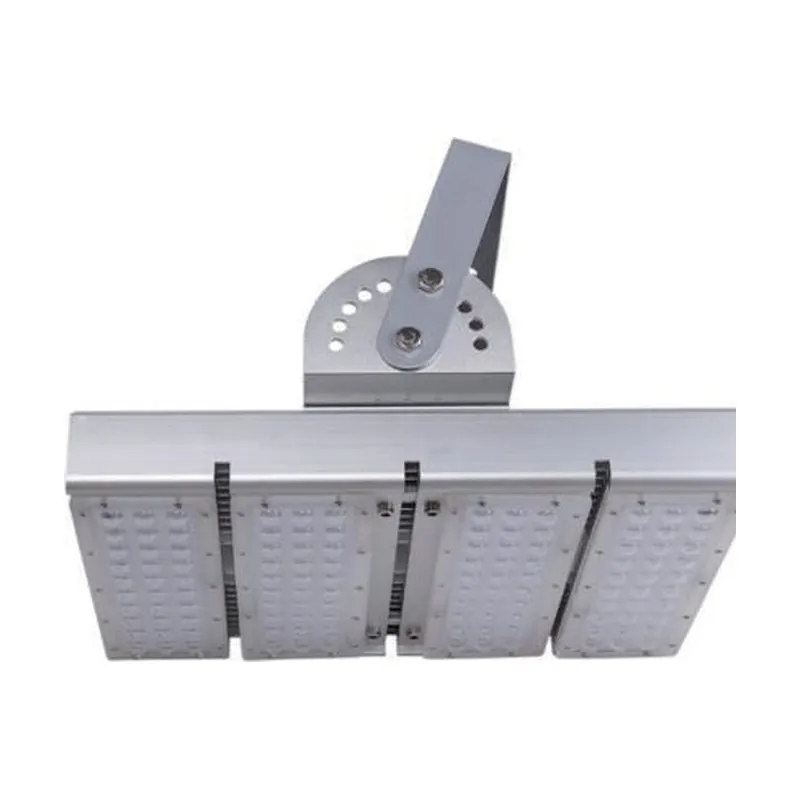
Typical outdoor schemes use LED floodlights of about 200–400 W each, 4–8 per court, depending on target levels. Our modular LED sports floodlight offers several beam options for courts and fields. See the flood light lens guide for how optics change the result.
Glare control
- Keep floodlights outside the court’s main viewing directions
- Use asymmetric optics with low tilt
- Add visors or louvres where needed
- Avoid aiming floodlights at the glass walls at shallow angles, which causes reflections
Indoor padel courts
Indoor courts are lit by fixtures above the court:
- Linear or high bay fixtures with wide, low-glare optics, arranged along the long sides
- Indirect or diffused lighting for comfort at high levels
- Mounting height typically 8 m or more above the court, depending on the hall
Avoid placing fixtures directly above the centre of the court, where players look up most. See gym lighting for sports hall principles.
Colour temperature and CRI
4000–5700 K is common, giving crisp contrast for the ball. CRI 70+ is adequate for recreational play; higher CRI helps for broadcasting and photos.
Light spill and neighbours
Many padel clubs are near homes. Asymmetric optics, glare shields and careful aiming keep light on the court. Turn lights off promptly after play, ideally with booking-linked controls.
Controls and energy
- Booking-linked switching: lights on only when the court is booked
- Dimming levels for training and matches
- Instant start, so lights can be switched off between bookings
LED floodlights start instantly and use far less energy than metal halide, which makes per-booking switching practical.
Poles and foundations
Poles must carry the floodlights’ weight and wind area at the local design wind speed. Foundations must be designed for the soil. Many court manufacturers supply poles integrated with the court structure; check that they are rated for the chosen floodlights.
Lighting calculation
Every court and site is different. A lighting calculation with the actual floodlights, poles and positions confirms the average lux, uniformity and glare before ordering. We provide IES files and can run calculations for court layouts.
Converting existing courts
Many older courts use metal halide floodlights. Replacing them with LED improves uniformity and reduces energy by 50% or more. Check pole condition and capacity when changing fixtures.
Example: a two-court outdoor club
A small club with two outdoor courts side by side might use six poles: three along each outer long side and shared poles between the courts. With 300 W asymmetric LED floodlights at 7 m, two per pole facing into each court, the courts can reach club-level illuminance with good uniformity. Shared poles cut foundation and installation costs, and a booking-linked control system switches each court independently. The exact count and wattage depend on the floodlight’s photometry, which is why a calculation is worth doing before buying.
Maintenance
Clean floodlight glass once or twice a year, more often in dusty areas, and check aiming after storms. LED floodlights need little else, but keep a spare driver or floodlight for quick repair during the season.
Supply
We supply LED sports floodlights for padel, tennis, football and multi-sport courts. Send us the number of courts, the layout, the target level of play and any pole positions already fixed, and we will propose floodlights and a calculation.
Sources
Frequently asked questions
How many lux does a padel court need?
Roughly 200–300 lux for recreational play, 300–500 lux for club and training, and 500–750 lux or more for competitions. Uniformity matters too, with minimum-to-average ratios of about 0.6–0.7 for good play.
How high should padel court lights be?
Outdoor floodlights are usually mounted at about 6–8 m on poles outside the court's long sides, above the glass and mesh walls. Indoor courts use fixtures above the court at the hall's ceiling height.
How many floodlights for a padel court?
A common outdoor layout uses 4 to 8 LED floodlights on 4 or 6 poles, depending on the lux target and floodlight output. A lighting calculation confirms the number.